Esteban Ocon doesn’t usually deal in doom-laden predictions, but even by pre-season standards his read on 2026’s new power units was blunt: Formula 1 risks turning the most theatrical moment in the sport into an awkward pause.
With the Australian Grand Prix looming as the first real stress test of the post-MGU-H era, Ocon warned that the grid procedure could end up forcing leading cars to sit stationary for as long as “one minute 30” before they’re able to launch cleanly. Not because drivers have suddenly forgotten how to start, but because the hardware and the control logic now demand a different — and slower — build-up to the right configuration.
The removal of the MGU-H has been the centre of plenty of winter chatter, and not just among engineers. In Bahrain’s first official pre-season running at Sakhir, teams and drivers homed in on the same visible symptom: getting these cars ready to leave the line is taking longer, and it’s looking messier.
Without the MGU-H masking turbo lag across the lower rev range, the engines don’t snap into the sweet spot as readily. That changes what drivers can do with revs and clutch, and it changes what the crowd sees when the lights go out. The old choreography — cars already primed, tyres warming, engines sitting where they need to be — is being replaced by something more tentative.
Ocon, now at Haas, put it in terms that should make race control wince as much as the teams: the front runners waiting around, tyres cooling, before arriving at Turn 1 on the wrong side of readiness.
“We’re obviously working on that with the team,” Ocon said during the Bahrain test. “It’s clear that the turbo lag is a very big topic. But we have to adapt to what the rules are.
“And it would not be nice, I think, for the top three to wait like one minute, 30 until the cars are stopped and have cold tyres into Turn 1.”
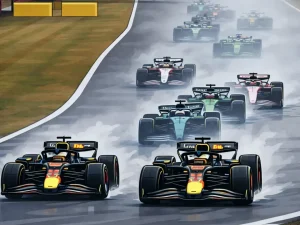
The real sting is in what he thinks it could do to the competitive order in the first 200 metres. In recent seasons a poor start tended to be a nuisance — lose a place, maybe two, and spend the first stint trying to undo it. Ocon reckons 2026 could be harsher, with launch variability wide enough that a driver can go from mid-pack to swallowed whole before the first braking zone.
“I think you are going to see a lot more struggling of the starts, and a lot more differences compared to other years before,” he said. “Where the worst start was losing one or two positions on the grid, now you could lose the whole lot.”
That’s the kind of line that gets repeated in strategy rooms. Not because it’s dramatic, but because it hints at a new risk profile: if starts become volatile, teams may end up valuing clean side-of-grid placement, clutch mapping confidence and procedural certainty as much as raw qualifying delta.
There’s also an intriguing wrinkle. Ferrari, in paddock talk, has looked like the outlier: a power unit that can operate in higher gears than rivals, reportedly easing the climb to its ideal launch configuration — perhaps thanks to a different turbo approach. Haas, though, isn’t enjoying any obvious shortcut despite using Ferrari power, a reminder that “same engine” and “same behaviour off the line” are not the same thing once installation, calibration and car characteristics enter the mix.
Ocon described the sensation as counterintuitive for a driver: this isn’t the old-school turbo game where you can largely bully the system with revs and feel.
“It’s not like the old rally cars or the old cars with simple turbos where you can get it up to spin quite easily,” he said. “What we do as drivers doesn’t have much of an input on that.
“It’s very strange, but I think it’s the same for all of us.”
The issue is already rolling toward the political machinery that governs F1. Haas team principal Ayao Komatsu confirmed the start procedure is on the agenda for the upcoming F1 Commission meeting, and it’s understood tweaks to the starting light sequence are being discussed — either enforcing a minimum time, or adjusting when that minimum time begins relative to the last car arriving on its grid slot.
Komatsu’s take was pragmatic rather than alarmist: everyone knew this could be awkward, but knowing in theory and living it in real time are different things.
“Start is definitely challenging,” he said. “So yeah, I think starts definitely needs to be looked at. I’m sure we look at it before Melbourne.”
Pressed on whether drivers might need to hold revs for around 10 seconds before they can launch, Komatsu didn’t pin himself to a number — but didn’t dismiss the premise either.
“Yeah, not the exact number of seconds,” he said. “But this is definitely not completely a surprise.
“We discussed this last year, but of course, we didn’t know last year exactly what we are dealing with. But yeah, it’s not a total surprise.”
The key line, though, was the one that points to why this will move quickly if it looks ugly in Melbourne. It’s not just about purity or tradition; it’s about making the start legible.
“I think it’s important that we have a regulation such that everybody can do a decent start,” Komatsu said, “so for the fans to understand to see it’s normal racing.”
That’s as close as you’ll get, in February, to a team boss saying: if this looks weird on television, it won’t last long.
And that’s the wider tension hanging over the opening rounds. Formula 1 has sold 2026 as a fresh technical chapter, but it still needs the sport’s most iconic moment to land properly. If the price of adapting to the new engines is a grid full of cars waiting, hesitating and launching at wildly different moments, the Commission won’t need much persuading to rewrite the script — not for the engineers, but for the show.