Pirelli’s next big wet-tyre reality check is heading somewhere it almost never rains: Bahrain.
On paper, a desert circuit in late February sounds like the wrong punchline to a serious development programme. In practice, it’s exactly the sort of deliberately awkward test Pirelli needs as Formula 1 heads into its first season of the 2026 rules package — and as the tyre supplier quietly sizes up what it wants its own future in the championship to look like.
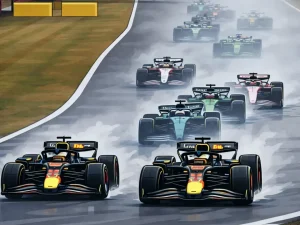
The Bahrain International Circuit is slated to host a two-day wet-weather test on February 28 and March 1, with McLaren and Mercedes providing mule cars built to replicate the performance window of the 2026 machinery. Pirelli offered the running to all teams, but those two will do the mileage. The twist is obvious: Bahrain will have to be made wet.
Mario Isola has been candid that it’s not a case of rolling out the usual convoy of water tankers and hoping for the best. Instead, Bahrain’s organisers are working on a system using sprinklers and other devices to soak the full layout — the critical point being consistency. Prototype comparisons live and die on repeatable conditions; if the water level varies more than the tyres do, the data becomes noise.
Isola, speaking after the first pre-season test at Bahrain, sounded unusually optimistic about pulling it off. He also sounded like a man who knows this opportunity isn’t going to come around often.
Pirelli’s 2026 tyres have been reshaped around narrower fronts and rears on the same 18-inch rims, and while the company has kept constructions and compounds broadly in line with last year, the cars they’re bolting them to are different in the ways that matter. There’s a particular focus on how the tyres cope with increased acceleration forces and with the moment the straight-line mode drops away and downforce returns abruptly, piling vertical load back into the contact patch.
That’s the dry story. The wet one is more political than poetic.
F1 has long wrestled with the full wet tyre being the tyre everyone complains about and nobody wants to use. Teams default to intermediates because they’re trying to cut pit stops and keep strategic flexibility. Race control is often reluctant to restart or continue in conditions where visibility becomes the defining problem. And visibility, in turn, is shaped by the aerodynamic platform as much as it is by the tread pattern.
For 2026, Isola expects some change in that balance. With the new cars moving away from the ground-effect approach, the spray picture may not be quite as brutal — and narrower tyres should also throw less water into the air. Whether that’s enough to shift the race director’s threshold is another matter, but Pirelli’s trying to do its part by making the wet tyre more attractive in the crossover zone.
“What we tried to achieve is to reduce the crossover time between the wet and intermediate in order to have the wet tyre more usable,” Isola said, outlining the core objective: make the full wet a tyre teams will actually consider when the track is transitioning, not just when it’s borderline undriveable.
That’s why Bahrain is interesting beyond the novelty. Its surface is relatively abrasive, and that severity matters because wet-tyre work isn’t only about shifting water — it’s about managing temperature, wear and the tyre’s operating window on a circuit that can punish rubber even when it’s soaked. If Pirelli can learn how its wet and intermediate prototypes behave on a high-energy track, it adds a valuable reference point alongside more traditional wet-test venues.
The obvious alternatives remain in play. Pirelli has other running planned at Fiorano, plus a dedicated wet test at either Paul Ricard or Magny-Cours. But Isola has been blunt about the limits: the calendar is 24 races, teams are stretched, and tyre testing days are capped — Pirelli is allowed a maximum of 40 days per year, with teams supplying cars and drivers on a rotating, voluntary basis. Getting three separate test sessions arranged already counts as a win.
“It’s a miracle,” Isola admitted, pointing out that in dry conditions Pirelli can sometimes piggyback on the days after a race, when teams are already on site and can stay on. Wet running doesn’t work like that; you need the right facility, or you need to build your own weather.
Which brings us back to Bahrain — and the subtext that’s hard to ignore. Pirelli’s F1 contract runs to the end of 2027, with an option for 2028. In the paddock during the Bahrain test, sources indicated the manufacturer is already looking seriously at taking up that option. The logic is familiar: F1 remains a high-profile development platform, and Pirelli likes the story that lessons learned at the sharp end filter into road-car technology, separate from the commercial value of being the sole supplier.
But the timing is delicate. Pirelli is also set to become MotoGP’s tyre supplier in 2027, and there’s been chatter — speculation rather than anything formal — that other manufacturers, including Bridgestone and Hankook, could be interested in F1 when the next tender cycle comes around. Neither has publicly committed to a bid, yet the mere possibility changes the temperature. Sole-supply deals are never just about performance; they’re about politics, perception, and who wants the headaches that come with being F1’s easiest target.
That’s why this Bahrain wet test matters more than the images it will produce. If Pirelli can deliver a wet package for 2026 that widens the workable window, reduces the awkward gap to inters, and performs predictably even on a harsh surface, it strengthens its hand when the conversation inevitably shifts from “tyres are the problem” to “who else would actually want this job?”
And if Bahrain’s sprinkler plan works, don’t be surprised if other “impossible” tests suddenly become possible too. In modern F1, control is the commodity everyone’s chasing — even when it comes to the weather.