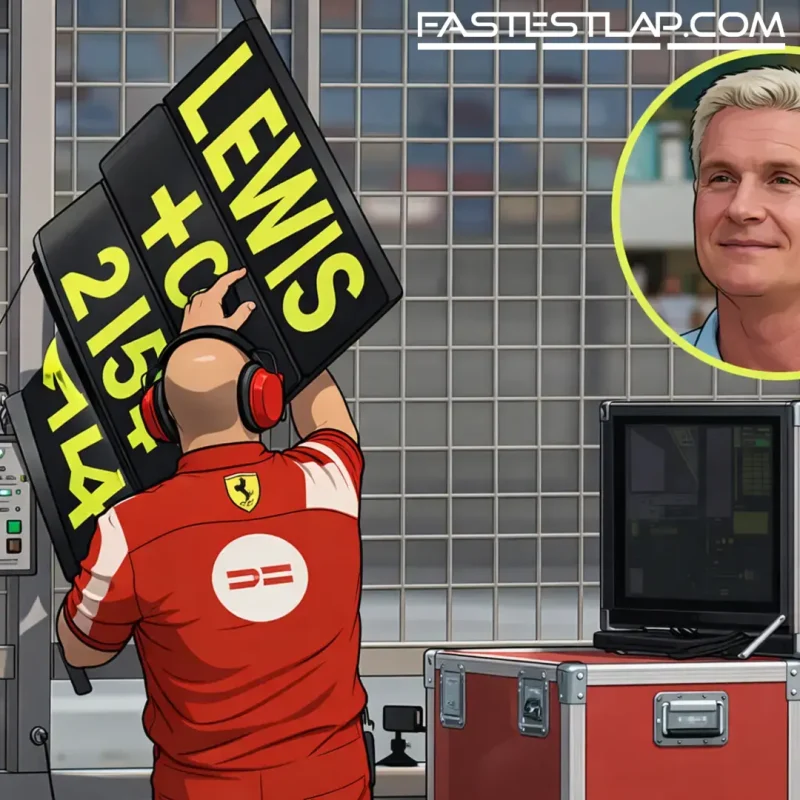
David Coulthard doesn’t say it to be cruel, and he doesn’t say it like a man trying to win an argument on the internet. He says it the way ex-drivers do when they recognise a familiar, uncomfortable pattern: the stopwatch is still talking, but it’s not saying what it used to.
On the *Up To Speed* podcast, Coulthard has floated the question hanging over Lewis Hamilton’s 2026 season before it’s properly begun — whether the “half a tenth” that once made Hamilton effectively immune to team-mate pressure has started to fade. Not collapsed, not disappeared. Just softened enough that the margins aren’t there when the grid’s tight and the cars are difficult.
Hamilton is 41 now, in his 20th year in Formula 1, and still chasing the eighth title that would finally separate him from Michael Schumacher. The ambition hasn’t dulled. But the results line from the ground-effect era has been jarring by Hamilton standards: two grand prix wins across four seasons in these regulations, and a stark 2025 at Ferrari that didn’t produce a single podium, let alone a win. For the second year running he lost the internal head-to-head — first to George Russell, then to Charles Leclerc — and he also went two seasons without a pole.
Coulthard’s own reference point is telling. He likened it to the moment in 2008, at 37, when he felt the lap time no longer arrived on demand. “When the stopwatch stopped talking to me and the lap times weren’t there anymore,” he said. In football terms, it’s the old line about “losing a yard” — still good, still smart, still capable of the big moment, but no longer reliably first to the ball.
The key point in Coulthard’s argument isn’t that Hamilton has suddenly become average. It’s that Hamilton spent the majority of his career having a small, repeatable advantage over whoever shared his garage — the kind that doesn’t always show up as a headline-grabbing gap, but quietly decides Saturdays and dictates Sundays. If that edge shrinks, even slightly, the modern grid punishes you for it. And at Ferrari, where the environment is less forgiving than it was at Mercedes, that punishment can become a narrative very quickly.
There’s another layer to Coulthard’s comments, though, and it’s arguably the more practical one: Hamilton’s Ferrari struggles may not be purely about age or raw speed. They may also be about infrastructure — the human kind, not the aerodynamic kind.
Hamilton didn’t just change teams when he left Mercedes after 12 seasons. He severed a long-built operating system. At Brackley, he had Peter “Bono” Bonnington on the radio — a race engineer relationship refined over years of high-pressure weekends, title fights, and those slightly odd in-session calls that only make sense when two people have developed a shared language. Hamilton also had Angela Cullen as a constant presence, a familiar touchpoint in a sport that rarely allows drivers to feel settled for long.
Cullen has returned to Hamilton’s side at Ferrari, which matters more than many will admit, but the engineering side has been the bigger headache. Hamilton’s first season at Maranello didn’t just end without a trophy; it ended with Ferrari moving his race engineer Riccardo Adami into a different role after the partnership failed to click. For 2026, Hamilton will work with Carlo Santi for the opening races, before a new engineer — rumoured in the paddock to be Cedric Michel-Grosjean — is expected to take over.
Coulthard, who always understood the politics of a garage as well as the mechanics of a lap, put it bluntly: whenever he moved teams, he tried to bring an engineer with him. Not as a comfort blanket, but as an advantage.
“They’re your data bank of knowledge,” Coulthard said, and he’s right. The race engineer isn’t simply the voice reading out gaps and tyre life. He’s the person translating a driver’s instincts into something the factory can turn into lap time. He’s also, crucially, an internal advocate — the one fighting for a driver’s direction when development paths split, the one who can sell a driver’s feel for the car to the people building the next floor or suspension layout.
In other words, if Hamilton really has lost a fraction of the speed Coulthard is talking about — that tiny, brutal “half a tenth” — then the support structure around him becomes even more important. When you’re no longer outrunning the problem, you have to solve it. And solving it at Ferrari demands alignment, clarity, and trust, because the team-mate on the other side of the garage isn’t going to wait while you bed in another new working relationship.
None of this means Hamilton’s finished. It doesn’t even mean Coulthard is correct. But it does explain why the scrutiny has shifted. In the past, questions about Hamilton were usually tactical: can anyone beat him if Mercedes nails the car? Now they’re operational and personal: can he rebuild the machinery around him quickly enough to get back to the level he expects of himself?
And that’s the uncomfortable truth of 2026 for Hamilton. The challenge isn’t just Leclerc, or the grid, or even the next chapter of ground-effect development. It’s proving that the smallest margins — the ones that used to belong to him by default — can still be claimed when the environment is new, the relationships are changing, and the stopwatch is no longer obliged to be kind.