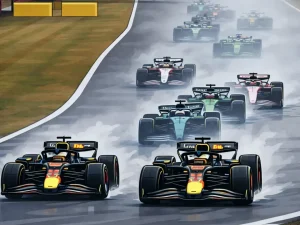
Bahrain testing has a habit of lying, but it rarely keeps a straight face for long. On the first full day of running under Formula 1’s 2026 ruleset, the timing screen offered a familiar comfort: Mercedes, McLaren, Ferrari and Red Bull still clustered at the sharp end, their names stacked across the top seven like nothing much had changed.
Behind that, though, the mood is already shifting — and Williams’ driver pairing might be the clearest window into what the new era could do to the competitive picture in the short term.
Alex Albon, speaking on Williams’ own YouTube channel alongside new team-mate Carlos Sainz, sounded genuinely unconvinced that Melbourne will deliver the tight, knife-edge Q1 traffic jams that became the sport’s late-2025 calling card. The Thai-British driver’s fear is simple: the reset has created room for teams to miss the concept, and for others to hit it early. That’s when you get a grid that doesn’t just have a “top four” and “the rest”, but multiple mini-championships separated by hard time gaps.
“I think everyone kind of always categorised last few years as F1 1.0 and F1 1.5,” Albon said. “I think this year there is going to be possibly even four different things. I think there’ll be the top teams, the upper midfield, the bottom midfield…”
That’s not a driver trying to sell a fairy tale. It’s someone bracing for a season where the stopwatch might be a lot less democratic than it was by the end of last year — and where a clean lap in Q1 doesn’t necessarily mean you’re safe, because the car might simply not have the underlying pace to move the needle.
Sainz didn’t exactly dismiss the idea of gaps opening up, but he framed it more as inevitability than alarm. He reached back to 2019, when Melbourne qualifying featured sizeable spreads through the field, and suggested 2026 could begin in that territory again — even if not quite that extreme. Last year’s situation, where 20 cars could be covered by half a second in Q1, felt like the end product of a mature rules cycle. This is the opposite: fresh concepts, fresh trade-offs, and the kind of early-season compromise that punishes anyone whose first iteration is off by a few key design calls.
“My feeling is, at least at the beginning of this year, the gaps are going to be big,” Sainz said. “Maybe not as big as back then, a bit smaller, but still bigger.
“Last year in Q1, there were 20 cars in half a second. I really doubt the fact that in Australia, race one, there’s going to be 20 cars in half a second.”
Albon went further, interrupting the optimism with a punchier prediction: “I think there will be two cars between half a second.”
Even between two team-mates who’ve both seen regulation resets up close, there’s a subtle difference in what they’re actually reacting to. Sainz sounds like a driver thinking in ranges — yes, the field will spread, but perhaps within a workable band. Albon sounds like someone who’s seen enough in the early data to suspect it could be uglier than people are prepared for, particularly once teams turn engines up and start chasing true single-lap performance.
And there was enough on Wednesday’s Bahrain timesheet to feed that suspicion without over-reading it. At the top, the big four were exactly where you’d expect them, with the fastest seven covered by 0.840s. But the moment you fell off that cliff, the gaps started to look more like old-school F1.
Sainz ended the day eighth in the Williams FW48 — a respectable headline — yet he was also the first driver more than a second away from George Russell’s benchmark. He finished 1.654s down and around eight-tenths slower than Lewis Hamilton in seventh. Those margins aren’t a verdict, but they are a reminder: “best of the rest” can still be a long way from the rest that actually matters.
Further back, the spread became brutal. Sergio Perez was slowest, 4.732s off the pace in the Cadillac, a number that raises its own questions about how quickly some programmes can stabilise in the opening flyaways.
The more interesting point is what this does to the texture of a grand prix weekend. If Albon’s forecast holds — multiple tiers, and not the politely compressed kind — then Melbourne could be less about heroic Q3 cameos and more about survival. The teams in that “upper midfield” bracket may find themselves fighting not just for points, but for basic access to the top 10 shootout. For the “bottom midfield”, it could be a year where a clean weekend and a smart tyre call still can’t overcome a baseline deficit.
Sainz, for his part, wasn’t hiding his disappointment at what that means for the drivers. A late-cycle season tends to be noisy and reactive: small setup swings, traffic management, and marginal gains. It’s stressful, but it’s also rewarding because it puts more of the outcome in the hands of execution. A regulation reset can take some of that away, at least temporarily, by making performance more structural than operational.
“And we were within half,” Sainz said, reflecting on how tight things had become at the end of last season. “So that proves to you what a new regulation also does in a negative way, because for us, as drivers, to be honest, Abu Dhabi or the last few races of last year was fun knowing that we all were within a couple of tenths of each other.”
That’s the undercurrent heading to Australia: not just who’s quick, but how quickly the sport re-learns how to be close again.
Because if the new chassis rules, lighter cars, active aerodynamics and the updated power unit formula do what they were always going to do — magnify the benefits of getting the first concept right — then the early part of 2026 might look less like a reshuffled pack and more like a field that’s been split into lanes. The argument in the Williams camp isn’t really about whether there will be gaps. It’s about how many, and how soon everyone else can start closing them.