Jolyon Palmer isn’t buying the idea that Mercedes simply “missed” the headlines in Bahrain. In his view, the most revealing thing about the W17’s test wasn’t where it landed on the timing screens, but what Brackley chose not to do.
Mercedes left pre-season running at the Bahrain International Circuit with George Russell only sixth on the outright times — a 1:33.197 that never threatened Charles Leclerc’s session-topping 1:31.992. Rookie Kimi Antonelli sat second, eight-tenths down on the Ferrari benchmark. On paper, it looked like a familiar story: Ferrari loud, Mercedes quiet.
Palmer’s read is that the quiet was the point.
“They’ve frustrated me because they didn’t go for performance,” Palmer said on F1’s official YouTube channel, arguing Mercedes deliberately avoided late-test glory runs. “But that speaks volumes… Smacks of confidence that they don’t feel they need to go and show their hand.”
It’s an interpretation that’ll resonate with anyone who’s watched this sport long enough to know testing is as much about information management as it is lap time. Some teams need the reassurance — or the narrative — of a big number at the end of the week. Others would rather keep the paddock guessing, even if it means looking undercooked when the cameras pan across the classification.
Palmer’s point is that Mercedes’ programme didn’t have the usual “let’s see what we’ve got” flourish. He noted the team spent plenty of time on longer running in the first week, then didn’t layer in the kind of end-of-test qualifying simulations that normally give outsiders a clearer handle on genuine pace.
Instead, the message from the cockpit sounded strikingly positive. Palmer’s takeaway was straightforward: the drivers look happy, the car looks decent, and Mercedes didn’t behave like a team that felt it needed to chase a morale-boosting headline before flying to Melbourne.
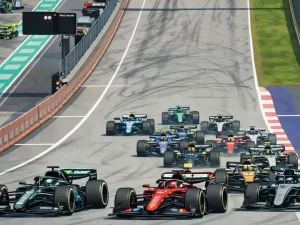
But there was one area Bahrain kept throwing back at them — starts.
Even as teams get to grips with the new power-unit era and its knock-on effects, the launch phase has been one of testing’s most awkward talking points. With the MGU-H gone, the old safety net that helped smooth turbo behaviour at low revs isn’t there anymore, and the choreography from lights-out to clutch bite has been visibly harder to nail.
The FIA’s response came on the Thursday, introducing a blue-light signal a few seconds before the start procedure begins, prompted by safety concerns aired by drivers and team principals. It’s a procedural tweak designed to reduce uncertainty — but it doesn’t magically hand anyone a better getaway.
And in Palmer’s eyes, Ferrari simply looked sharper off the line than Mercedes. Russell did manage to stay ahead of Leclerc in Friday evening running despite Leclerc starting fifth and arriving at Turn 1 under Russell’s rear wing, but Palmer wasn’t convinced that told the full story.
“Well, to be honest, the start, he started from pole and he just about held off Charles from fifth,” Palmer said. “Yeah, he was the first into the first corner, but I still think that they’ve got a little bit of work to do in that area.”
That’s the nub of Mercedes’ Bahrain aftertaste: the impression of a car with potential, paired with a weakness that can ruin your Sunday before you’ve even completed the first 200 metres. In a field that’s going to be tightly packed as the new rules bed in, losing a place or two at the start isn’t just cosmetic — it’s strategy blown up, tyre offsets wasted, and track position surrendered to rivals you might not get past again.
Palmer also flagged a more muted concern hovering over Mercedes’ week: reliability. He described it as “a little bit more questionable”, the sort of phrase that doesn’t cause panic in February but does raise eyebrows when a team is otherwise projecting calm.
Still, the overall tone of his assessment was that Mercedes looked like it had something in reserve. Not that it was definitively quickest — Bahrain rarely gives away clean truths, and this year’s tests have been as opaque as ever — but that Mercedes behaved like an outfit that already knows where the performance is, and doesn’t feel the need to prove it to anyone.
Now comes the part where all the coyness disappears. Testing games end the moment the freight lands in Australia, and Albert Park will demand actual answers. If Mercedes turns up in Melbourne with the same “we’re fine” body language but still bleeds places at the launch, it won’t matter how good the long-run “vibes” felt in Sakhir.
Because if Ferrari’s starts are genuinely better — and if Leclerc’s Bahrain pace is even half as representative as it looked — Russell and Mercedes can’t afford to spot them two car lengths every time the lights go out.