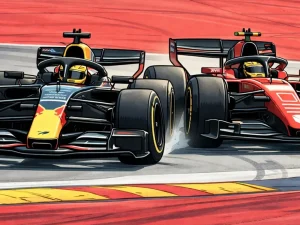
Max Verstappen doesn’t do panic, and he rarely gives anything away for free. Which is why his throwaway line after Bahrain testing — that “any good team with a Mercedes engine will do well” in 2026 — landed with the kind of weight that only comes when the paddock already suspects the same thing.
Testing read-outs are famously slippery at the best of times, and this winter’s regulation reset has only made the smoke thicker. Still, the mood in Bahrain was hard to miss: the knowing glances in the Mercedes and Ferrari direction, and the slightly guarded body language everywhere else. Verstappen’s comment didn’t name a favourite outright, but it did frame the early story of 2026 in a way that matters. If the new era is decided by power-unit quality and how quickly teams can exploit it, then the engine badge on the back of the car might be the simplest tell we’ve got.
The consensus coming out of the test is that the same four teams that defined the sharp end last season — McLaren, Mercedes, Red Bull and Ferrari — are still the top four as the sport heads to Melbourne for the opening Australian Grand Prix. The difficulty is putting them in order. And the more people try, the more they end up sounding like they’re speaking in code.
McLaren boss Andrea Stella has already pointed to Mercedes and Ferrari as the “teams to beat” right now, and Lando Norris has been candid about McLaren feeling a step short on race pace compared to its closest rivals. That’s notable, because McLaren is also a Mercedes customer — and they’re not exactly known for under-selling their own position. If a reigning world champion is hinting he’s got work to do, it either means the others are genuinely quick, or McLaren is playing a deeper game than usual.
Mercedes, meanwhile, has its own internal balancing act between confidence and caution. George Russell has been talked up as the bookmakers’ title favourite for 2026, yet even he has been walking back some of the more alarmist chatter from earlier in the winter. After previously describing Red Bull’s new Red Bull-Ford power unit as “pretty scary”, Russell has since suggested Red Bull’s deployment advantage has “closed drastically” versus the Mercedes-powered teams — though he still believes Red Bull retains an edge in that particular area.
That detail matters, because it points to the kind of performance that doesn’t always show up neatly in headline lap times. Deployment, energy management, and how seamlessly the package works across a stint can decide races long before anyone reaches for a DRS button. Russell also flagged starts as a Mercedes concern, while Ferrari has appeared sharp in that phase — another small, technical clue that can become a big championship theme once points are on the table.
Verstappen’s Mercedes-engine line, delivered on the ‘Up to Speed’ podcast when asked who he expects to be his biggest competitor, felt less like a prediction and more like a nudge. Not necessarily at Mercedes alone, either. The Mercedes power unit is also in the back of McLaren’s cars, plus Williams and Alpine. In a season where the field is effectively re-shuffled by a new chassis and engine ruleset, that spread suddenly looks strategically important. If the Mercedes PU really is the reference item, it doesn’t just elevate the works team — it gives its customer squads a foundation sturdy enough to build something more ambitious on.
That’s the part of Verstappen’s remark that should make rival engineers uneasy: he didn’t say “Mercedes will be strong”. He said any good team with that engine will be strong. In other words, the advantage — if it exists — may be portable.
Of course, Verstappen is also speaking from a Red Bull garage that’s living through its own pivotal moment. Red Bull is debuting its first ever in-house engine in Formula 1, developed with Ford, and the early running in Barcelona and Bahrain has been close to faultless. Reliability has been the headline. Verstappen has described it as “honestly incredible to witness” a group “starting from zero” and producing a power unit that “is running well”.
That admiration came with an important caveat, though. “We don’t have any issues,” he said, but asked whether it’s fast enough, Verstappen admitted: “I have no idea.”
It’s a very Verstappen answer — complimentary without being comforting. Red Bull’s winter, by the account of those watching closely, has been about competence and cleanliness rather than fireworks. And that’s not nothing. In the first year of a new formula, a car that runs properly is already a weapon. But once the championship starts, “runs well” quickly stops being the bar. The bar is whether you can attack on Sunday, defend on strategy, and still have something left in the tyres when others fall away.
What Bahrain has really done is set up Melbourne as less of a season opener and more of an audit. The first qualifying session will be the first moment teams have to show something resembling their true hand. If Mercedes and Ferrari are as far along as Stella suggested, they won’t be able to hide it when everyone turns the engines up and the fuel comes out. If McLaren is genuinely a touch behind, we’ll see it. And if Red Bull’s new Red Bull-Ford unit is the real deal, it’ll have to prove it not by surviving, but by taking time off the people Verstappen just pointed at.
Either way, Verstappen has already helped define the conversation. In a sport that loves to pretend it’s all about the chassis until the stopwatch says otherwise, he’s reminded everyone where the early betting is shifting: towards the teams who’ve nailed the new power game — and towards anyone fortunate enough to be bolting a Mercedes engine into the back of a “good” car.