Bahrain’s final test days weren’t just about lap times and fuel loads. Down at the business end of the pit straight, teams quietly treated practice starts like qualifying runs — because in early 2026, a clean getaway might be worth more than a tenth on Saturday.
Mercedes left the desert sounding notably less anxious about its launches than it did earlier in the week, but there’s no escaping the paddock’s current reference point: Ferrari. Kimi Antonelli didn’t dress it up when asked what he’d seen from the SF-26 off the line. The Italian’s verdict was blunt — Ferrari’s power unit looks “very strong on starts” — and the evidence from the mock grids backed him up.
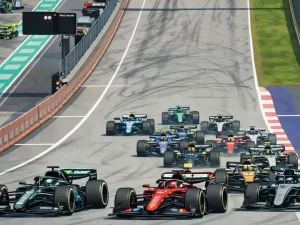
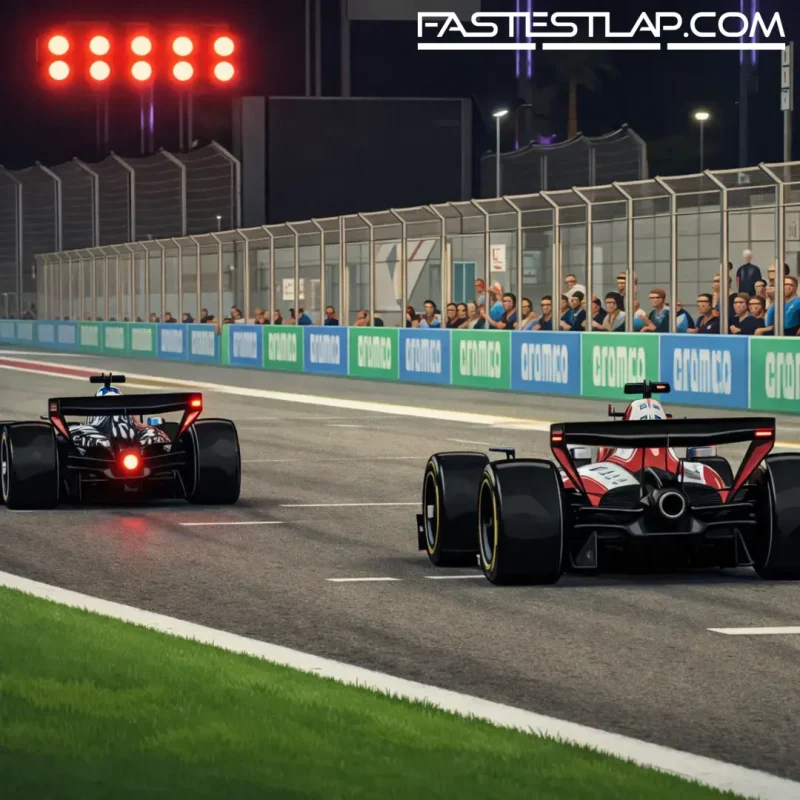
Ferrari’s advantage has been one of the clearest “tell” moments of testing. In two separate practice starts, the Ferrari driver ahead of George Russell was already past him before Turn 1 despite Russell lining up on pole. One of those runs had Lewis Hamilton down in 11th, underlining just how much of the story is about the first 150 metres rather than how the field sorts itself later. Russell did manage to hold position in a later run, though that came with Charles Leclerc starting fifth — not quite the same direct fight.
There’s a technical theory doing the rounds in the paddock about Ferrari potentially running a smaller turbo than some of its rivals — something Russell himself has previously suggested — and whether that’s a key part of why the SF-26 seems to hit its stride earlier in the launch phase. Nobody’s going to confirm details in public at this stage, least of all in February, but the pattern has been hard to ignore: when the lights would’ve gone out in anger, Ferrari looks like it would’ve been the first car to properly “go”.
Mercedes, for its part, is trying to turn a winter weakness into something at least serviceable before the season opener in Melbourne. Antonelli said the team had made “a lot of changes” during the test and that the starts “felt a lot stronger” by the end, even if the limitations of testing meant the team couldn’t always run the full grid procedure exactly as it will on race weekends.
“It’s been a bit of a weak point for us, to be fair,” he admitted. “It’s just very complicated with the procedure, and [we] just need to really get it right.”
That line — complicated procedure — is doing plenty of work. With the 2026 power-unit layout, drivers are having to build the car into the right launch configuration more deliberately than they’re used to. The removal of the MGU-H has become a very real, very tangible change from the cockpit: without that system smoothing the turbo response at low revs, cars can take longer to settle into the window teams want before the clutch bite and throttle application. It’s not that anyone’s forgotten how to start a Grand Prix; it’s that the machinery now demands a different rhythm.
The FIA clearly doesn’t want the first race of the new era to be defined by stalled cars and scattergun launches, so it has already moved to reduce the risk. Across the final two days of Bahrain testing, the governing body introduced a pre-warning into the start sequence — a small procedural tweak, but one aimed squarely at avoiding a mess when 20 drivers are balancing torque delivery, boost and bite point with far less margin for error than before.
And Ferrari wasn’t the only one to look sharp. Haas, running Ferrari power, also caught the eye for its initial traction and urgency off the line. Esteban Ocon said the team started the winter struggling to even establish a consistent pre-start rev point — “we sat on the grid for ages before we could finally go” — but felt it had moved into a better place as the test went on.
“This test we’ve improved the power unit, the way the boost comes in, etc,” Ocon explained. “So it felt quite nice to get away and off the line.”
That comment matters because it hints at where this pre-season fight is really happening. It’s not just the raw output of a new engine concept; it’s the calibration — how quickly the boost arrives, how predictably the torque is delivered, how forgiving the car is when the driver commits. In that sense, starts have become a neat proxy for overall integration between power unit and chassis, and it’s why teams are burning so much track time on something that used to be a brief box-tick at the end of a session.
Ocon also offered the obvious caution: if Haas has found something, so will everyone else.
“But if we have improved, I guess the other manufacturers will be able to improve as well,” he said. “So we need to see how this develops in Melbourne.”
That’s the key. Testing is a laboratory, not a courtroom. Ferrari may have looked like the benchmark in Bahrain’s made-up race starts, and Mercedes may have found a direction late on, but the first proper answer comes when the grid forms in Australia and nobody’s practicing. Still, it’s telling what teams chose to prioritise when the cameras weren’t focused on headline lap times.
In 2026, the opening metres are back in fashion — and right now Ferrari is the one making everyone else look like they’re reacting rather than attacking.