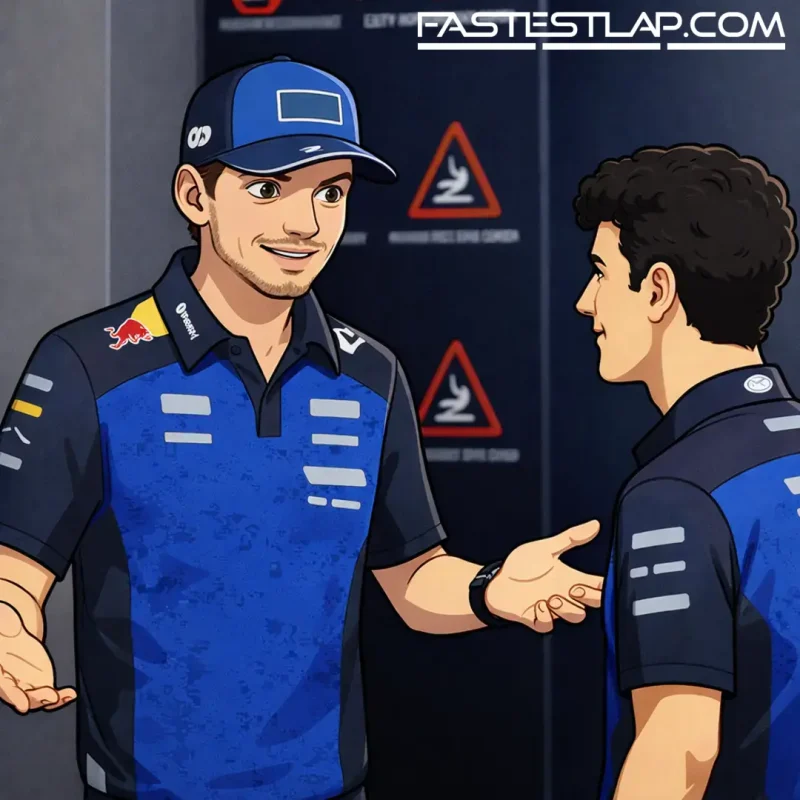
Max Verstappen doesn’t do hand-holding in public very often, but his message to Isack Hadjar ahead of their first season together at Red Bull was about as direct as it gets: don’t arrive thinking you’re here to learn. Arrive thinking you can beat anyone.
That advice lands with a bit more weight than the usual pre-season motivational noise, because Red Bull’s second seat has become its own cautionary tale. Since Daniel Ricciardo left at the end of 2018, Verstappen has been the fixed point and everyone else has been a variable — some lasting seasons, others barely lasting a fortnight. Hadjar becomes Verstappen’s sixth team-mate since Ricciardo and, more strikingly, the fourth to rotate through the seat in the last 16 months after Sergio Perez bowed out in December 2024, Liam Lawson’s brief two-weekend stint at the start of 2025, and Yuki Tsunoda seeing out the remainder of last season.
So when Verstappen talks about mindset, he’s not selling a slogan. He’s describing the only psychological equipment that’s ever given a driver a chance of surviving alongside him.
“I think, as a driver you have to believe that you are always the best, right?” Verstappen said on the *Up to Speed* podcast. “I mean, that should be the approach. You have to say to yourself, ‘I can beat anyone’.
“When I started in F1 in my first year, I was like, ‘Well, if you give me the car, I will win the championship’. That’s how you think.”
It’s classic Verstappen — blunt, slightly ruthless, and entirely consistent with the way he operates inside a team. There’s no suggestion he’s going to soften himself to make the garage feel nicer. If anything, he’s pointing Hadjar toward the only posture that doesn’t immediately concede the battle before it begins.
Hadjar, to his credit, hasn’t exactly arrived with a shrinking-violet profile. His rookie season had the full range: the brutal, very public low of crashing on the formation lap in Melbourne and being reduced to tears at the trackside, and the kind of high that only comes when you end up on a Formula 1 podium — in his case, sharing the Dutch Grand Prix rostrum with Verstappen. Red Bull’s decision to elevate him for 2026 was confirmed after that first year, a move that clearly signals the team sees him as more than just the next name in the churn.
But there’s no getting around the rough edges. Hadjar’s rookie campaign also featured a collision with Kimi Antonelli at Silverstone and costly errors in Baku, the sort of mistakes that don’t just hurt results — they create noise, and noise is the one commodity Red Bull rarely tolerates for long. He also had another reminder of how quickly things can bite at this level when he crashed on day two of a private Red Bull test in January in wet conditions.
Verstappen’s take is that those early mistakes are part of the apprenticeship, provided they’re banked as lessons rather than repeated patterns. He even framed it in a way that will feel uncomfortably familiar to anyone who’s watched young drivers promoted too early into the sharp end of the grid: it’s better to make the errors before you’re in a car that’s supposed to win titles, because the consequences hurt less.
“Of course, when you then look back at things, you have to make mistakes, you have to learn from them, and that is better to happen in a car that is not capable of fighting for a title,” Verstappen said. “It hurts a little bit less.”
That line is doing a lot of work, because 2026 is a year where nobody’s quite sure who will have what kind of car. Red Bull is entering the new regulations with its Red Bull-Ford engine programme, and the paddock’s already split between those who think Red Bull will simply continue its era and those who suspect the field could shuffle dramatically. In that environment, Hadjar isn’t just being judged against Verstappen’s lap times; he’s being judged against how well Red Bull can execute a reset while keeping its internal dynamic stable.
That’s where Verstappen, now heading into his 12th F1 season, sounds almost… casual about it all. Not complacent, but less performative. He openly admitted he hasn’t been hovering in the garage watching “every single detail”, and even noted he wasn’t at the track at the time he spoke. There’s a veteran’s confidence in that — the sense that he knows what matters, knows when to intervene, and doesn’t need to make a show of leadership.
For Hadjar, the challenge is different. Second seasons are where drivers stop being defined by potential and start being defined by habits. The speed is usually there at this level; the question is whether the decision-making keeps up when the car’s on the limit, the tyres are fading, and the radio is alive with competing instructions.
Verstappen insists the relationship is good and that he’s known Hadjar for a long time through the Red Bull system. “He’s great, honestly, he’s a very nice guy,” Verstappen said, adding that he expects them to get along “absolutely fine.”
All of that is pleasant, but it’s not what will decide whether this pairing works.
The real test will come the first time Hadjar qualifies a couple of tenths down and has to choose between forcing the issue next session or building the weekend properly. Or the first time he’s close enough on Sunday to see Verstappen’s gearbox and has to decide whether to be brave or be clever. The drivers who last at Red Bull alongside Verstappen tend to be the ones who can hold two truths at once: you *must* believe you can beat him, and you *must* accept that beating him usually takes time.
Verstappen has now told Hadjar to start with the belief. In that seat, it’s the only way you even get to find out what the second part looks like.