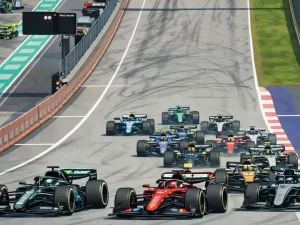
Esteban Ocon isn’t pretending 2025 went to plan at Haas — but he’s pushing back on the easy version of the story that paints it as a simple case of an experienced hand being shown up by a rookie.
Team principal Ayao Komatsu set the tone over the winter with a notably blunt appraisal of his senior driver’s first year in black and white, admitting the team “expected more” given Ocon’s mileage and pedigree. In pure points terms, Ocon ended the season three behind his rookie team-mate, which is never a great look when you’re the one with 10 years of F1 in your back pocket.
Komatsu didn’t dress it up. He framed the outcome as something that couldn’t satisfy anyone at the team, while also conceding Haas didn’t always give Ocon a car he could lean on — particularly on Saturdays, where the damage tends to be irreversible in the midfield. His verdict was a neat split of responsibility: “50/50”, driver and team.
Put that assessment to Ocon ahead of the 2026 campaign and the response was measured rather than defensive. He didn’t dispute the core point — that Haas needed more from him — but he was clear the details matter, and that he and Komatsu had already gone through it in private.
“I’m completely focused on this season,” Ocon said, before acknowledging he understood why Komatsu spoke the way he did. There’s no sense, from Ocon’s side, of a relationship fraying. If anything, he sounded like someone who’s had the uncomfortable debrief, accepted the parts he owns, and now wants the conversation to stop living in headlines.
What Ocon did underline, though, is that his side of the garage spent a large chunk of 2025 chasing a specific and persistent problem that didn’t present itself the same way on the other car. He described a recurring front-locking tendency and instability that lingered for “12, 13, 14 races” — and he’s adamant it wasn’t about confidence, nor an inability to adapt his technique.
In Ocon’s telling, the maddening part was that the inputs and conditions weren’t wildly different between cars: similar brake pressure, similar circumstances, yet very different outcomes. That’s the kind of issue that can poison a season quietly — not with dramatic blow-ups, but with a steady drip of compromised qualifying laps, awkward set-up directions, and a driver perpetually asked to “just drive around it” while the other side appears to have an easier time extracting the baseline.
Haas, to its credit, eventually found something. Ocon pointed to the final round in Abu Dhabi as the moment the fog lifted. He wouldn’t say what was changed — and in truth there’s no reason he should — but he described a transformation that will ring familiar to any driver who’s spent months fighting a car: one day it’s half a second away from where it ought to be, the next it suddenly responds like the machine you expected when you signed the contract.
“So we were clear about something that was not going on,” he said, adding that the breakthrough only arrived on the Friday in Abu Dhabi. From there, he felt the car “came back to life”, and his pace returned accordingly.
The bigger point, reading between the lines, is that this isn’t a case of Haas offering Ocon a free pass. Komatsu has already made it plain he wants a higher sporting return, and Ocon isn’t contesting that. But he is drawing a line under the simplistic narrative that being outscored by a rookie automatically equals underperformance in a vacuum. In the midfield, where a tenth can swing you from Q1 to Q3 and a tiny balance shift can dictate whether you attack or survive, a season-long technical gremlin can flatten even very good drivers.
For Haas, the upside is that both sides appear aligned on what went wrong: there were things Ocon needed to execute better, and there were things the team needed to deliver better. The risk — and it’s the one Komatsu is implicitly warning about — is that 2026 won’t be patient. If you’re the senior driver and you start the year already explaining why last year didn’t reflect your level, you don’t get long before results have to do the talking.
Ocon’s message is straightforward: the winter was used to clear the air and do the work, not to trade blame. Now it’s about proving that Abu Dhabi wasn’t a one-off revival, but the start of a cleaner baseline — and that the “50/50” can tilt back in his favour when it counts.