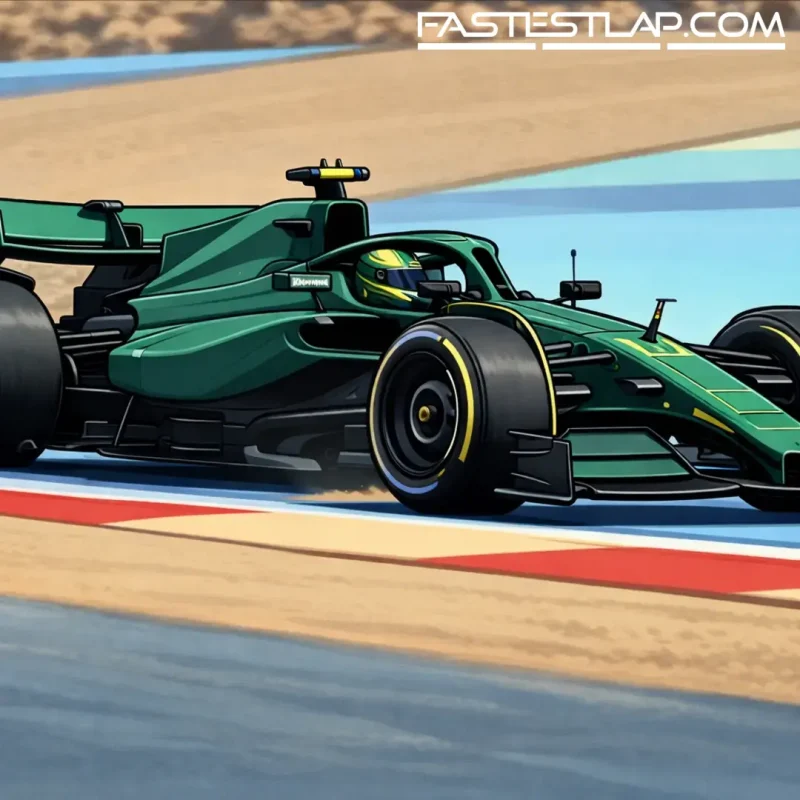
Aston Martin left Bahrain with the kind of pre-season mileage deficit that doesn’t just bruise confidence — it steals options. Across the three official test days, the AMR26 logged only 400 laps, the lowest of any team, and a number that looks even starker alongside Williams’ haul and even Cadillac’s busy debut programme. For a squad trying to bed in a brand-new works partnership with Honda under a fresh set of 2026 power unit rules, it’s exactly the wrong way to start a season.
Honda insists it now understands the core problem that repeatedly stopped Aston Martin in its tracks: “abnormal vibrations” severe enough to damage the battery system. That diagnosis matters because it reframes the situation from the vague, catch-all “reliability issues” into something more specific — and potentially more awkward — given vibrations are rarely the fault of one department acting alone.
Speaking in Japan on Thursday, Honda Racing Corporation managing director Ikuo Takeishi said the vibration phenomenon was the primary trigger behind the Bahrain interruptions.
“Abnormal vibrations occurred and caused damage to the battery system; this was the main reason the car had to stop,” Takeishi explained, adding that Honda is investigating on the power unit side while Aston Martin is working on countermeasures from the chassis end. Honda is using its Sakura real-vehicle dyno to replicate the conditions, simulate the vibrations and cycle through proposed fixes.
That last point is significant. Honda isn’t talking in hypotheticals; it believes it can reproduce the issue off-track, which is usually the difference between a problem that drags on for races and one that can be attacked methodically in the gap before the opener.
The most visible blow landed on the penultimate day in Bahrain when Fernando Alonso’s car came to a halt in a stoppage that didn’t just end a run — it created a knock-on effect for the final day. Honda, operating at the ragged edge of available parts after repeated swaps, ran out of components. The last battery available had been compromised as the supplier burned through ancillary hardware faster than expected.
Honda president Koji Watanabe was careful not to simplify the problem into “the battery failed”, because the evidence suggests the battery is the victim rather than the culprit.
“The vibration caused damage to the battery,” he said, while stressing it’s still unclear whether the battery itself is the fundamental cause. Takeishi expanded on the nature of the failure: the battery pack is being shaken, which means the structure it’s mounted to is vibrating. In other words, this isn’t just an electrical gremlin; it’s a mechanical environment problem with electrical consequences — the sort that can live at the intersection of power unit excitation, chassis response, mounting strategy and even how the car reacts to track inputs.
Honda’s engineers believe they know which areas are shaking and are now testing ways to damp or shut down those vibrations. Takeishi noted that, while track surface input can influence vibration behaviour, Honda still gathered enough data despite the lack of long runs — and the fact it can reproduce the problem gives it a workable path to a remedy.
What Honda wouldn’t do, yet, is point a finger at a specific frequency, or confirm whether Aston Martin’s new gearbox or suspension might be contributing. Watanabe acknowledged that analysis is still to come, and Takeishi admitted the reality: if it were a single clean cause, you’d fix it quickly. Multiple linked factors are harder — and could take time.
There’s also the calendar pressure unique to 2026. Power units are heading toward homologation, with a cut-off looming on March 1, although changes are permitted for reliability and durability. Honda’s current plan is to submit the Bahrain-spec unit for homologation, while applying countermeasures to address the vibration-induced battery damage. Watanabe said the immediate priority isn’t some late performance swing, but operationally maximising what they’ve got once the system stays alive.
In the background sits the part nobody in the paddock wants to dwell on too loudly this early: relationships get stress-tested fastest when the lap count collapses. Rumours of tension are inevitable when one side can’t run and the other can’t learn. Watanabe pushed back firmly, saying Honda is approaching Aston Martin as a long-term partnership and that discussions with chairman Lawrence Stroll and Adrian Newey have been “positive” and focused on solutions before the opening race. Takeishi’s version was similar: at the track, the atmosphere has been about data and fixes, not politics.
Aston Martin’s chief trackside officer Mike Krack, for his part, didn’t attempt to file everything under “Honda problem” either. He pointed out that the AMR26 is loaded with newness: electronics, partners, a new gearbox and new suspension. When several of those strands are moving at once, reliability becomes less a single fault and more a cascade.
That context matters because the cost of Bahrain isn’t simply that Aston Martin looked scruffy. It’s that the team barely got to do the work that makes a modern pre-season valuable: understanding aero balance trends, mapping drivability, stress-testing cooling and energy deployment, and building the feedback loop between factory tools and track reality. Krack admitted the deficit bluntly — if you’ve accumulated three times fewer laps than the best-prepared competitors, you’re behind. And nobody is waiting.
Honda, too, acknowledged that its return to full works participation hasn’t been a seamless continuation of the Red Bull years. Watanabe outlined how, after stepping back from official involvement in 2021, staffing thinned in 2022, then ramped back up after Honda’s re-entry was approved in 2023 — right as the cost cap began to bite. That time lag, he said, is being felt now.
Still, Honda’s public messaging is clear: it believes the vibration problem can be fixed, it’s throwing resource at reproducing it on the Sakura dyno, and it expects to have countermeasures in place for the first race. The more sobering truth is that even if the AMR26 runs cleanly next time it turns a wheel, Aston Martin is trying to start a new era having already spent its most precious pre-season commodity: mileage.