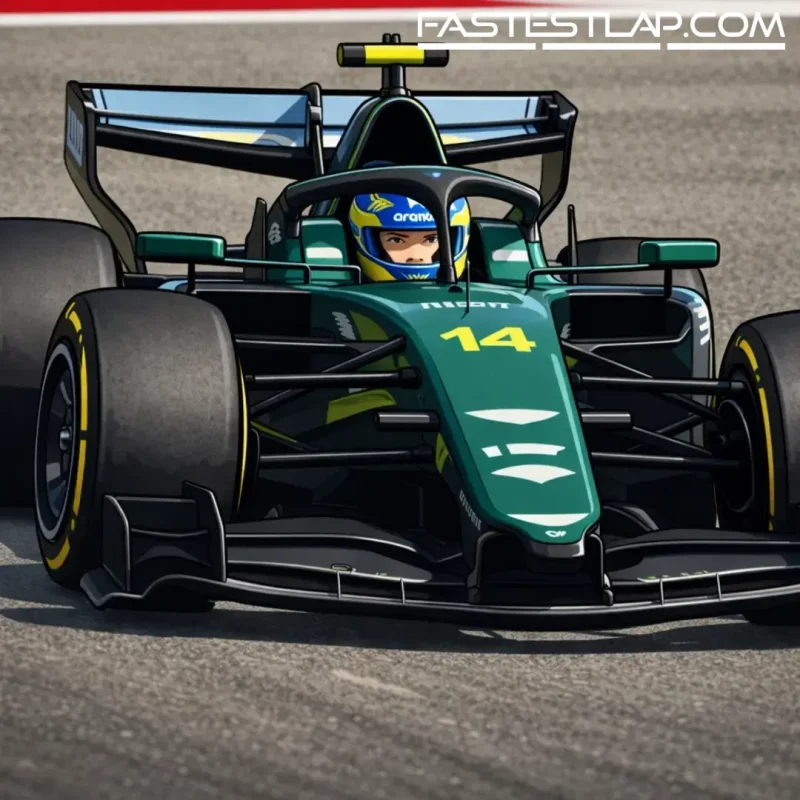
Aston Martin arrives in Melbourne with a problem that’s both brutally simple and awkwardly complex: it still doesn’t really know what its 2026 car is.
In Bahrain, the AMR26’s winter programme never became a proper programme at all. Reliability interruptions were frequent, then terminal. Fernando Alonso’s stoppage late in the second test had a knock-on effect that effectively wrote off the final day, leaving Lance Stroll to complete just six laps when the team needed a full day of correlation work. In a season defined by new hardware and new baselines, Aston Martin has turned up to the opener without the one commodity every engineer craves: clean, repeatable running.
The root issue, as Honda has openly admitted, sits on the energy recovery side of the power unit — specifically abnormal vibrations that damaged the battery system. Honda Racing Corporation’s managing director Ikuo Takeishi laid it out in Tokyo: the vibration wasn’t a single smoking gun but “combined factors during running”, and both Sakura and Silverstone have been forced into parallel countermeasures. Honda’s been using its real-vehicle dyno to recreate the conditions; Aston Martin has been doing what it can at the factory to ensure whatever arrives in Australia has a fighting chance of surviving a race weekend.
That last point is what makes the Australian Grand Prix so strange for Aston Martin. This isn’t the usual “we don’t know where we are” coyness you hear up and down the pitlane in March. It’s a genuine lack of reference because the car rarely stayed alive long enough to deliver meaningful data. Until the power unit runs reliably, the team can’t properly judge the chassis platform, can’t get confidence in aero behaviour, and can’t separate what’s a performance limitation from what’s simply an engine installation that’s shaking itself apart.
There’s also an undercurrent to this that’s hard to ignore: late packaging and installation changes, requested after Adrian Newey’s arrival last year, have been floated as a possible contributing factor to Honda’s headaches. No-one is pinning it on Newey in public — and it would be simplistic to do so anyway — but it’s an illustration of how tightly coupled the 2026 cars are. Change the peripherals, the mounting, the way components are supported or cooled, and you can end up with vibration modes you never saw coming on the bench. In that sense, this is as much an integration story as it is a Honda story.
Aston Martin’s hope is that Melbourne marks the pivot. The homologation deadline has already passed — March 1 — and Honda has confirmed it homologated the power unit in its Bahrain specification. But reliability fixes remain possible after that date, provided the FIA is satisfied the changes are legitimate and not performance upgrades in disguise. That’s the loophole Aston Martin is effectively living in this week: the ability to apply engineering triage without reopening the performance arms race.
In the background, the usual paddock noise has cranked up to eleven. There’s been talk — some of it frankly theatrical — that Aston Martin might do the bare minimum laps to classify, or even pull the cars after the formation lap on Sunday if things look ugly. The reality is more grounded. Even if the weekend turns into damage limitation, parking the car helps nobody. If you’re missing baseline data, the worst thing you can do is stop gathering it.
There have also been whispers of Aston Martin considering not starting the weekend at all, citing force majeure. That, too, feels detached from the practical world the team inhabits: commercial commitments, partner expectations and contractual obligations make a no-show close to unthinkable, even before you get to the sporting consequences.
What makes this more than a simple reliability watch is that Aston Martin is expected to introduce elements of a new aerodynamic package on the AMR26. That adds urgency. Aero updates without robust on-track running are just expensive ornaments; you need real-world laps to understand whether the windtunnel and CFD predictions are honest, and whether the platform is stable enough to exploit the downforce you think you’ve found.
Inside the team, there’s a careful kind of optimism — not that everything will be fine immediately, but that the upside could arrive quickly once the car stops interrupting itself. There’s “low-hanging fruit” in any project that’s been prevented from doing basic development work, and sources around the operation have suggested the performance curve could steepen once Aston Martin can finally move from firefighting to tuning.
Newey is understood to have spoken to staff at Silverstone on Monday with a message that won’t surprise anyone who’s worked under him: the recovery is underway, but progress won’t be instant just because the organisation wants it to be. That tone matters. With a problem like this, the danger isn’t only losing track time — it’s losing clarity, and then making a string of hurried decisions that stack new problems on top of the original one.
So the first meaningful session of Aston Martin’s season might not be a qualifying simulation or a race run. It might simply be Friday in Melbourne, watching whether the proposed fixes translate from the dyno to the circuit. If they do, Australia becomes something close to a belated test: a chance to build mileage, validate correlations and finally establish a baseline for a car that has spent more of its pre-season in the garage than on song.
If they don’t, then Aston Martin’s opening weekend risks becoming a slog of stop-start running and compromised learning — and the sport has a habit of punishing teams that begin a new era chasing lost time. Either way, the story in green this weekend isn’t lap time. It’s whether the AMR26 can stay on the road long enough to reveal what it actually is.