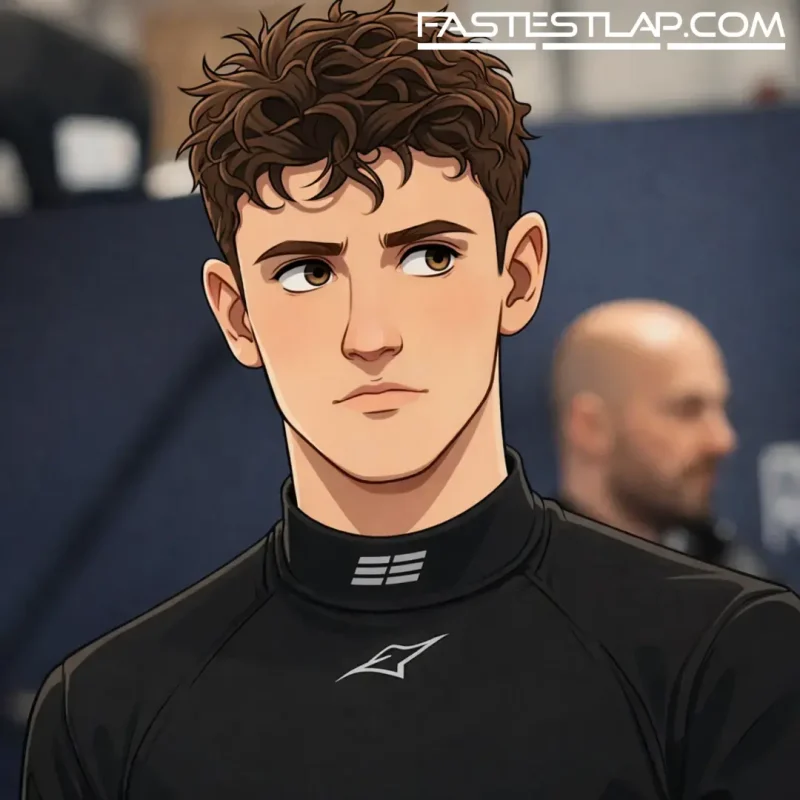
Alex Dunne’s junior career has had more plot twists than most drivers see in a lifetime, and 2026 has barely started. After months of back-and-forth, the Irishman has now landed at Alpine, joining the Enstone team’s academy in time for the new Formula 2 season opener in Melbourne.
It’s a significant capture for Alpine — and not just because Dunne is quick. This is a driver who’s been passed around some of the sport’s most powerful structures in the space of a year, and yet has still managed to keep his trajectory pointing upwards. Alpine will present it as a straightforward “talent acquisition”. In truth, it’s also a timely piece of squad-building in a driver market where the best young prospects are increasingly locked down early.
Dunne arrives from an unusual place: the exit door. He walked away from McLaren’s Driver Development Programme last season after the two sides couldn’t align on what came next. With no obvious F1 pathway opening at Woking, McLaren’s preferred alternative was IndyCar — a route Dunne wasn’t prepared to take.
That split in itself wasn’t the wild part. What followed was.
In the aftermath, Dunne was signed to Red Bull’s programme by Helmut Marko, only for the deal to be scrapped when senior management — Laurent Mekies and Oliver Mintzlaff — became aware of it. The contract was effectively quashed, and Dunne received a $600,000 compensation payment, money that will help underpin his second F2 campaign.
That sequence tells you two things. First, Dunne’s stock is high enough that people in powerful positions have tried to move quickly. Second, not everyone in those structures has been pulling in the same direction — and in 2026, the politics of driver development can be as decisive as a stopwatch.
Now, it’s Flavio Briatore’s turn to make the case. Alpine has confirmed Dunne will join its academy alongside Kush Maini and Gabriele Mini, giving the team a top-heavy F2 roster this year. Dunne will remain with Rodin Motorsport in F2, but will race in Alpine colours and take on the wider branding and simulator responsibilities that come with academy status.
On performance alone, Alpine can point to a strong justification. Dunne stepped up to Formula 2 in 2025 after a bruising 2024 in Formula 3 and immediately made himself relevant. He became the first Irish winner in F2 by taking the Bahrain feature race, then repeated the trick at Imola a few weeks later. Add six more podiums and it’s easy to see why he was regarded as a genuine player in the title fight.
The final standings don’t show the full picture. Dunne ended his rookie F2 season fifth — a result shaped not only by the usual incidents and rough weekends, but also by operational errors and technical disqualifications that blunted what could have been a cleaner championship challenge.
Alpine is buying into the version of Dunne that appeared at his sharpest last year: assertive in wheel-to-wheel fights, decisive on restarts, and fast enough over a stint to make strategy look clever. He also logged two F1 first-practice appearances with McLaren, at the Austrian and Italian grands prix, and Alpine says those outings helped confirm what it believes is “pure, natural speed”.
“I am really happy to be joining the Alpine Academy and making this next step in my racing career,” Dunne said. “Naturally, after a competitive season in 2025, the goal this year is to fight for the Drivers’ Championship… I aim to give my all for Alpine.”
Briatore, never a man to undersell a signing, framed it in similarly direct terms: “His performances in FIA Formula 2 and also his Free Practice sessions in Formula One last year were impressive… We look forward to watching the three of them compete in FIA Formula 2 in 2026 where the goal is very clear: to win the Drivers’ Championship.”
There is, however, a very 2026 complication sitting behind all of this: the Super Licence.
Dunne’s eligibility situation is understood to have been a sticking point in negotiations because he doesn’t yet have the 40 points required over the most recent three-year period for a full FIA Super Licence — the key that unlocks a proper F1 role beyond limited practice outings.
As things stand, Dunne is on 29 points. That total comes from fifth in F2 in 2025 (20 points), second in GB3 in 2023 (seven points), plus two points from last year’s FP1 appearances. The maths is blunt: he needs another serious haul this season. A top-five finish in F2 would get him over the line, and he can also add single points via further FP1 outings.
This is where Alpine’s interest becomes sharper. An academy signing is one thing; having a driver you can actually use is another. Without those Super Licence points, Dunne can’t simply be slotted into the kind of reserve role that gives teams flexibility across a long season.
And yet Alpine has still pushed to get it done. Dunne even turned up in a pink-liveried car featuring BWT and Alpine Academy branding during the recent Barcelona F2 test before the deal was fully signed off — the sort of not-so-subtle pre-announcement that tends to happen when everyone already knows where the story is going.
If Dunne ticks the Super Licence box this year, the stakes rise quickly. He’d be in the frame for reserve duties currently held by Paul Aron, and would put himself on the list of credible options if Alpine’s driver market shifts — with Pierre Gasly and Franco Colapinto both mentioned internally as potential movers should opportunities arise elsewhere.
For now, though, the assignment is simple and brutal: deliver in F2, and do it consistently enough that Alpine’s investment turns into leverage rather than just a logo on a race suit.
Melbourne is the first checkpoint. After everything that’s already happened in Dunne’s career, it won’t be the last.