Sky Sports F1 isn’t in the mood for a revolution in 2026. With the sport walking into a new era on track, the broadcaster has gone the other way off it: keep the faces familiar, keep the format stable, and trust that continuity is what viewers want when the racing itself is about to change character.
The headline from Sky’s on-screen roster ahead of the season-opening Australian Grand Prix is less about who’s been added than who isn’t there. Danica Patrick’s name is absent from the confirmed line-up for the year, a small but noticeable tweak given Sky’s preference in recent seasons for rotating a broad cast of voices in and out across the calendar.
Beyond that, this is essentially the same operation: the same lead anchors, the same paddock reporters, the same commentary pairing when the schedule allows it, and the same blend of ex-drivers and technical specialists deployed to keep the analysis moving.
Simon Lazenby remains the spine of Sky’s presentation, a role he’s held since the network took full-time UK F1 rights back in 2012. He’s long since made the switch from rugby union to motorsport, and Sky still leans on his ability to steer long live shows without turning them into a series of awkward handovers.
Natalie Pinkham continues to be one of the broadcaster’s most versatile operators — presenter, pit-lane presence, interviewer, occasional commentator when required. Her return to the paddock after undergoing neck surgery in 2025 adds a human note to what can be a brutal travel schedule, and she’s confirmed she’ll be back from the Japanese Grand Prix in 2026.
Rachel Brookes’ remit has only broadened as Sky’s coverage has expanded with the calendar. She’s a regular around the garages and in the pens, but also increasingly trusted in the commentary booth — particularly for FP1 — and as a lead anchor when the rotation demands it.
And then there’s Ted Kravitz, who remains exactly what he’s always been: the paddock’s compulsive note-taker and the show’s connective tissue between the garage door and what’s being said on air. Approaching three decades in F1 television dating back to his ITV days, Kravitz’s value to Sky is that he’s still prepared to chase a thread even when it’s uncomfortable. “Ted’s Notebook” has become part debrief, part gossip filter, part forensic exercise — and in 2026, with so much likely to be in flux, it’ll probably be more watched than ever.
Craig Slater’s dual role across Sky Sports News and Sky F1 keeps him in the thick of it through a weekend, shuttling between live hits, pen interviews and the sort of behind-the-scenes reporting that tends to land when everyone else is looking at lap times.
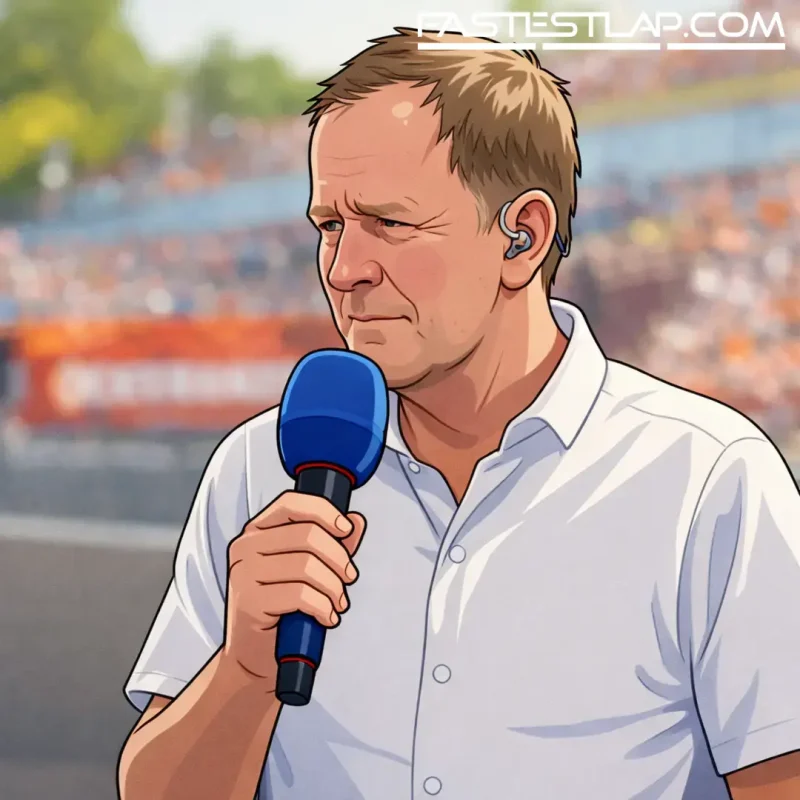
In the commentary box, the main act remains David Croft and Martin Brundle when schedules line up. Croft is still Sky’s lead voice, though the days of calling every race are gone as the calendar footprint grows. Brundle, meanwhile, continues to pick his moments more selectively than he once did — the “lighter schedule” is now simply part of the rhythm — but his status as the reference point for live analysis hasn’t shifted.
When Croft isn’t present, Sky has again turned to Harry Benjamin to step up. Benjamin continues to juggle his Radio 5 Live duties alongside television work, and Sky hasn’t detailed exactly which rounds he’ll lead on comms, but his role as the designated stand-in is now well established.
If the commentary is built on familiarity, the studio and paddock analysis is designed to give Sky multiple flavours — and not always harmonious ones.
Jenson Button is set for a bigger on-air year after stepping away from full-time racing at the end of last season. Sky is getting more of him in 2026, while Button also takes on an ambassadorial role with Aston Martin, having previously done similar work with Williams. Button’s strength has always been that he doesn’t need to force the point; he can be critical without sounding like he’s trying to win an argument.
Nico Rosberg remains the opposite energy — sharp, direct, and often happy to ask the question others dance around. His Sky appearances have been sporadic since retiring at the end of 2016, but when he’s on a weekend, he tends to shape the tone simply by refusing to soften his edges for the sake of access.
Jacques Villeneuve, too, is back in the mix. He first appeared on Sky for the 2024 Canadian Grand Prix and has become a regular presence around North American rounds since — another voice that doesn’t arrive to smooth anything over. Whether you find that refreshing or exhausting probably depends on your tolerance for pundits who treat every topic like it’s a court cross-examination.
Where Sky’s coverage has quietly become more compelling is in how it handles strategy and data in real time, and Bernie Collins is central to that. Since leaving her strategy engineer role at the end of 2021, Collins has developed into Sky’s calm, credible “this is what they’re trying to do” explainer. With “Pit Wall Live” introduced in 2025 giving her more immediate information to work with, the broadcast now has a genuine tactical layer rather than the usual after-the-fact guesswork.
Jamie Chadwick also continues with Sky in 2026, building on her previous TV work with Channel 4. She’ll balance F1 weekends with her own racing commitments — continuing in the European Le Mans Series this year — and also represents Williams as an ambassador. Her on-air presence has tended to be less about hot takes and more about clarity, which is rarely a bad thing in a sport that loves to complicate the obvious.
Naomi Schiff is retained as well, following a 2025 in which she presented “The F1 Show” and expanded her media work more broadly. She also fronted at launch events — including Audi’s first launch in 2026 — and returns to the paddock after having her child last autumn.
Karun Chandhok and Anthony Davidson round out the familiar technical voices. Chandhok remains the go-to on the Sky Pad for breaking down sequences with a driver’s eye, while Davidson continues his close-up analysis of wheel-to-wheel combat — and still maintains an active paddock role as a Mercedes development driver in 2026.
Put it all together and Sky’s 2026 message is clear: the sport can change, the cars can change, even the competitive order might tilt — but the broadcast wants to feel like home. For viewers, that’s either reassuring or a little too comfortable. Either way, with only minor movement in the cast list and one notable omission, Sky is betting that in a year of big on-track unknowns, familiarity is the safest production choice it can make.