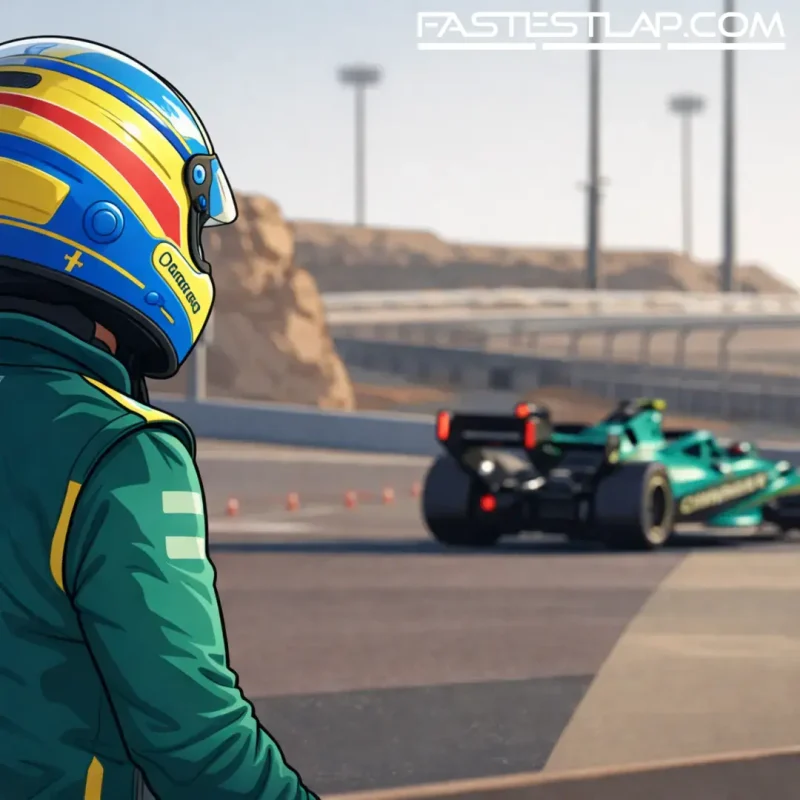
Fernando Alonso didn’t dress it up in Melbourne: Aston Martin’s new era with Honda has started with a problem that you can literally feel in your bones.
After pre-season running in Bahrain was repeatedly interrupted by vibration-related issues — Alonso himself stopped less than an hour into an afternoon session on the penultimate day — the two-time world champion says the AMR26’s frequency is severe enough to leave his hands and feet “a little bit numb” after 20 to 25 minutes in the car.
“It’s just vibrating everything,” Alonso explained ahead of the Australian Grand Prix. “But it’s not only for us. I think the car is struggling a little bit so that’s why we have some issues… reliability problems that made our days a bit short.
“The vibrations coming from the engine are hurting a little bit the components on the car. And, you know, to drivers, we feel them.”
That’s the key detail here. This isn’t the usual early-season gripe about harsh kerbs or an uncomfortable seating position. This is a power unit-induced vibration that Aston Martin believes is shaking hardware loose and, more worryingly, could pose a health risk for the people strapped into it.
Team principal Adrian Newey has already acknowledged Aston Martin will have to restrict running for both Alonso and Lance Stroll in Melbourne because the issue hasn’t been fully resolved. Newey’s line is stark: prolonged exposure risks permanent nerve damage. Stroll, he said, felt he could manage 15 laps; Alonso, 25.
Alonso didn’t dispute the numbers or the concern. What he did make clear is that the sensation isn’t “painful” and it isn’t compromising his ability to drive the car — which, in a way, is what makes it more insidious.
“No, not painful. Not difficult to control the car,” he said. “I mean, the adrenaline is just way higher than any pain. If we were fighting for the win, we can do three hours in the car, let’s be clear.
“So I think that overcomes anything… but definitely it is something that is unusual. It shouldn’t be there.”
The immediate complication for Aston Martin is operational. If you’re already talking about lap limits on Friday, your entire weekend is compromised before you’ve even seen the first red light. Set-up work becomes triage. Long runs become a luxury. And for 2026, with everything still fresh — new regulations, new behaviours, new margins — track time is gold dust.
But the bigger complication sits behind Alonso’s last few sentences, because he’s essentially drawn a line between Honda’s fix timeline and his own.
Alonso will turn 45 this year. He’s still fast, still sharp, still a nuisance in the best way, but he’s also realistic about what he’s prepared to tolerate in the late stages of a career that has already proved longer — and more elastic — than anyone expected.
“I have 100 percent faith that Honda will fix the problems,” he said. “The thing is probably the time that is required, and it’s not matching with my time in my career, and that’s something that remains to be seen.
“I don’t have a crystal ball to know exactly when problems will be fixed. So, yeah, we will go race by race and month by month… Hopefully we can see improvements in the short term, and that will help my decision as well for next year.”
It’s a very Alonso way of applying pressure without looking like he’s applying pressure at all. He’s not questioning Honda’s competence — in fact he leans into its history of turning things around — but he is making the point that time is the one resource he doesn’t have in abundance.
And it’s not just a personal calculus. For Aston Martin, 2026 is supposed to be a statement season: a full factory partnership, a clean-sheet car, Newey’s technical leadership now front and centre. When that story is immediately hijacked by a vibration problem serious enough to trigger medical warnings, it becomes something else entirely: a race against the calendar to stop a performance project becoming an attrition project.
Alonso noted that solutions have already been trialled since Bahrain and that some have been implemented on the car in Melbourne. “Every day they try to find solutions,” he said. “Since Bahrain, there were a couple of tests done… curious to see what tomorrow we can improve and we feel.”
That’s the near-term reality: incremental steps, constant monitoring, and the uneasy tension of trying to compete while simultaneously making sure your drivers don’t spend their Sundays wondering what the long-term cost might be.
Because the most striking part of Alonso’s comments wasn’t the numbness itself. It was the bit that followed — the acknowledgement that nobody can say, with confidence, what happens if you simply grit your teeth and race through it for months.
“We don’t know the consequences either if you keep driving like that for four months,” he said. “So, you know, a solution has to be implemented.”
In other words: this can’t become normal. Not for Aston Martin, not for Honda, and not for a driver who has seen enough of Formula 1’s cycles to know how quickly “we’ll fix it soon” can drift into “next upgrade” and then into “next season”.