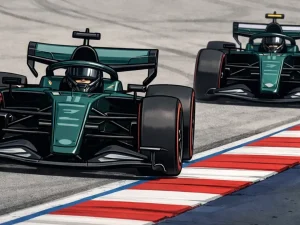
Max Verstappen turned up in Melbourne doing his best impression of a man entirely uninterested in the paddock’s favourite new hobby: reading meaning into other people’s lap times.
On the eve of the 2026 Australian Grand Prix, the Red Bull driver insisted he’s got “no idea” where the team sits in the order and, more pointedly, that the RB22 “is not the quickest” car heading into the opening weekend of the new regulations. That’s either refreshingly straight, or the sort of line that gets filed under *things drivers say when everyone’s trying to bait them into an early-season headline*.
Either way, it’s already become a talking point because the messages around Red Bull’s true pace are all over the place. Mercedes’ George Russell and Ferrari’s Lewis Hamilton both arrived in Australia with the same raised eyebrow: Red Bull, they reckon, hasn’t shown its real hand yet.
Russell, speaking in Melbourne, described Red Bull as “suspiciously slow” during the Bahrain test. His specific gripe was that the RB22 appeared to drop around 0.7 seconds between the first and second tests in Sakhir — a swing big enough to invite theories about fuel loads, engine modes, programme changes, or simply a team shifting focus away from headline laps.
Hamilton echoed the suspicion, suggesting the “full, unleashed Red Bull” still hasn’t been seen.
Verstappen wasn’t interested in picking up the thread. Asked directly whether Russell’s claim was fair — and whether he, too, was suspicious of what others are doing — Verstappen batted it away.
“No, no. I don’t know. I don’t really think about those things,” he said at Albert Park. “I just focus on what we do here and I’m not really too bothered what other teams do and what other people say.”
The fascinating part is that Verstappen can sound dismissive without sounding defensive. He isn’t trying to win the pre-season narrative war; he’s trying to keep Red Bull’s own project on its rails.
And there’s plenty going on inside that project. Red Bull is running an engine of its own making for the first time this year, with Red Bull Powertrains drawing admiration up and down the pitlane through testing. Toto Wolff even claimed early in Bahrain that Red Bull was a second per lap faster on the straights thanks to its deployment — a huge number, even by the elastic standards of test-week gossip. Williams driver Carlos Sainz went further in his own way, describing what he saw from the RBPT engine as “a clear step” ahead.
So how do you square that with Verstappen calmly saying the RB22 isn’t the quickest? That’s the crux of the mind games heading into Melbourne.
One explanation is that straight-line performance and overall lap time aren’t the same currency under these rules. Another is that Red Bull may well have strengths — power unit behaviour, integration, drivability — while still lacking the all-round package in aero efficiency, tyre management, or simply the last bit of performance needed over a full lap. And then there’s the most basic reality: testing is not a controlled environment, and teams don’t share their run plans.
For his part, Verstappen sounded genuinely pleased with how the new-era car-and-engine combination has come together, even if he’s leaving the door open for improvement.
“I’m very happy with what we did in pre-season. It’s been, I think, a really great and proud moment for everyone how the whole project came together between the engine and the car,” he said. “I was really positively surprised with how everything felt. Also, the rule changes have been really complex, I think, for everyone.
“But in terms of the feeling in the car, driving experience between the engine and the car, it was good.”
That last line is easy to skim past, but it matters. When a driver talks about “feel” and “driving experience” this early, it’s often code for the car responding in a predictable way — torque delivery, harvesting and deployment characteristics, and how all of that blends with the chassis. Under a fresh set of regulations, a car that makes sense to the driver can be worth more than one that occasionally does something spectacular on a low-fuel run.
Verstappen did acknowledge there were aspects he “didn’t like” — a reference to earlier comments he’s made about the direction of the rules — but he separated that wider frustration from Red Bull’s internal execution.
“What happened here within the team has been really, really good, so we’re very happy with that,” he said.
Then came the part everyone will latch onto when the first practice times drop: Red Bull isn’t, in his words, the quickest on what it learned in Bahrain.
“Of course, looking on the performance side of things, I think we want to be a little bit faster. Naturally, I think everyone always wants to be faster,” he said. “But, from the things that I think we learned in Bahrain at least, we’re not the quickest.
“But I have no idea. We’ll just see where we are here to start with.”
The broader expectation in the paddock is that Mercedes and Ferrari look like the front-runners for Melbourne, with Red Bull and reigning constructors’ champion McLaren closely matched behind. That makes Verstappen’s tone interesting: not panicked, not bullish — just noncommittal, as if he’d rather let the stopwatch do the talking than spend Thursday playing along with Russell’s insinuations.
And maybe that’s the point. If Russell and Hamilton want to frame Red Bull as the shark circling quietly before it bites, Verstappen’s response is to shrug and get on with it. It’s a neat way of taking the oxygen out of the speculation — and a reminder that, in 2026, nobody truly knows what anyone’s got until qualifying happens and the fuel burns off for real.
Melbourne will start answering the questions. The only one Verstappen isn’t interested in is the one everyone keeps asking.