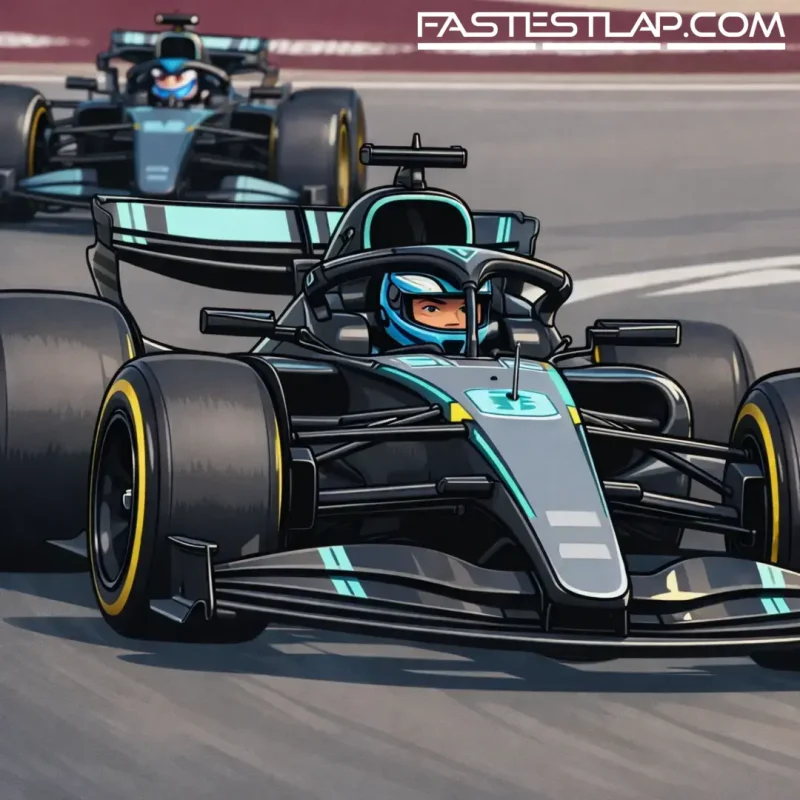
Mercedes arrived in Melbourne with that familiar pre-season glow: the paddock whispers about a strong new power unit, the encouraging Barcelona shakedown times, and the sense that Brackley might’ve hit the ground running as F1 turns the page to its 2026 regulations.
Then Friday practice happened.
George Russell ended FP1 seventh and rookie team-mate Kimi Antonelli eighth, both more than a second away from Charles Leclerc’s leading Ferrari, and Toto Wolff didn’t try to dress it up as anything else. The Mercedes boss insisted the team’s issues are “surmountable”, but he also made it clear that anyone crowning Mercedes early has been reading the wrong tea leaves.
“FP1 today was much more challenging than the Bahrain tests,” Wolff said after the session. “So it’s not inherent problems that we have in the hardware; some of the software is just teething problems.”
That word — software — is doing a lot of work in the opening hours of this season. A fresh rules cycle always brings a learning curve, but 2026’s reset has sharpened the edge: new power units, new car concepts, and increasingly complex integration between systems. Wolff’s read is that Mercedes isn’t staring at a fundamental mechanical flaw so much as the messy, time-consuming business of calibrating how everything talks to everything else when it counts.
It also gives some context to the slightly contradictory picture Mercedes has painted across winter running. Bahrain wasn’t entirely smooth, with reliability hiccups affecting Antonelli in particular during the first test. Even so, the team piled on mileage in the second test and ended up completing the most laps of anyone, despite a pneumatic issue for Antonelli on the final day.
That’s useful data gathering, but it doesn’t automatically translate to being quick in the first meaningful hour of the season — and Wolff sounded like someone who’s been around F1 long enough to know how quickly a narrative can turn into a trap.
“I’ve always stated that I think that Red Bull and Ferrari are very fast, and people try to continue to talk us up, and that’s flattering,” he said. “But I’m not sure it’s 100 per cent the reality, and certainly not what we have seen in FP1.”
Wolff didn’t go into detail about the specific problems inside the garage, but he hinted that the Friday hit was expected to some degree when you throw new regulations into a real-world track environment, with real wind, real kerbs, and real pressure.
“It was a difficult burst today, also for us, but not unexpected, I guess, when you start with new regulations,” Wolff explained. “We weren’t in such a good place on the chassis side, power unit side, but all things that are surmountable… interesting, exciting challenges to overcome for FP2 and the rest of the weekend.”
There was also a telling aside in the FIA press conference, where Wolff compared Mercedes’ situation to the magnitude of the problems affecting Aston Martin under Adrian Newey’s leadership. It wasn’t a dig so much as a benchmark: yes, Mercedes has work to do, but it isn’t a car that’s fallen off the map. The implication is that the foundations are there — it’s the execution, the integration, and the fine tuning under pressure that needs tightening.
And that’s where Mercedes’ early-season mood feels notably different to the version of the team that used to stride into the opener talking about winning. Wolff, typically guarded, sounded almost allergic to projecting certainty — even by his standards.
“In 15 years or so, I have never been confident,” he said. “And, even if we started the season magnificently, I’ve never been confident enough to say that we are going to be fast… and that is no different this year.”
It’s easy to hear that as classic Wolff pessimism, but there’s something pragmatic in it too. If the performance picture is genuinely mixed — strong when the W17 is “running smoothly”, but vulnerable when it isn’t — then banking on race-winning form straight away is a good way to end up fighting your own expectations.
Reliability, inevitably, sits in the middle of the conversation. Mercedes’ late test concerns in Bahrain have carried over as a talking point, not because Wolff pointed to a smoking gun, but because he didn’t. His emphasis was on the overall concept rather than a single weak part.
“The reliability is always an issue, particularly with new cars and new power units,” he said. “I guess that’s going to be the motto for this first couple of Grands Prix, to say where our limitations, where our reliability worries are on either component or any component in the car.
“So no, [I’m] not particularly worried about one reliability issue related to the engine, but it’s more the overall car concept.”
That’s a more nuanced concern than simply asking whether the power unit will last. It’s about the whole machine holding together — hardware and software — while Mercedes tries to unlock the lap time it believes is in there. And if Friday in Melbourne is any guide, the sport’s first proper look at the 2026 order could be far less predictable than pre-season gossip suggested.
Mercedes still has time this weekend to turn the picture around. But Wolff’s message was blunt: this isn’t a team arriving as the obvious favourite, and it’s not pretending otherwise. For now, it’s about building a clean weekend, fixing the teething issues, and seeing whether “surmountable” translates into something more convincing when the clock starts to matter.