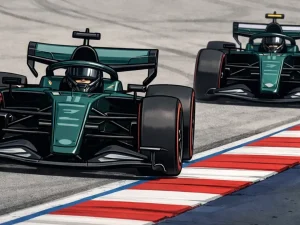
Aston Martin arrived in Melbourne talking up a clean-sheet start to 2026. By Friday night, the conversation in its garage had narrowed to something far more basic: how to stop the car shaking itself — and its drivers — to pieces.
Honda says it’s at least nudged the problem in the right direction. After free practice two at Albert Park, the manufacturer reported a reduction in battery-related vibrations on the AMR26 power unit, with the first countermeasures trialled on track after being developed on the dyno at HRC Sakura. It’s not a cure, but in a weekend already shaped by compromised running and an awkward shortage of batteries, it’s the first sliver of forward motion.
Shintaro Orihara, Honda’s chief engineer and trackside general manager, said FP2 finally gave the group enough mileage to judge whether its initial fixes were doing what the data promised.
“FP2 today was valuable for us, as we were able to see the effects of our countermeasures,” Orihara said. “With Lance and Fernando completing a combined 31 laps, we were able to gather the necessary data to determine that the items we implemented first on the dyno at HRC Sakura are working at the track.
“As a result, there are less battery vibrations occurring according to our analysis gathered during the session.”
Thirty-one laps between two cars isn’t exactly the sort of haul you want on the first Friday of a new era, especially when you’ve rolled out what Alonso described as a “completely new package” that needs basic set-up mapping. But that’s been Aston Martin’s reality so far: doing the jobs you can do, rather than the ones you planned to.
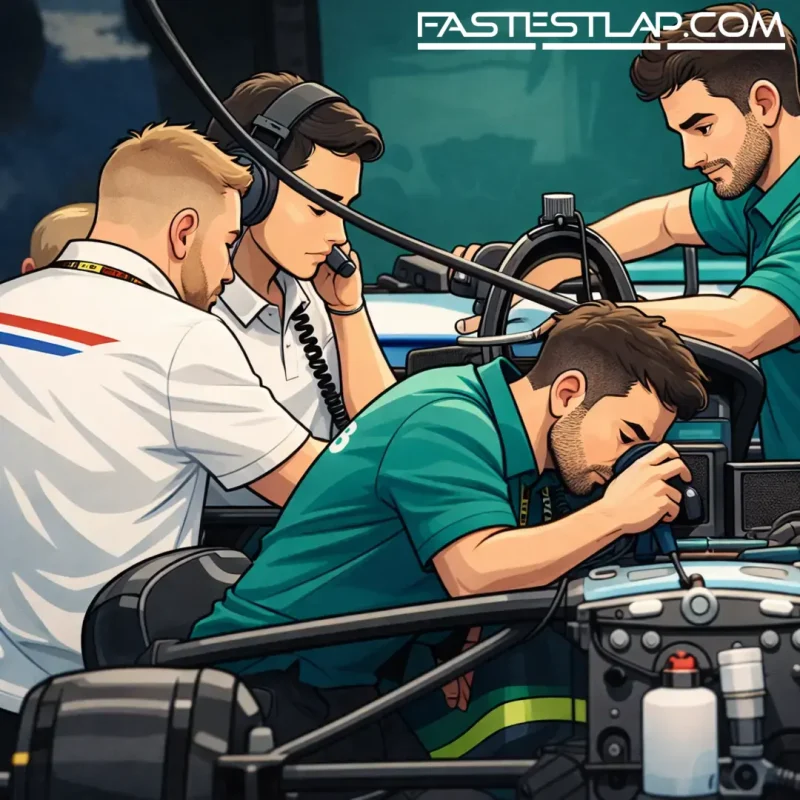
Orihara also detailed a messy start to the day. Alonso’s car hit a power unit issue early enough that Honda and Aston Martin tried to rectify it before FP1, only to run out of time, leaving the #14 parked while work continued. Stroll’s side wasn’t drama-free either; Honda identified an issue on his power unit and called him in to investigate, with changes made ahead of FP2.
Against that backdrop, the vibration update almost feels like a morale boost as much as a technical one. The stakes are uncomfortably human. Adrian Newey had been candid about the severity of what Alonso is feeling through the car — vibrations transmitted straight into the hands — and the team’s own concern that pushing beyond roughly 25 laps could risk lasting nerve damage. Alonso himself had previously described a “numb” sensation after longer runs.
Those are not the sort of comments you expect to attach to a modern F1 programme, and they’ve given Aston Martin’s first weekend of 2026 an edge of urgency that’s hard to miss in the paddock. When your limiting factor isn’t tyre life or energy deployment but whether the driver can keep feeling his fingertips, your priorities get reordered very quickly.
Honda insists the trend line is encouraging, albeit early. “Less” vibration is not “solved” vibration, and Orihara was careful not to oversell it. But in the context of a battery shortage that has already forced Aston Martin to be conservative with its track time, even incremental progress matters. It’s why those 31 FP2 laps were treated like gold dust inside the garage — not for lap time, but for evidence.
Alonso, as ever, didn’t dress it up. Asked about Friday, his verdict was blunt: the team simply didn’t learn enough.
“Yeah, not much learning, to be honest,” he said. “Unfortunately, the Honda issue in FP1 and some Honda issues as well in FP2, a little bit limited our number of laps today.
“Not needed again, because we need to recover a little bit in terms of understanding the car as well and the window of where this car operates. Obviously, we brought a completely new package into this race, and we need to understand where to run that package in terms of setup, and we didn’t manage too many laps today. Hopefully a cleaner FP3 tomorrow.”
That last line carries the quiet pressure of the situation. Aston Martin doesn’t just need more running; it needs running that’s representative, repeatable and safe enough to push into race preparation. Melbourne’s a circuit that can punish uncertainty, and this is the first qualifying of the new season — nobody wants to start 2026 already firefighting.
For now, the team will take Honda’s data point for what it is: confirmation that the first attempt at a fix has had an effect. The bigger question is how quickly “less vibration” can become “manageable over a full stint”, because unless Aston Martin can trust the car over distance, the weekend becomes an exercise in limitation — and the start of a season becomes an exercise in damage control.
FP3 will tell us whether Friday’s step is the beginning of a solution, or merely a brief easing of symptoms.