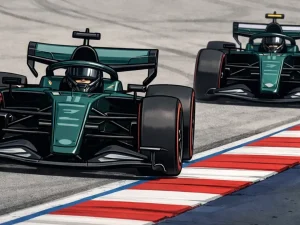
Aston Martin arrived at the first race of 2026 talking up ambition and infrastructure, but it’s turned into a very different kind of conversation once the covers came off. In the pitlane, the question hasn’t been whether the AMR26 is a dark horse — it’s whether it can simply string together representative running without something expensive and electrical deciding otherwise.
Martin Brundle didn’t sugar-coat it on Friday, warning that the scale of Aston Martin’s early-season power unit trouble is the sort that doesn’t get tidied up with a late-night fix and a few stern meetings. In his view, Aston Martin and Honda are staring at a timeline measured in months, not days.
“They’re between a rock and a hard place,” Brundle said ahead of FP1. “They’re in a very difficult position. The car didn’t exactly look like it was stuck to the road when it ran in Bahrain testing.
“Clearly it doesn’t have reliability, doesn’t have speed and the big problem they have is they’re the only team running on their engine.”
That last point is the one that really stings. New regulations always produce winners and losers early on, but there’s a particular cruelty in being a works outfit without any customer teams feeding back data, mileage, and failure modes. Mercedes-powered teams can collectively rack up kilometres and accelerate learning across different chassis philosophies and operating conditions. Aston and Honda don’t have that luxury right now, and Brundle pointed to the knock-on effect: if you’re not running, you’re not learning — and if you’re not learning, everything else gets compromised.
“Imagine how many kilometres Mercedes engine power unit teams did in testing,” he said. “So they’re not learning anything about deployment, about starts, about pit stops and everything sort of falls away.”
The backdrop to Brundle’s warning is an uncomfortable one for Aston Martin: Adrian Newey, now running the team, has been uncharacteristically blunt about where the finger points. The immediate practical headache is a restricted battery supply — Aston Martin reportedly down to just two for the weekend — paired with wider questions about whether the car can reach the 107% qualifying threshold if the running remains broken and interrupted.
There’s a particular irony in the way this is unfolding. Newey’s reputation has been forged on solving problems with clever design and ruthless iteration, but power unit troubles are a different species — especially when they start to dictate your track time and, by extension, your development direction. If you can’t validate aero or balance changes because you’re nursing hardware, you’re effectively engineering in the dark.
Brundle’s forecast was stark: “It’ll take them six months to begin to really turn that around.”
He even floated the idea — half as a grim joke, half as a reflection of how severe the situation looks — that a few extra weeks might be the most valuable “upgrade” Aston Martin could receive if early races were disrupted by world events. But he didn’t sound convinced that any such reprieve would materialise, and the subtext was obvious: this is going to hurt, and it’s going to hurt in public.
Jenson Button, working alongside Brundle, struck a noticeably more optimistic tone — while also caveating that it’s far too early to label it a full-blown crisis. Button’s view was that the start has been ugly, but not necessarily defining, and that Aston Martin has the foundations to muscle its way out of trouble given time.
“First of all, I think it is too early, definitely too early to call it a crisis,” Button said. “It’s just not been the best start for them.
“As Adrian said, they were on the back foot coming into this race anyway, or coming into the 2026 season. But they have everything to make this work. So it will work, it just takes time.”
Button also brought Fernando Alonso into the frame, noting the Spaniard’s lived experience of Honda’s difficult early days in the turbo-hybrid era — and, crucially, what Honda became later with sustained development. The patience Button is preaching, though, is easier to argue for from a commentary box than from inside a garage staring at curtailed run plans and a parts inventory being treated like it’s rationed.
Still, Button’s read on Aston Martin’s leadership was telling: he pointed to Lawrence Stroll’s backing and Newey’s presence as reasons to believe this will eventually turn into something formidable.
“It’s a bit about being patient, understanding your surroundings and understanding the leadership of this team, which is great with Lawrence and with Adrian,” Button said. “So I think it is going to happen. I think this team will be winning races — it’s just the painful part that they’re going to go through.”
That “painful part” is the bit Aston Martin can’t hide from. A new era doesn’t wait for anyone, and the midfield won’t offer sympathy while it’s picking up the points Aston is currently leaving on the table. The question now is whether this is simply an early-season struggle that looks worse because it’s happening under a spotlight — or whether Aston Martin’s 2026 has already become an exercise in damage limitation while others sprint ahead.
Either way, Brundle’s line about time is the one that will linger. Talent and budget aren’t the issue. The calendar is.