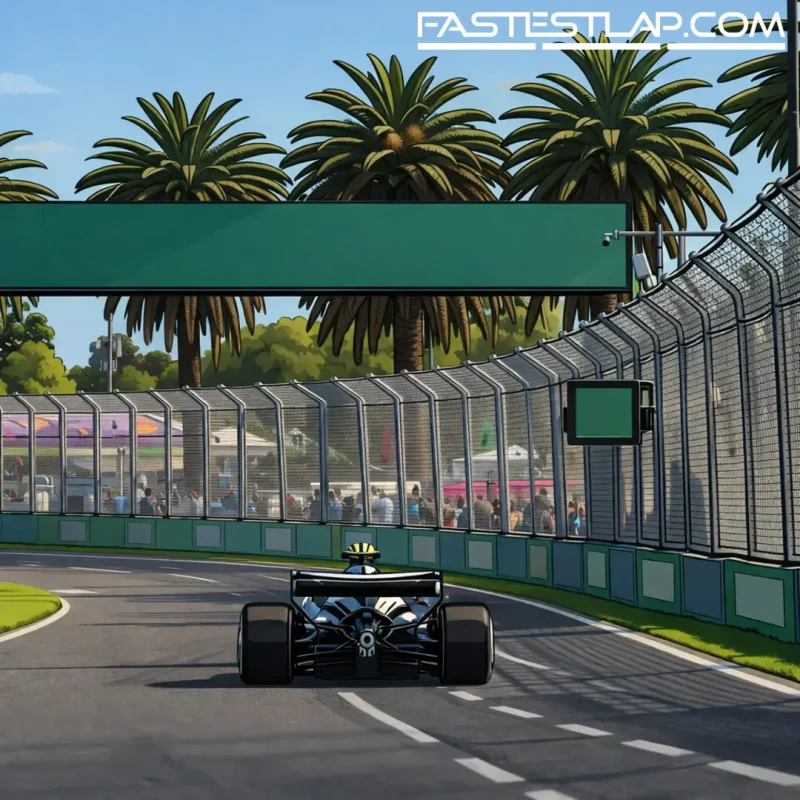
The FIA has pulled the pin on one of Albert Park’s new 2026 Straight Mode zones after drivers warned it was asking for trouble.
Following Friday night’s meeting with the grid in Melbourne, the governing body has removed the fourth Straight Mode activation area for the rest of the Australian Grand Prix weekend. The concern was straightforward: sending cars into the long, slightly curving run from Turn 6 through to Turn 9 with the wings flattened was leaving too little downforce on a section that already punishes any hint of instability — and it got worse in traffic.
That means drivers will now stay in Corner Mode down Lakeside Drive and arrive at the fast Turns 9/10 sequence with more aero load and a more predictable platform. In other words, the “bravery zone” has been toned down before it turned into something uglier.
FIA single-seater boss Nikolas Tombazis admitted the Melbourne layout choice had been on the aggressive side, and that the feedback from the cockpit carried weight once the numbers backed it up.
“We had a meeting yesterday with the drivers, and some expressed the concern that the downforce in that area was a bit too low, especially if they were fighting for position with other cars,” Tombazis said. “They felt they could risk losing control of the car in such conditions.
“As, of course, safety is number one for us, we decided, following some analysis, to err on the side of caution and to remove the fourth Straight Mode zone for here, for Melbourne.”
From a paddock perspective, it’s a revealing moment in year one of the new rules set: Straight Mode isn’t just a push-button overtaking tool, it’s a moving target, and teams are finding out in real time where the tolerances sit once 20 cars actually start running in anger.
Tombazis described the call as “draconian” — not because the FIA doubts the concept, but because the sport is still short on the sort of hard evidence that usually underpins these decisions. The FIA’s original placement logic revolved around three key parameters: the cars’ overall downforce level after winter development, how much of that downforce drops away in Straight Mode, and the aero balance shift created by the reduction — particularly how the front-to-rear relationship changes when the mode is engaged.
On that last point, the data set made for uncomfortable reading. Analysis from all 11 teams showed seven were running with less front-axle downforce than the FIA had anticipated when Straight Mode was activated. That’s exactly the sort of trait that turns a quick direction change into a lottery if you’re tucked up behind another car, coping with dirty air and a moving braking point.
The sequence in which this unfolded will also irritate a few engineers. Teams ran Friday practice with one aerodynamic and energy-management picture, then woke up on Saturday to be told it had changed. The FIA carried out further analysis overnight in Europe before teams were informed at 9:45am local time on Saturday — late enough to trigger a scramble, even if parc fermé restrictions don’t bite until later.
“Teams have to adjust the setups of the cars and have been running Friday in one condition, and they now need to make adjustments, so I’m sure there will be some who are not happy about that,” Tombazis said. “But we feel that obviously trying to put safety first.”
It’s not only a setup headache, either. The 2026 energy picture is already tight at Albert Park, and removing a Straight Mode zone changes the rhythm of how cars harvest and deploy. With Corner Mode maintained through that section, cars will reach Turn 9 at a lower speed, shortening the braking phase and trimming the window to recharge. That might sound marginal, but on a lap where energy management is a constant background calculation, marginal is the point.
The FIA did consider a compromise — shortening the Straight Mode zone rather than deleting it — but rejected it for this weekend. The implication is that the sport will need a more robust framework once more circuits throw up similar questions, rather than relying on late-weekend triage.
Albert Park is the first race of the season, and only one of four venues scheduled to feature a Straight Mode zone on a distinct curve. The Melbourne outcome doesn’t automatically doom the others, but it does underline what’s coming: the moment you place Straight Mode somewhere that isn’t a simple, straight-line blast, you’re balancing lap-time intent against stability, wake sensitivity, and the way these cars behave when they’re actually fighting.
For now, the FIA has sided with the drivers — and, realistically, with common sense. Melbourne has plenty of ways to punish over-ambition without the rulebook adding another.