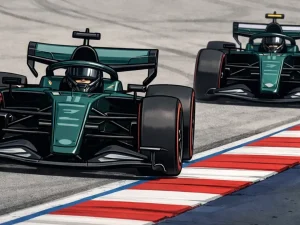
George Russell has started Formula 1’s 2026 ruleset the way Mercedes would’ve drawn it up in a boardroom: in control, unruffled, and comfortably quickest. At a jittery, incident-packed qualifying session for the Australian Grand Prix, Russell delivered pole position with a 1m18.518s — the first pole of the sport’s new technical era — while the big headline elsewhere was Max Verstappen failing to even see Q2 after a Turn 1 crash.
If Melbourne’s first proper competitive hour of the new regulations was meant to offer clarity, it mostly served up a warning: the margins are tight, the cars can still bite, and small system quirks can flip a weekend in an instant.
Russell looked fast from the moment the lights went green in Q1. His early 1m19.840s benchmark immediately put daylight between the Mercedes and the rest, and even as the usual names shuffled into position behind him — Charles Leclerc, Oscar Piastri — the impression remained that Russell had pace in hand rather than a lap in the locker.
Behind the scenes, though, the garage picture was messy. Kimi Antonelli was being patched back together after his FP3 crash, with Mercedes effectively running two different programmes at once: Russell chasing the top spot, Antonelli just trying to get a meaningful qualifying under his belt. Williams, too, was still at work on Carlos Sainz’s car after his final-practice stoppage, while Lance Stroll hadn’t turned a lap all Saturday because of an ERS issue.
Then Verstappen’s session detonated.
On his first flying lap, the Red Bull snapped into a spin at Turn 1. The rear appeared to lock, the car skated off, and Verstappen hit the barrier hard enough to bring out the red flag. Over the radio, the frustration was immediate and unfiltered: the rear axle had “locked” and that was that. More concerning was the moment afterwards, Verstappen shaking his right hand as he climbed from the car — a reminder that even relatively low-speed impacts can hurt when you’re braced against a steering wheel.
The red flag, ironically, arrived at a handy time for Mercedes’ second car. With 7:29 left on the clock when running resumed, Antonelli rolled out in a rebuilt W17 and joined the queue, immediately giving himself a chance to salvage what had looked like a lost afternoon.
At the sharp end, the times tumbled quickly once the track reset. Lewis Hamilton briefly went quickest before Piastri and then Russell reasserted the order, Russell’s 1m19.507s putting him back on top. Antonelli slotted in sixth — not spectacular, but vital progress given where his day had been.
For Verstappen, Sainz and Stroll, there was no such recovery: all three were out in Q1, along with Sergio Perez, Valtteri Bottas and Franco Colapinto.
Q2 did little to change the feeling that Russell had the measure of this place in the new-spec Mercedes. A 1m18.934s — the first trip into the 1m18s — put him six tenths clear again, with Piastri his closest early challenger and Antonelli initially third. Hamilton, meanwhile, found himself uncomfortably low after a mistake on his first run and had to reset with fresh tyres; Ferrari, too, looked slightly less convincing than it had in Q1, Leclerc only seventh before his later improvement.
But the strangest moment of the session came away from the timing screens. As the cars flowed down the pit entry at the end of runs, a slow Gabriel Bortoleto held up Liam Lawson, and Arvid Lindblad arrived on the scene with a closing speed that could’ve ended in a mess. Lawson darted left, Lindblad threaded past on the right, and everyone involved will have been grateful that modern F1 brakes still do their job even when the choreography doesn’t.
Bortoleto did the job on track — he was through to Q3 — but didn’t get to enjoy it. Audi reported a technical issue on the in-lap at the end of Q2, leaving him parked and unable to take part in the final shootout.
By the time Q3 arrived, the session had the brittle feel of a weekend still finding its feet. Piastri led the train out, backed off, and then the red flags flew again when pieces came off Antonelli’s Mercedes — apparently cooling fans used between sessions. Lando Norris hit the debris and immediately asked for checks on his front-left, McLaren giving the car a close look before sending him back out once the track was cleared.
Once it restarted, Russell went right back to business: 1m19.084s was half a second clear of Norris on the first serious runs, with Isack Hadjar impressively third. Leclerc, Piastri and Hamilton followed, while Antonelli had an off into the gravel and had to regroup.
The final runs were where Mercedes underlined its early authority. Antonelli — first out — fired in a 1m18.811s to briefly take P1, a statement lap considering his morning. Russell responded with the kind of reply that changes the tone in a garage: 1m18.518s, pole position, and a clean, emphatic start to 2026.
Hadjar held on to third for Red Bull, ahead of Leclerc and the two McLarens of Piastri and Norris. Hamilton ended up seventh in the Ferrari, not a disaster, but a reminder that the new season’s first qualifying didn’t hand out anything for free. Lindblad and Lawson locked out eighth and ninth for Racing Bulls, while Bortoleto was classified 10th without a time after Audi’s Q2 problem.
Antonelli, though, may not be finished with the stewards: he’s under investigation for a pit lane infringement and an unsafe release, which could yet shuffle the front row.
Still, the wider message from Saturday is hard to miss. While others fought the car, the clock, or simple misfortune, Russell and Mercedes looked like a team that arrived with a baseline it trusts — and in the first qualifying of the new era, that counted for plenty.