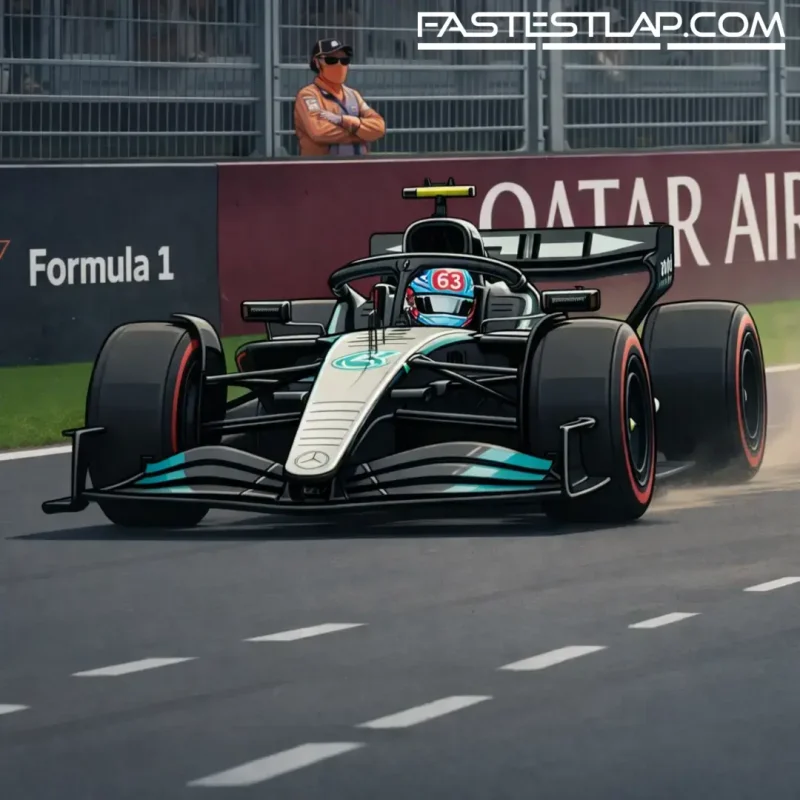
Mercedes didn’t just start 2026 quickly in Melbourne — it started like a team that’s had the answers for months.
On the first proper, no-excuses Saturday of the new rules era, George Russell put the W16 on pole position for the Australian Grand Prix, with rookie team-mate Kimi Antonelli completing a front-row lockout that felt equal parts statement and warning shot. It’s only qualifying, and the first race of the season hasn’t even been run yet, but the paddock always treats the opening competitive session as a truth serum. This one didn’t disappoint.
Russell’s lap had the calm, clinical feel of a driver who knows exactly where the car will be when he turns in — the kind of confidence you don’t fake in the first weekend of a regulation reset. Antonelli, thrown straight into the deep end, looked anything but overawed. Second on the grid in your first F1 qualifying of a new technical era is the sort of debut that changes the tone of a season inside a team. Mercedes will rightly play it down in public; internally, it’s dynamite.
Behind them, the most eye-catching name on the timesheets was Isack Hadjar. Third place on his Red Bull qualifying debut is a heavy marker, even allowing for the chaos that unfolded elsewhere in the session. It was tidy, committed, and — crucially — it looked repeatable rather than a one-lap lottery ticket.
Because while one side of the Red Bull garage had a breakthrough, the other suffered a meltdown. Max Verstappen was out in Q1 after an accident triggered by a rear-axle lock-up that sent him into the barriers. That’s the sort of error you associate with drivers fighting a car rather than flowing with it, and it’s hard to ignore the broader context: Verstappen has been sceptical of these regulations for a long time, and his first meaningful taste of them in anger hasn’t softened the stance.
He’s already framed the new direction as “not correct” for the sport — not as a heat-of-the-moment complaint, but as a continuation of an argument he’s been making for months. The crash won’t strengthen his case on paper, but it does give it an ugly visual to accompany the words: a four-time world champion looking like he’s wrestling something unpredictable when it matters.
And Verstappen isn’t remotely alone. If there’s been a consistent theme around Albert Park this weekend, it’s drivers trying to describe an F1 car that sometimes doesn’t behave like one. The new power units are engineering marvels, no question, but the driving experience has become a talking point in a way Formula 1 rarely enjoys. The sight of cars shedding speed and downshifting on straights is jarring — not because it’s inherently “wrong”, but because it looks and feels like the category is fighting itself.
Lando Norris was among the most blunt, arguing the concept of such a high electrical contribution — a 50/50 split in the power unit’s output — simply doesn’t mesh with the demands of these cars. He went further, describing the jump from what he considered the best F1 cars ever to the worst. That’s not a line you deliver lightly on the opening Saturday of a new era, and it underlines how quickly the romance of “fresh regulations” can evaporate when the cockpit sensations don’t match the sport’s self-image.
The interesting bit, though, isn’t just the grumbling. It’s what the grumbling implies about where performance might come from this year.
Andrea Stella offered a more pragmatic read from McLaren’s side, pointing to a likely “knowledge gap” between a works team and a customer when a brand-new power unit architecture arrives. In plain terms: Mercedes the manufacturer will understand how best to exploit Mercedes power before anyone buying it does. Stella’s view is that this gap is not only real, but potentially worth “a lot of lap time” as McLaren learns how to extract more from the package.
It’s a telling comment, because it frames Mercedes’ early edge as something more structural than setup luck or track fit. In a new era, the winners are often the teams that understand the grey areas first — energy deployment strategies, how to avoid the ugly power drop-offs, how to keep the car in its sweet spot without destroying the tyres or compromising the lap. If Mercedes has hit that window already, the rest aren’t just chasing downforce; they’re chasing know-how.
That’s why this qualifying result lands with such weight. A front-row lockout at the first time of asking is rarely “just” one weekend. It suggests integration — chassis, power unit, controls, driveability — that other teams may still be patching together. And if customer outfits like McLaren believe there’s sizeable time to be found simply by understanding the new PU better, it hints at a season where the biggest gains might come from laptops and dynos as much as wind tunnels.
Of course, it’s Melbourne. The first race will provide the next layer of truth, particularly on race pace and energy management when you can’t just throw everything at one lap. But the psychological picture is already developing: Mercedes looks settled; Antonelli looks ready; Hadjar looks like he belongs; Verstappen looks furious — at the car, at the regulations, and maybe at the fact the first punch of 2026 didn’t land from the corner he’s used to owning.
The sport wanted a reset. Albert Park has delivered one, loud and early.