Carlos Sainz hasn’t just had a miserable start to his Williams life in Melbourne — he’s already burning through the sort of power unit allocation you really don’t want to touch this early in a season.
After the FW48 stopped on Sainz’s installation lap in FP3 and never made it back to the garage under its own steam, Williams has fitted multiple new power unit elements ahead of the Australian Grand Prix. The Spaniard will start from P21, but the bigger concern is what this weekend has done to his 2026 “stockpile” before the championship has even had a chance to breathe.
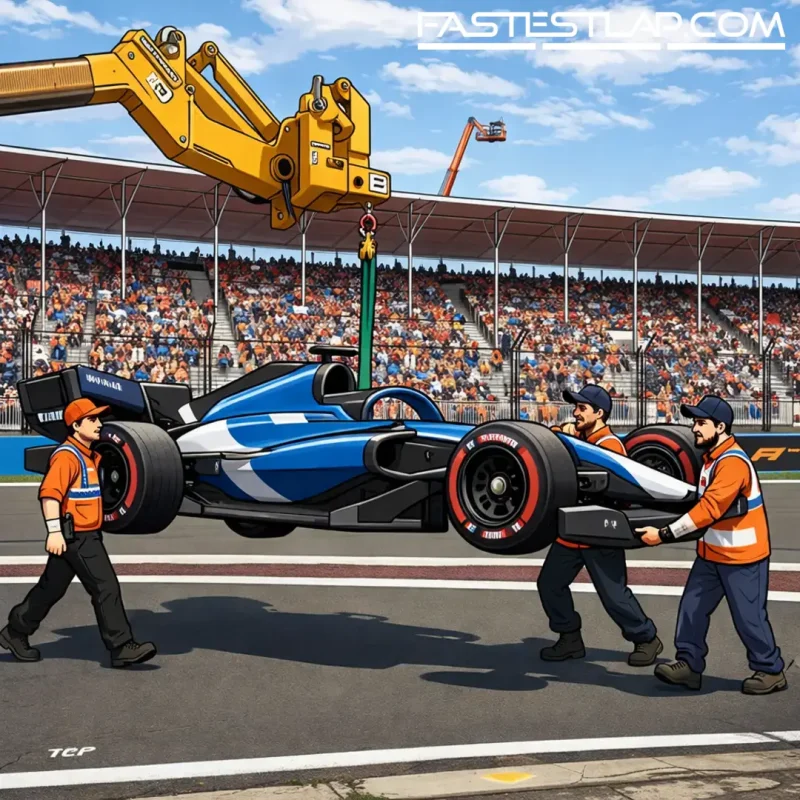
Sainz didn’t record a single lap on Saturday. He left the pits in FP3, lost power almost immediately, and coasted to a halt at the pit entry. The Virtual Safety Car came out as marshals reached the car, and it soon escalated to a red flag. While Sainz walked back down the pit lane, Williams’ engineers were left with the kind of headache that ruins not only a session, but an entire weekend’s programme.
With the car in need of diagnostics before any meaningful work could begin, the clock became the real enemy. Two hours after FP3, qualifying arrived — and Sainz was still a spectator.
“We had an ERS package issue and we didn’t manage to solve it in time for qualifying,” Sainz said. “No laps in FP2, no laps in FP3, no laps in Q1 so a very disappointing first weekend with this set of regulations.
“No FP2 long run, no FP2 run on softs, no FP3 laps, no Q1. Even going into China next weekend, not being able to do mileage this weekend and not being able to do a qualifying session for the first time is not ideal to start the year.
“It looks like a long year ahead of us so hopefully we can start sorting our issues.”
That last line lands with a little extra weight given what Williams has had to do since. The team has installed a new energy store, new control electronics and a new power unit ancillary component on Sainz’s car.
In allocation terms, the energy store (ES) and control electronics (CE) are now his second of the three permitted for the season. The ancillary component (AC) is also his second, although the rules allow six of those before penalties kick in.
It’s not a grid penalty today — but it’s how penalties start. Most seasons, even in stable regulations, become an exercise in planning your failures: when you can afford them, where you can hide them, and how you can stop one issue turning into three. With 2026 still in its first weekend and teams learning the quirks of a new era, that planning tends to get ripped up pretty quickly.
For Sainz, the immediate damage isn’t only the compromised Sunday. It’s the loss of mileage at the point he needs it most — early days in a new team, in a new car, in a new regulation set, with a power unit package that’s clearly not yet behaving itself. Those are exactly the weekends you want to bank clean running, because the learning compounds. Instead, he’s leaving Melbourne with nothing but questions and fresh components.
Williams will argue, reasonably, that reliability fixes now are better than limp compromises later. But there’s no way around the reality: using up your second energy store and second control electronics in round one is the sort of “insurance” that can come back with interest when the calendar gets busy and the margins tighten.
Sainz will start 21st for the grand prix, and at least he’ll finally get some laps on the board. Yet if this is what the opening weekend looks like, the story isn’t just about how far he can climb on Sunday — it’s about how many weekends Williams can afford to spend fighting its own car before the season starts fighting back.
Elsewhere in the power unit movements, Lance Stroll and Gabriel Bortoleto have also switched to their second PU-AC.