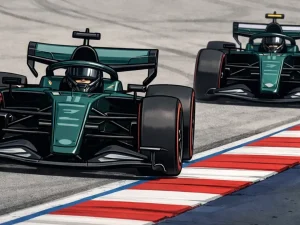
George Russell didn’t sound like a driver trying to play down a statement win. If anything, Melbourne left him almost puzzled by how much Mercedes found when it mattered — and how little everyone else did.
In the cooldown room after converting pole into victory at the 2026 Australian Grand Prix, Russell put it bluntly to Charles Leclerc: Mercedes’ rivals “screwed up” qualifying’s final segment. Not because Ferrari was secretly miles off, Russell argued, but because Q3 simply didn’t trend the way it normally does. The lap time jumps that usually come as the track rubbers in and drivers hook everything up… never really arrived for the rest.
“I think you guys screwed up Q3,” Russell told Leclerc, “because nobody really improved.”
It landed with the kind of half-smile you get when a driver isn’t sure whether to take it as banter, a compliment, or a needle. Leclerc’s response said plenty without needing to: “But, yesterday guys…”
Russell’s point, though, wasn’t that Ferrari had suddenly forgotten how to qualify. It was that Mercedes executed the one thing you cannot fake in the new era: nailing the window when the tyre is at its most sensitive and the car is at its most peaky. In a weekend where margins were expected to compress, Mercedes didn’t just lock out the front row — it did so by a margin that raised eyebrows up and down the pit lane.
Sunday was a reminder that a big qualifying advantage doesn’t automatically buy you a stress-free afternoon, even at a circuit where clean air helps. Ferrari had arrived from testing with a reputation for savage launches, and Leclerc delivered exactly that, catapulting from fourth on the grid to lead Russell out of Turn 1.
The start itself carried an intriguing detail. Leclerc asked Russell if Mercedes had an energy issue off the line. Russell confirmed both he and Kimi Antonelli effectively rolled off the grid with nothing in reserve.
“We both started on the grid zero per cent battery,” Russell said, referencing himself and his rookie team-mate.
Leclerc, who’d still managed to spring forward, replied that he had “a little bit more” than that — but not much. If there’s a theme emerging already in 2026, it’s that the margins in deployment and preparation are going to be brutally exposed the moment the lights go out.
For the opening phase, it was properly alive: Leclerc and Russell swapping track position as they leaned on each other’s strengths. Then the race’s strategic fork arrived with a Virtual Safety Car for Isack Hadjar’s stricken Red Bull.
Mercedes committed. Both cars pitted. Ferrari didn’t — leaving Leclerc and Lewis Hamilton out while the silver cars reset their race with fresh rubber.
On paper, you can argue either way. In reality, Mercedes got exactly what it wanted: control. Track position mattered, but so did tyre life, and Melbourne’s complexion made it hard for Ferrari to turn its earlier pace into a sustained threat once the pit cycles shook out. Everyone ultimately went one-stop, yet the fresher tyres Mercedes banked under the VSC were enough to blunt Ferrari’s ability to attack later.
Russell took the flag three seconds clear of Antonelli, with Leclerc 15.5 seconds back. That final gap didn’t tell the whole story — the early laps were combative and the race had moving parts — but it did underline the same uncomfortable truth Ferrari had felt since Saturday: Mercedes has a qualifying gear that, at least right now, isn’t being matched.
Russell, perhaps sensing the optics of a front-row lockout and a one-two, tried to reframe it in conversation with Leclerc.
“You guys weren’t slow. You were not slow,” he insisted.
Leclerc didn’t bite. The expression did the talking: sure, Ferrari wasn’t slow — but it also wasn’t where it needed to be when the grid was decided.
That nuance carried into Leclerc’s post-race comments. Asked whether he was “very pleased” with Ferrari’s pace compared to Mercedes, he resisted the temptation to sell it as a moral victory, even if the race pace offered encouragement.
“Very pleased is maybe a big word, but I am positively surprised for sure,” Leclerc said. “After qualifying yesterday, I think yesterday for sure we were not in our optimum window, but we are still very, very far off the Mercedes in qualifying.
“In the race, though, we seem to be closer… Doesn’t mean we are the fastest car, I don’t think we were, but we are a bit more reasonably behind.”
The more interesting part was what came next: the early-season read on how this championship will be decided. Leclerc wasn’t dressing it up as a two-team duel settled by driver brilliance alone. He sees a development race — and he’s almost certainly right.
“I think this championship anyway will be won by development and upgrades, and for that we need to be on it,” he said.
Melbourne, then, felt less like a definitive statement of season-long dominance and more like an early warning shot: Mercedes has started 2026 with a car that can produce a devastating lap when others can’t find theirs. Ferrari’s race looks competitive enough to keep the pressure on, but if it’s regularly conceding that much on Saturdays, strategy becomes more reactive than proactive — and you end up relying on VSC calls, traffic breaks and perfect starts just to stay in touch.
Russell can call it rivals “screwing up” Q3. Ferrari will call it missing the window. Either way, Mercedes left Australia with the points, the momentum, and the kind of qualifying advantage that forces everyone else into catch-up mode before the season has even properly found its rhythm.