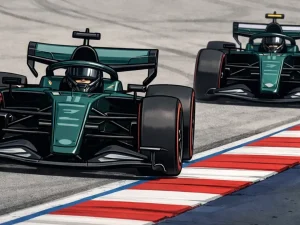
Melbourne was supposed to be the first proper stress test of Formula 1’s 2026 reset: new cars, new power units, new race-management headaches, and a grid still working out what’s “normal” now. Instead, the Australian Grand Prix doubled as a blunt reminder that you can change the rulebook and still end up with the same old problem if one team lands the opening hand cleaner than everyone else.
Mercedes didn’t just win the first race of the season — it made the win look repeatable.
George Russell emerged as the year’s first victor, taking control on lap 28 and never really letting it breathe from there. It’s his sixth grand prix win, but the bigger story was behind him: Kimi Antonelli followed him home for a Mercedes 1–2 that felt more like a statement than a surprise. Pre-season chatter had painted Mercedes as the benchmark, Ferrari briefly offered some early-race jeopardy, and then the pendulum swung back to where the paddock suspected it would.
Ferrari, to its credit, made the opening phase interesting. Charles Leclerc launched into the lead with the kind of opportunism you only get when a driver reads the start better than the pack and isn’t afraid to be a little cheeky with positioning. Lewis Hamilton slotted into third, giving red a genuine chance to pressure Mercedes in the first stint.
But the moment that will linger in Maranello isn’t the start — it’s the hesitation. A Virtual Safety Car window presented Ferrari with an obvious strategic fork in the road, and the team’s indecision proved costly. The irony is that nobody inside Ferrari sounded convinced the call alone decided the race; the prevailing view was that Mercedes had the underlying pace to win regardless. That’s not an excuse so much as an uncomfortable admission: even when Ferrari does the hard parts well, it still needs Mercedes to blink.
While Mercedes and Ferrari were arguing over tenths and timing screens, Oscar Piastri’s Sunday unravelled before it even began. Melbourne’s home favourite crashed on the reconnaissance lap — a gut-punch moment for the grandstands and a brutal way to start a season that McLaren will have targeted as a step forward.
Piastri’s explanation was as eyebrow-raising as the incident itself: a sudden surge of power, 100kW extra, arriving at exactly the wrong time and firing the car into the barriers. In a new regulatory era where everyone is learning the sharp edges of fresh systems, it was the sort of pre-start gremlin that teams dread because it raises the question: one-off, or symptom?
Max Verstappen at least got to turn his bad weekend into something watchable. Starting 20th and finishing sixth earned him Driver of the Day, and it was hard to argue — it was real racecraft, the kind that still cuts through even when the cars and rules are being debated in every media pen up and down the pitlane.
Yet Verstappen’s most consistent performance trait right now might be his scepticism. He left Melbourne still unimpressed with what 2026 is asking of the drivers and what it’s doing to the racing, framing it as not how he believes Formula 1 should look or feel. He wasn’t alone in that mood; he’s just the one saying it with the least varnish.
Aston Martin, meanwhile, had the kind of weekend you try to delete before the freight leaves the circuit. Both cars retired, and Fernando Alonso’s race in particular played out like an engineering debrief that accidentally went public. He vanished into the garage on lap 15, then reappeared 11 laps later — only to retire properly afterwards.
Alonso’s explanation was telling: the second stint wasn’t a heroic attempt to salvage points, but a data-gathering exercise to help the team understand and hopefully fix whatever it’s fighting. That’s where Aston Martin is right now — not racing rivals so much as chasing answers.
And hovering over all of it was the broader discomfort about the new regulations. Verstappen’s criticism has been loud, but it’s spreading beyond Red Bull’s corner. Carlos Sainz, now at Williams, labelled F1’s new Straight Line Mode “dangerous” and dismissed it as “a plaster” — not a solution, but a patch over a deeper issue.
That’s the subtext Mercedes will quietly enjoy: while others are still arguing about how the sport *should* work in 2026, Mercedes’ weekend suggested it already understands how it *does* work — and how to win under it. One race doesn’t make a season, but Melbourne rarely lies about the pecking order. If anything, it tends to understate it.
The rest of the grid will arrive at the next round with the usual talk of “learning” and “optimisation”. Mercedes will arrive with something more valuable: proof of concept.