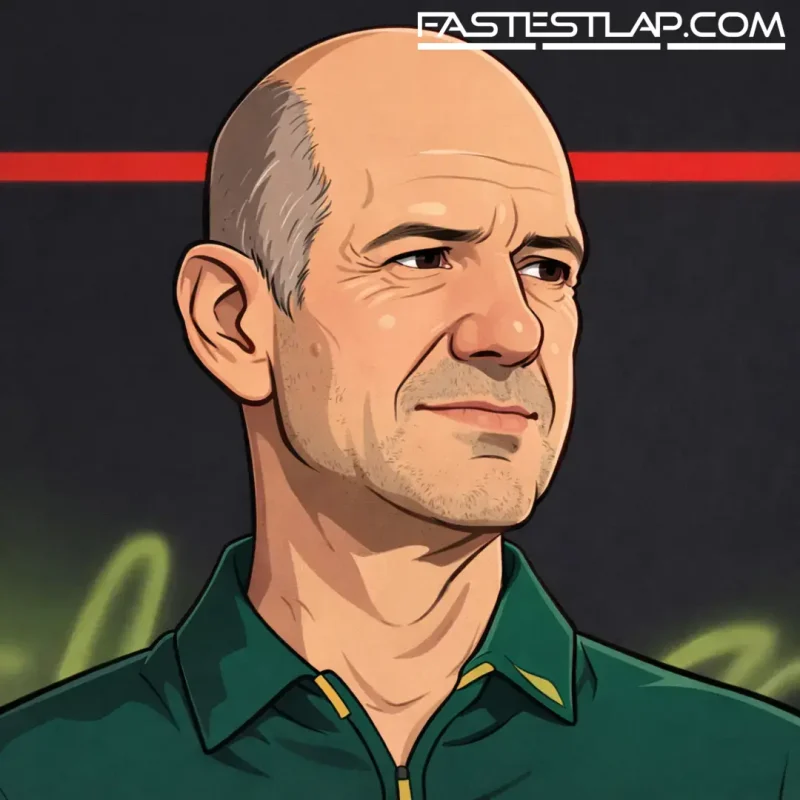
Adrian Newey doesn’t do subtle on a grand prix grid. While most team principals spend those final minutes before the start glued to timing screens or radio checks, Aston Martin’s new boss was doing what he’s always done best: walking the pitlane like it’s a design studio, eyes up, hunting for ideas.
In Melbourne, that curiosity took him straight to Nico Hülkenberg’s Audi R26.
Newey was spotted leaning in for a close look at the Audi on the Australian Grand Prix grid, with Mattia Binotto also hovering nearby as the car drew attention for all the wrong reasons. Hülkenberg ultimately didn’t even make the start, felled by a pre-race mechanical issue that left Audi’s debut weekend lopsided before the lights went out.
Still, the fact Newey made a beeline for it said plenty. Audi arrived in Formula 1 this season with a point to prove after taking over the former Sauber operation, and even in a weekend that didn’t fully come together, the car remains one of the more discussed pieces of hardware in the paddock.
That started in Bahrain testing, where Audi rolled out a B-spec chassis featuring a strikingly inventive sidepod concept. It was the sort of visible, high-conviction aerodynamic statement that gets noticed quickly in modern F1 — not because rivals can copy it overnight, but because it hints at the team’s direction and the compromises it’s chosen around cooling, flow conditioning and the car’s overall aerodynamic map.
Newey’s presence by the R26 in Melbourne felt like a continuation of a long-standing ritual. He’s never been shy about taking information where he can find it, and the grid remains one of the few places in a race weekend where you can still pick up unfiltered detail: how tightly bodywork is packaged, how suspension members are shaped, what’s happening around brake ducts and cooling exits, and — crucially in this new era — how teams are interpreting the regulations in the messy space between “legal” and “optimal”.
For Aston Martin, the timing is hard to ignore. The team’s season opener was grim: Fernando Alonso and Lance Stroll both failed to reach the chequered flag, capping a bruising weekend that has already been overshadowed by more fundamental worries. Newey admitted the drivers had raised fears of “permanent nerve damage” due to vibration concerns linked to the new Honda power unit — an alarming phrase to hear attached to any package, let alone one meant to be the cornerstone of Aston Martin’s long-term project.
It’s in that context that Newey’s grid-walk habit becomes more than paddock theatre. Aston Martin is trying to build a championship-level operation while simultaneously living through the teething pains of a new technical era and a new power unit relationship. When your own car is shaking your drivers to the point they’re talking about nerve damage, you don’t just need fixes — you need reference points. You need to understand who’s stable, who’s efficient, and who looks like they’ve made smarter mechanical and aerodynamic choices under the 2026 ruleset.
Audi, despite the early reliability gremlins, offered a useful case study straight away. Hülkenberg’s non-start was the headline, but Gabriel Bortoleto’s weekend provided the counterbalance: a qualifying reliability issue stopped him from reaching Q3, yet he recovered to finish ninth in the race and score Audi’s first Formula 1 points. That’s a quietly significant result in the first round of a debut season — the kind of “not perfect, but alive” weekend that suggests the underlying package has something to work with.
Newey has been doing this long enough to know that early-season form can be misleading. A car can be quick and fragile, slow and robust, or fast only under narrow conditions. But an innovative idea is an innovative idea, and the best technical leaders have always been the ones who can recognise when a rival’s concept has potential — even if it’s not yet delivering consistently on Sundays.
It also fits the broader pattern of where Newey’s attention has drifted lately. Last season, in his first trackside appearances with Aston Martin, he was repeatedly seen studying McLaren’s title-winning MCL39 — in Monaco, again at Silverstone, and later in Qatar. The same Qatar weekend also drew him toward Max Verstappen’s Red Bull RB21. That’s not random sightseeing: it’s a designer building a mental library of how the sharpest teams are solving the same problem.
Now, with Audi entering the arena and Aston Martin’s own start to 2026 already messy, that library matters more than ever.
The most intriguing detail from Melbourne wasn’t simply that Newey looked; it was what he chose to look at. When the sport’s most famous aerodynamic mind is taking a moment over a debutant’s car on the grid — in the middle of his own team’s crisis weekend — it’s a reminder that Formula 1’s competitive battle isn’t confined to lap time. It’s an arms race of interpretation, and Newey, as ever, is reading everything he can.