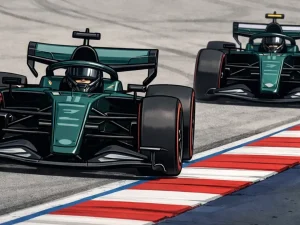
George Russell didn’t need much prompting to swat away Lando Norris’ early-season discontent with Formula 1’s 2026 machinery. Fresh off a controlled win in Melbourne, the Mercedes driver suggested the reigning world champion’s new-found scepticism might have more to do with McLaren’s Sunday than any fundamental flaw in the regulations.
Norris, who trailed home a distant fifth at the Australian Grand Prix – 51 seconds behind Russell – delivered a brutal verdict afterwards, calling the new generation of cars a slide from “best” to “worst”. His sharpest barb was aimed at what he described as increasingly artificial overtaking driven by battery deployment, and he doubled down by claiming the cars are “ever worse” in race trim compared to qualifying. In Norris’ view, the near 50/50 split between electrical and internal combustion power isn’t delivering the racing he wants.
Russell’s reply was pointed, and not especially sympathetic.
“If he was winning, I don’t think he’d be saying the same,” Russell said, turning the conversation from technical philosophy to the more familiar territory of driver self-interest.
There was more than a little paddock memory in Russell’s response, too. He reached back to the ground-effect era’s early pain points to make his case: when Mercedes were warning about porpoising and stiffness, Russell argued, the complaints were loud in some corners and mysteriously muted in others.
“We weren’t happy with how stiff the cars were last year and the porpoising, and everyone had a bad back and drivers were complaining about that, but McLaren drivers said there was no porpoising, even though we watched their car and they were porpoising,” he said. “So, you know, everyone’s always looking to themselves and we’re all selfish in this regard.”
It’s a classic drivers’ argument dressed up as a wider critique: the sport’s “problems” tend to become more urgent when you’re the one paying the price on lap time. Norris began this rules cycle relatively upbeat before swinging into the camp of vocal critics that already includes Max Verstappen. Russell’s counter is that it’s far too early to declare the experiment a failure after a single weekend that happened to expose McLaren more than Mercedes.
He also made the obvious point: 2026 is going to be track-sensitive. Melbourne, with its energy management demands spread across multiple acceleration zones, won’t define the year.
“It’s different, it’s definitely different,” Russell said in the post-race press conference. “But I think the interesting thing with these regs is every track we go to, they’re not always going to be like this.
“We’re going to Shanghai next where you’ve got one big, long straight, so the majority of drivers will be using their energy on that one straight. You don’t need to divide it up between four, like you do here in Melbourne.”
That’s not just a rhetorical flourish from the winner; it’s a warning against building a season’s narrative out of one circuit’s characteristics. If the energy deployment picture changes significantly from Melbourne to China, it will inevitably shift how “manufactured” the racing feels, and how much control drivers have in the moments that matter.
Russell’s broader frustration seemed to be with the way F1 debates circle back on themselves. When drivers are comfortable and tyre degradation is low, they complain the racing is poor. When the cars are harder to drive and the field is forced into more compromise, the product can look better — even if the drivers themselves enjoy it less.
“We’re 22 drivers,” Russell said. “When we’ve had the best cars and the least tyre degradation and when we’ve been happiest, everyone moans the racing’s rubbish. Now drivers aren’t perfectly happy and everyone said it was an amazing race. So, you can’t have it all, and I think we should just give it a chance and see after a few more races.”
There’s another layer here that Russell didn’t hide from: the competitive cycle between teams that now share key hardware. Last season, Russell noted, Mercedes and McLaren were running the same engine and McLaren “did a better job” and beat them. The early evidence of 2026 suggests the pendulum has swung the other way — and Russell’s not pretending that won’t influence how the protagonists talk about the new cars.
“The truth is last year we had the same engine as them and McLaren did a better job than us and they beat us,” he said. “Now McLaren have got the same engine as us, the same as Williams and the same as Alpine, and so far we’ve done a better job than them. So that’s just how the game goes.”
It’s a neatly unsentimental summary of F1’s eternal reality: regulations don’t hand out fairness, they hand out opportunity — and the teams still decide who looks like a genius and who looks like they’re driving “the worst cars ever”.
Norris will have his own reasons for speaking as forcefully as he has, and it’s not hard to see why a driver who’s used to being on the front foot might bristle if the new tools don’t allow him to race the way he wants. But Russell has landed the first meaningful punch in what could become one of 2026’s recurring subplots: whether the sport’s loudest critics are responding to genuine structural issues, or simply to the discomfort of being beaten.
The next stop in Shanghai should, at the very least, give the grid a different set of problems to argue about.