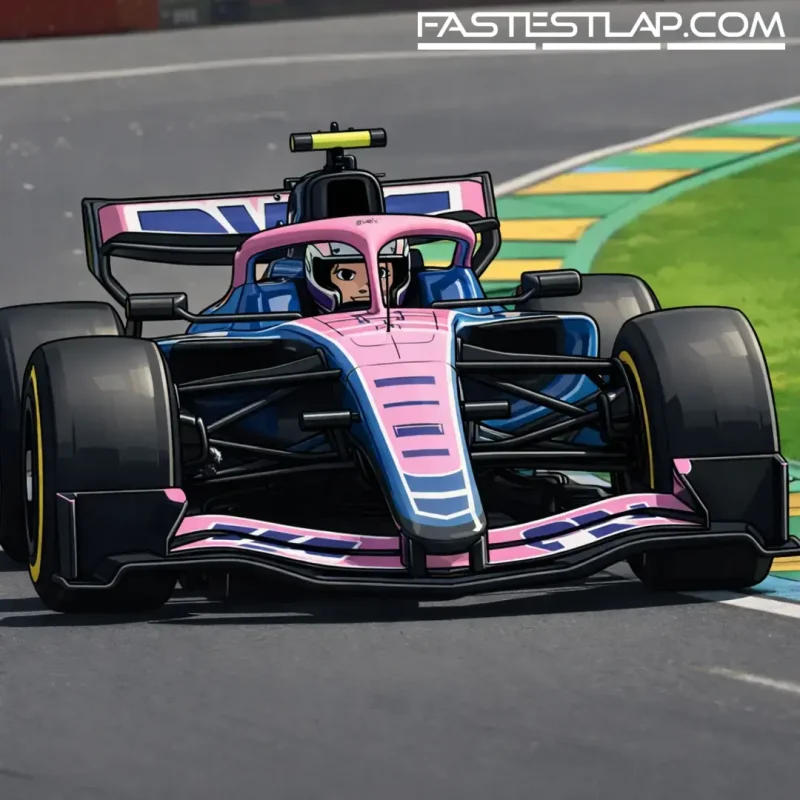
Alpine didn’t just turn up to 2026 with a better car. It turned up with a different posture — less “hang on and hope” and more “try us.”
That shift was on full display at Suzuka, where Pierre Gasly spent more than 25 laps staring at an increasingly impatient Max Verstappen in his mirrors and simply refused to blink. Sixth place might not sound like a revolution in any other season, but context is everything: 12 months ago Alpine was marooned at the back, and now it’s scrapping on merit with a team that’s spent the last few years treating the midfield like furniture.
The uncomfortable truth for much of 2025 was that Alpine had already mentally left the old rules behind. The car was uncompetitive, the returns on development were tiny, and the team made a call that looked borderline defeatist from the outside: stop chasing the crumbs and bet everything on the reset. It made for a grim year — a handful of minor points mainly through Gasly’s nous — but there was at least a coherence to it. Alpine wasn’t “failing to catch up”; it was choosing not to fight yesterday’s war.
Steve Nielsen, operating as managing director in the wake of further organisational change after Oli Oakes resigned early last season, didn’t hide from how bruising that looked. At the end of 2025, he openly acknowledged the mismatch between Enstone’s infrastructure and what it had been putting on track. That’s the kind of line you deliver when you know excuses have expired.
What’s changed in 2026 is that Alpine’s big decisions have started paying back quickly — and loudly. Renault’s works power unit programme is gone, and Alpine is now a Mercedes customer. For a team trying to stabilise, it’s the safe kind of “boring” that engineers adore: a proven platform, reliable baselines, and no energy being burned just to stop the thing being a handicap. Last year the paddock chatter had Alpine’s engine deficit to the best units sitting around an ugly seven-tenths. No amount of aero genius makes that go away.
The early evidence suggests the new approach has pulled Alpine out of its own gravity. After three rounds, it sits fifth in the standings — and it doesn’t feel like a flattering points haul built on chaos and safety cars. In Shanghai, Franco Colapinto’s weekend was strong enough that he came away annoyed at “only” being 10th, after contact with Haas driver Esteban Ocon dropped him back from a fight that had looked closer to sixth. That’s the real tell: expectations inside the cockpit have changed.
And Gasly? He’s been razor-sharp. Points in all three grands prix, and crucially he’s doing it without the usual asterisk of “best of the rest because everyone else tripped over each other.” He’s also, at this moment, the only driver outside Mercedes or Ferrari machinery to have scored in every race so far — a stat that underlines just how immediately usable Alpine’s A526 is across different weekends.
Suzuka was also the first proper snapshot of Alpine’s 2026 development direction. Nielsen has been blunt about where the car still bites: high-speed changes of direction, presenting as high-speed understeer — precisely the sort of limitation that gets exposed in Suzuka’s first sector and tends to make a driver feel like they’re negotiating with the front axle rather than controlling it.
Alpine brought revisions aimed at cleaning up that operating window: a redesigned front deflector for more consistent performance delivery, and rear wing endplate changes to improve local loading and airflow conditioning. It’s not the sort of upgrade package that makes for glossy launch videos, but it’s the kind that matters when you’re trying to turn a “good in two corners” car into one that behaves for a full lap.
Gasly qualifying seventh and racing to sixth felt like the natural result of a car that’s fundamentally in the fight, rather than one that’s dragging itself there. The Verstappen duel was the headline — and it should be. Alpine didn’t need fortune; it needed execution. Gasly didn’t cave, didn’t overheat his tyres into a mistake, didn’t compromise his exits into the places Suzuka punishes you. Verstappen, for his part, noted Gasly’s speed afterwards — and you don’t tend to get charity compliments from a driver who measures weekends in trophies.
Flavio Briatore, now hovering with influence over the operation, has essentially said the quiet part out loud: Alpine’s target is to be ahead of Audi if possible and close to Red Bull if possible. That’s not a title pitch; it’s a statement of where Alpine believes the real battle sits once you accept the current “top four” are operating on their own layer. Still, even talking about Red Bull as a reference point — not a distant lighthouse, but an opponent you can occasionally beat — would’ve sounded absurd during the bleakest parts of last year.
There is, of course, a looming question behind the optimism: can Alpine keep up once the development war gets properly vicious? Red Bull has resources, depth, and the institutional habit of out-developing people over a season. Alpine’s early leap could be partially explained by the Mercedes power unit and a clean-sheet focus that started earlier than rivals. None of that guarantees it stays ahead when the big hitters start firing upgrades every other week.
Nielsen, wisely, isn’t selling timelines. He’s never liked the neat “100-race plan” soundbites. His view is more old-school and arguably more realistic: put the right people in the right seats, align the organisation, and grind — accepting that modern F1 is rarely turned around on a schedule you can print on a PowerPoint slide.
What Alpine does have right now is momentum, and that can be worth more than a few tenths. Williams and Aston Martin have left openings early in this new cycle, and Alpine’s closest day-to-day rivals look like other customer outfits such as Haas and Racing Bulls. In a tightly bunched midfield, the fact the Mercedes unit appears to be the class of the field could become a decisive advantage — but only if the chassis keeps evolving rather than plateauing.
Gasly sounded like a driver who trusts his tools again. He talked after Japan about the car “working on all types of tracks”, and that’s the kind of sentence drivers only offer when they’re no longer bracing themselves for a different weakness every Friday.
For now, Alpine isn’t asking anyone to believe in miracles. It’s just making itself a problem — and after 2025, that alone is a hell of a turnaround.