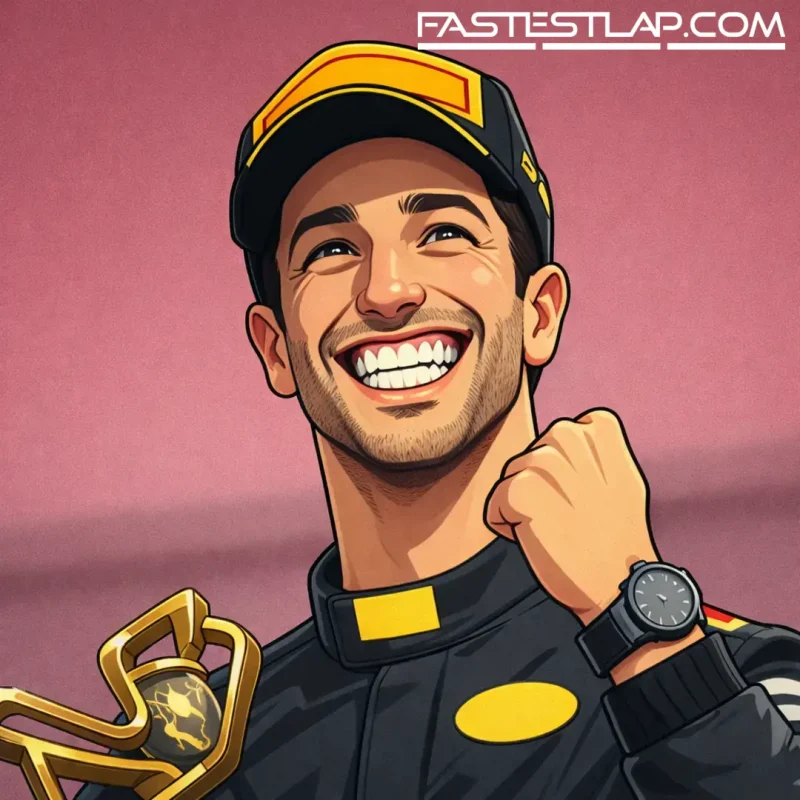
Daniel Ricciardo has never lacked for self-belief. It’s part of what made him so watchable at his peak — the late-braking swagger, the grin that could fill a paddock, the sense that if you gave him a sniff of an opening he’d take your lunch money and say thanks on the radio.
But as Formula 1 rolls on into 2026, Ricciardo’s reflections on the way his career ended are striking precisely because they’re stripped of the usual protective layers drivers wrap around themselves. He’s not dressing it up as unfinished business. He’s not hinting at a comeback. If anything, he sounds relieved that someone else finally took the decision out of his hands.
“Ultimately, I got let go,” Ricciardo said on Ford CEO Jim Farley’s podcast, describing the late-2024 call by Racing Bulls to replace him. “That was the reality at the time.”
In F1, endings are rarely tidy. Teams prefer to frame them as “moving in a different direction”, drivers prefer to talk about “new chapters”. Ricciardo didn’t bother with any of that. He put it in the blunt terms every driver understands: you’re in or you’re out, and in his case it happened twice in quick succession.
Once Racing Bulls made the move, Ricciardo admitted it landed on top of the emotional residue of the previous split — his premature exit from McLaren, and the long, public attempt to rebuild his standing after it. “I think once that happened, I’d been let go twice in the last two years, and it had also taken a lot out of me,” he said. “I’d put a lot of my soul into it. I was pretty exhausted by it.”
That context matters, because Ricciardo’s post-Red Bull years weren’t just a sequence of contracts; they were a sequence of bets. Walking away from Red Bull Racing at the end of 2018 — after seven grand prix wins as a senior driver — was a bet on himself. He felt the internal balance had tilted unfairly toward Max Verstappen, the “new hot-shot” on the rise, and he didn’t want to spend the next phase of his career as the second narrative in his own garage.
Renault was the next wager, and even there, as Ricciardo acknowledged by the timeline of his own choices, he pivoted quickly: one year into a two-year deal and he’d already committed to McLaren. That move was sold as a route back to the front, a chance to reboot in a team on the climb. Instead, it became the most stubbornly difficult period of his career — the kind where you keep telling yourself the next upgrade, the next reset, the next weekend will be the one that makes it click, until you wake up one day and realise you’ve been saying that for months.
By the time he returned to Red Bull, the romance of the reunion came with a caveat. Christian Horner publicly admitted he “did not recognise” Ricciardo’s driving style anymore, pointing to “bad habits” picked up at McLaren. That’s a brutal thing for a team principal to say about a driver who’d once been the face of the organisation’s freewheeling era — and it also told you exactly how Red Bull viewed the comeback: not as a coronation, but as a trial.
The lifeline was a seat at Racing Bulls, the junior outfit where Ricciardo had first come through. Even that return was interrupted: he suffered a hand injury at the 2023 Dutch Grand Prix, and when he did get back into the car, the comeback never quite became the storybook revival. He drove eight races, stayed on for 2024, and then the decision came that so many drivers fear and so few can avoid forever — someone in a meeting room decided it was over.
What Ricciardo is saying now, with the distance of time and the calm of a life not organised around Sunday afternoons, is that he’s glad he didn’t have to make the call himself.
“In reflection, I was grateful that they made the decision for me,” he said. “I think it would have been hard to be like, ‘I’m done.’”
Drivers are conditioned to interpret doubt as weakness. The entire profession rewards the ability to override warning signs — physical, mental, competitive — and keep turning up. That’s why Ricciardo’s admission lands: he’s talking about the quiet erosion that happens when the peak version of you becomes harder to access.
“I think I knew I was probably done because I knew it was harder for me to perform at the level I could,” he said. “For whatever reason, I lost a little bit of something, and it’s okay to admit it.”
That “something” is the part nobody can quantify: the razor-edge commitment that lets you brake five metres later, the instinct to throw the car into a corner without bargaining with yourself, the confidence that survives a bad Saturday and still expects a good Sunday. Lose a fraction of it and the sport doesn’t meet you halfway. It just moves on.
Ricciardo described leaving the Singapore paddock that night — the last driver to go — and arriving at the realisation that support, however well-meaning, can become background noise if it keeps you from being honest.
“There’s people that love you and will still tell you that you’re great and you can do it,” he said. “But as much as you love them as well, you need to just close the door and make that decision on your own and be really honest with yourself.”
He admitted that even if he’d reached the end of that year on his own terms, the same internal conversation would’ve been waiting for him anyway. “If I would have got to the end of last year, I think I would have still had a lot of these thoughts… because I knew it was becoming harder for me, and I had to dig really deep to pull out a result that I was proud of.”
That’s the line that sums up the final phase better than any statistical recap ever could. It wasn’t that Ricciardo stopped caring; it’s that caring wasn’t enough to make it feel natural again.
“Last year, my retirement year, I gave myself a lot of time to just reflect on my career and to be at peace with it,” he said.
There’s a temptation in F1 to treat a driver’s exit as either tragedy or failure, especially when the peak was as bright as Ricciardo’s. The more honest reading is simpler: the sport took what it needed from him, he took what he could from it, and eventually the exchange stopped making sense.
And for once, a driver is admitting that out loud — not bitterly, not defensively, just as a fact. In a paddock built on denial, that kind of clarity is its own rare victory.