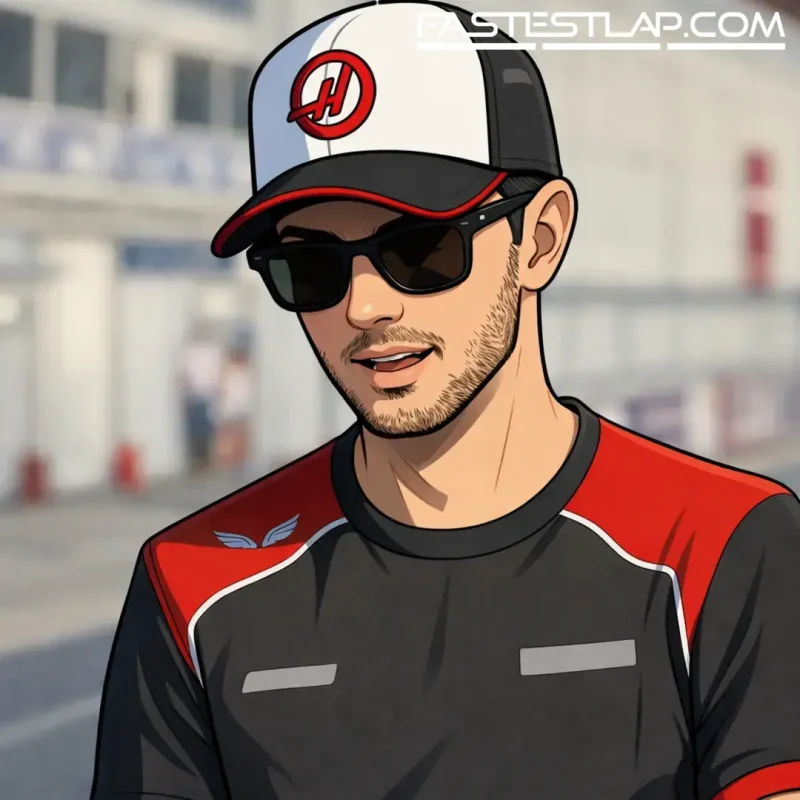
Esteban Ocon doesn’t talk like a driver who’s ticking off a comfortable Formula 1 career. He talks like someone still measuring himself against a very different expectation — and coming up short.
In Melbourne at the season-opening 2026 Australian Grand Prix, the Haas driver was asked whether he’d imagined he’d be a world champion a decade into his time on the grid. Ocon didn’t hesitate. “Yeah,” he said, before quickly pivoting to the part that clearly matters more to him: what he feels he hasn’t done.
He’s proud of what’s on his CV — and he should be. Ocon is a grand prix winner, with three more podiums to his name, and he’s been around long enough to have seen how thin the margins are between a career that pops and one that quietly plateaus. But he’s also blunt about the numbers. One win from roughly 180 starts, in his own words, “to my standard, it’s disappointing so far.”
That’s the line that sticks, because it’s not a complaint about bad luck or a deflection onto machinery. It’s a driver publicly setting his own bar higher than the paddock often does for him.
Ocon’s background has always suggested a different trajectory. He came into F1 in 2016 with Mercedes backing and a junior record that, at the time, carried real weight — titles in European Formula 3 and GP3, and a European F3 crown that came ahead of Max Verstappen back in 2014. In the years since, Verstappen has become a four-time world champion. Ocon has had to build his career the harder way: fighting for relevance in teams that were rarely in position to offer it consistently.
He did take his moment when it arrived — that breakthrough win for Alpine at the 2021 Hungarian Grand Prix — but that hasn’t been enough to quiet the sense of unfinished business. “I’ve won in every category that I’ve driven in the past, apart from DTM maybe,” he said, referencing his short spell there, “but from karting to single seater, I’ve won everywhere. And yes, I’ve won one race in F1, but it’s not enough.”
The timing of that honesty is interesting, because Ocon is now in the phase of his career where the paddock starts making quiet decisions about you. Not loudly, not in press conferences — but in the way expectations shift and opportunities narrow if results don’t keep pace with reputation.
His move from Alpine to Haas ahead of 2025 was supposed to be a reset: new environment, a team looking to push itself forward, and a chance to reframe his value around leadership and execution. Instead, the opening year didn’t land cleanly. Ocon was narrowly outscored by rookie team-mate Oliver Bearman across the 2025 season, and Haas team principal Ayao Komatsu admitted publicly that the team “expected more” — even while taking on “half” the responsibility themselves.
Fast-forward three rounds into 2026 and the split is stark. Ocon has one point. Bearman has 17.
That’s not a fatal story in April — plenty of seasons swing with one upgrade, one technical direction finally clicking, one run of clean weekends — but it does frame why Ocon sounds the way he does. This isn’t just a driver reflecting on the past. It’s a driver who knows he needs the next chapter to arrive quickly.
There’s also something revealing in the way Ocon describes his own standards. Drivers who’ve made peace with being “solid” in F1 don’t tend to count starts and measure return so clinically. Ocon does, and it suggests he still sees himself as someone who should be fighting for more than points and the occasional Q3. He’s not chasing validation; he’s chasing the kind of career that matches what he was told — and what he told himself — was possible when he arrived.
“I hope that this will change in the near future,” he said. “But I will work hard for that to change.”
That’s the only part of the quote that sounds like typical driver speak, but even there, you can hear the edge. Because in Formula 1, “work hard” isn’t the differentiator; everyone does. The difference is whether your circumstances ever meet your ability at the right moment — and whether you’re ready when they do.
Ocon has already shown he can win a grand prix when the door opens. The question, now that he’s in Haas colours and staring at another season that could drift away, is whether that door opens again — and whether he can kick it down rather than slip through it.