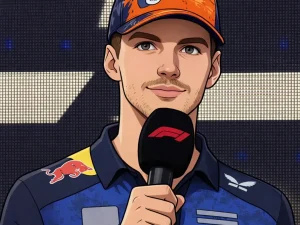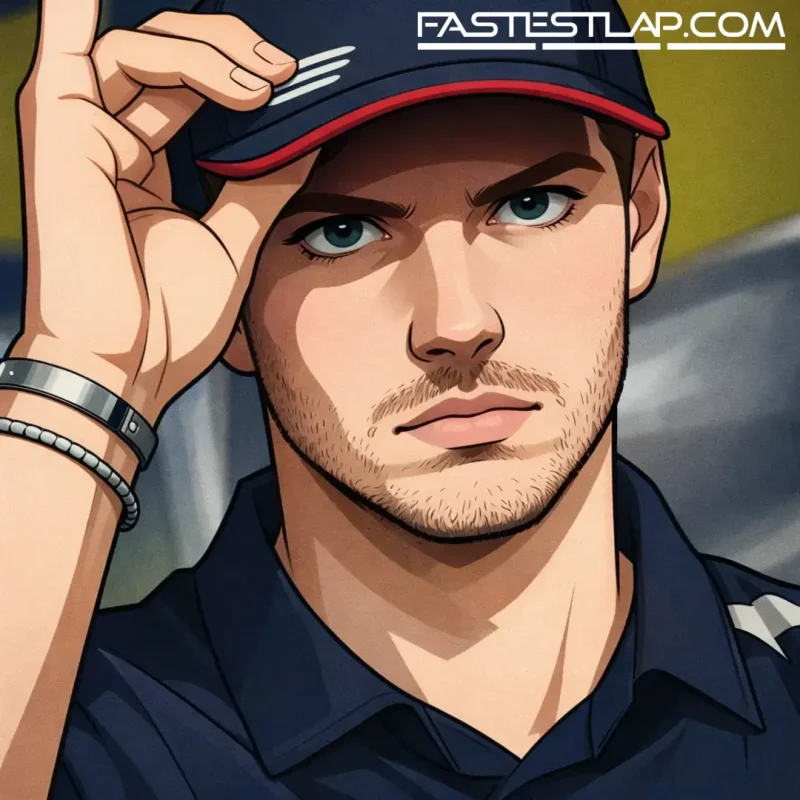
Martin Brundle didn’t so much push back on Max Verstappen this week as roll his eyes at him.
On Sky F1’s *The F1 Show* podcast, Brundle said he’s become “bored” of Verstappen’s persistent criticism of Formula 1’s 2026 regulations — and suggested the four-time world champion is doing the sport “damage” by continuing to air his discontent so publicly. The subtext was clear enough: either crack on, or stop threatening the door.
It’s a familiar dynamic whenever F1 hits a regulatory reset and the first few races don’t quite land as promised. The difference this time is that Verstappen’s complaints aren’t dressed up as a driver in a bad car moaning about his lot. He’s been at pains to separate performance from experience — insisting his issue is the way the new cars want to be driven, not where Red Bull happens to be on a given Sunday.
That’s why the Brundle-versus-Verstappen exchange matters. It isn’t really about one driver being “negative”; it’s about who gets to frame the narrative around 2026’s early growing pains — the world champion who’s living it at 300km/h, or the broadcast voice telling him to keep it down.
Brundle’s core point is one the paddock has always understood: drivers are happier when they’re winning. “The drivers’ love and comments are directly proportional to how their cars are going at the moment,” he said, adding that those further from the front tend to be more “vociferous”.
He also acknowledged Verstappen’s extraordinary level — “generational speed and car control” — and admitted he’d “hugely miss” that talent if it left the grid. But the patience ran out quickly. Brundle’s message to Verstappen was blunt: “Either go, or stop talking about it.”
The irony is Brundle isn’t exactly pretending everything is perfect either. In the same breath, he conceded the new package needs work — cars that are “more linear to drive”, less reliant on “AI, algorithms, and other things going on underneath”; battery deployment shared “better around the lap”; overtakes that aren’t quite so “battery-driven”. That’s not far from the territory Verstappen’s been staking out since he first ran the RB22 at the Barcelona shakedown in January, and then called the rules “anti-racing” during Bahrain testing.
Where they diverge is in method. Brundle painted Verstappen as the modern opposite of a Michael Schumacher-style operator: the kind of champion who, in Brundle’s telling, would close the door, “thump the desk”, apply pressure internally — and only then smile for the cameras until the situation changed. Verstappen, by contrast, is unfiltered and public, and that openness is what Brundle thinks crosses the line from critique to collateral damage.
There’s also a second strand running through Brundle’s comments: the sport’s institutional shrug. He made the point that nobody is indispensable, namechecking the next wave — Antonelli, Bearman and Lindblad — as evidence the grid will replenish itself at a fraction of the cost. If Verstappen walked, F1 would move on. It always has.
That’s true, in the coldest business sense. But it’s also a remarkably convenient argument for a championship trying to sell a new era while its most bankable competitive force keeps telling anyone with a microphone that the product isn’t fun to drive.
After the Japanese Grand Prix, Verstappen told the BBC his frustration isn’t rooted in expectation management. He can live with finishing seventh or eighth, he said, because he’s “very realistic” about cycles in F1. What he can’t stomach is feeling detached from the act of driving.
“When you are in P7 or P8, and you are not enjoying the whole formula behind it, it doesn’t feel natural to a racing driver,” Verstappen said. “Of course, I try to adapt to it, but it’s not nice the way you have to race. It’s really anti-driving.”
That word — *anti-driving* — is the sort of phrase that makes broadcasters wince and promoters grind their teeth, because it’s hard to spin away. Verstappen went further in a separate interview with Jennie Gow, explaining that when the core experience stops being enjoyable, the rest of the lifestyle stops justifying itself.
“I want to be here to have fun, have a great time and enjoy myself. At the moment, that’s not really the case,” he said. “I enjoy working with my team… But once I sit in the car, it’s not the most enjoyable, unfortunately.”
The sport’s response so far has been to point to process: meetings, commissions, advisory committees. There are ongoing discussions at the F1 Commission and the Power Unit Advisory Committee to evaluate possible improvements. Brundle even nodded to the idea of change on the horizon, suggesting Miami is a moment people are “looking forward to” in terms of sorting it out.
But telling Verstappen to either shut up or leave isn’t a solution — it’s an attempt to change the tone, not the substance. And it risks misunderstanding what makes Verstappen’s critique uncomfortable: it’s credible precisely because it doesn’t read like leverage for a better contract or a tantrum at losing. He’s a driver who spends his free weekends racing other things because he likes racing. If *that* guy is telling you the new flagship formula feels wrong, you probably want to hear him out — even if it’s repetitive, even if it’s inconvenient, even if it lands with a thud in the middle of your shiny new era.
Brundle is right about one thing: Formula 1 will survive without Verstappen if it has to. It always survives. The better question is what it says about these regulations if they’re capable of making an in-his-prime champion seriously weigh up whether the trade-offs are still worth it.
Because if Verstappen does eventually decide he’s had enough, the “damage” won’t be the interviews. It’ll be the silence that follows.