Red Bull didn’t build its first fully in-house Formula 1 power unit to be asking the FIA for a helping hand four races into the new era. And yet, that’s exactly the awkward little reality sitting beneath Laurent Mekies’ otherwise upbeat readout of where Red Bull Powertrains (RBPT) stands as 2026’s pecking order starts to harden.
Speaking in Japan, Mekies made it clear he expects RBPT to fall on the right side of the FIA’s Additional Developments and Upgrade Opportunities (ADUO) “safety net” at the first checkpoint of the season — the mechanism designed to stop the new power unit formula turning into a multi-year procession. In plain terms, if your internal combustion engine performance index is more than two per cent off the leading unit, you’re allowed an early upgrade outside the normal homologation cadence. More than four per cent off, you get two bites at the cherry.
The first checkpoint remains pegged to the post-Miami point in the calendar, even after the cancellation of Bahrain and Saudi Arabia shifted Miami to round four. That matters, because any ADUO allocation issued at that point can be cashed in immediately for the next upgrade window — which begins at the Canadian Grand Prix.
This is where the politics and the messaging get interesting.
RBPT’s debut has been framed, in paddock conversation and by Red Bull’s own mood, as a genuine success: competitive out of the box, broadly reliable, and not the obvious culprit for a car that’s been skittish enough to leave its drivers fighting the thing rather than exploiting it. Mekies even leaned into that broader view when asked what’s holding Red Bull back right now.
“In terms of criticality, we don’t think there is one area in particular that is lacking. We think it’s across the board,” he said. “So it’s chassis, it’s PU, it’s everything.”
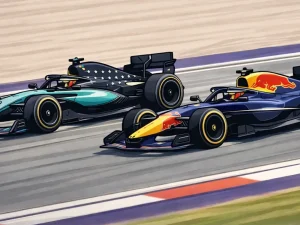
But then came the line that will have rival manufacturers raising an eyebrow: “We think Mercedes is clearly ahead. Hence, with them being clearly ahead, we expect to be in the group of guys that will get ADUO.”
That’s a neat encapsulation of the tension baked into ADUO. The system exists for those who are genuinely behind — yet nobody in F1 likes publicly admitting they’re behind. Even less so when you’ve spent the last half-decade building a power unit programme that was supposed to protect you from being at the mercy of anyone else’s hardware. RBPT qualifying for ADUO would be both a validation of the FIA’s fear (that someone would start 2026 with a clear advantage) and an uncomfortable reminder that autonomy doesn’t guarantee parity.
Mekies, who inherited the project leadership after Christian Horner was removed from his roles midway through 2025, was careful not to drill into specifics on where the deficit might be. He pointed, fairly, to how hard it is to read the true hierarchy in an era dominated by complex energy deployment strategies.
“It’s a difficult business to estimate your core output compared to the competition, especially in the game we are in with the energy deployment,” he said.
When pressed on whether he expected one ADUO upgrade or two — a question that effectively asks “are you two per cent down, or four?” — Mekies laughed and batted it away: “If you have information, I’ll take them!”
Behind the jokes, though, sits a pretty pointed strategic question for Red Bull: if ADUO is on the table, how aggressively do you play it, and what do you target?
Because even in a tightly controlled regulatory cycle, ADUO isn’t just free performance. It’s a constrained opportunity, deployed on a fixed schedule, in a season where development efficiency will decide who turns early promise into a sustained campaign. Use the upgrade too narrowly and you don’t shift the overall picture. Use it as a blunt instrument and you risk chasing a headline gain that doesn’t translate to lap time across a range of circuits.
RBPT’s early reliability picture has been mixed but not alarming. Max Verstappen’s Chinese Grand Prix ended with an ERS cooling issue, while Isack Hadjar suffered a power unit failure in Australia. Racing Bulls, also running RBPT machinery, have managed to get both cars to the flag in all three races so far — not a bad marker given how spiky the first weeks of a new engine formula can be.
What makes the ADUO conversation more pointed at Red Bull is that the team’s struggles haven’t looked like a simple “engine down the straights” story. Red Bull has scored just 16 points from the first three Grand Prix weekends and sits sixth in the Constructors’ Championship, with Verstappen and Hadjar not featuring near the podium. That’s not the profile of a team being dragged backwards solely by a weak power unit — it’s the profile of a group missing performance in more than one place, and not yet able to access what it does have.
That’s why April’s unexpected breather — the result of those two cancelled Middle Eastern races — suddenly becomes a critical pressure valve for Mekies. With racing paused, teams have retreated to the factories, and Red Bull will try to turn correlation time into clarity.
“I’m confident that we will use that break to make a very good step forward,” he said. “We need the time to deep dive into our data… try some sensitivities, and all of that we can do without racing.
“Does it mean you come to Miami and you have solved everything as a miracle? No… I don’t think we should expect a miracle about the amplitude of closing the gap, because the gap is substantial.”
That last sentence, more than the ADUO speculation, is the most revealing. Red Bull can talk up process, upgrades and development rate all it likes — but Mekies is already managing expectations about how quickly the car can be made driveable at the limit, and how quickly any gap to Mercedes can realistically be closed.
If RBPT does indeed qualify for ADUO after Miami, Canada becomes a fascinating tell: not just of what Red Bull thinks it needs from its engine, but how seriously it views the wider competitive landscape. Because in a regulation reset year, early deficits have a habit of becoming long-term habits — unless you’ve got both the tools and the permission to break them. ADUO offers the permission. Red Bull now has to prove it has the rest.