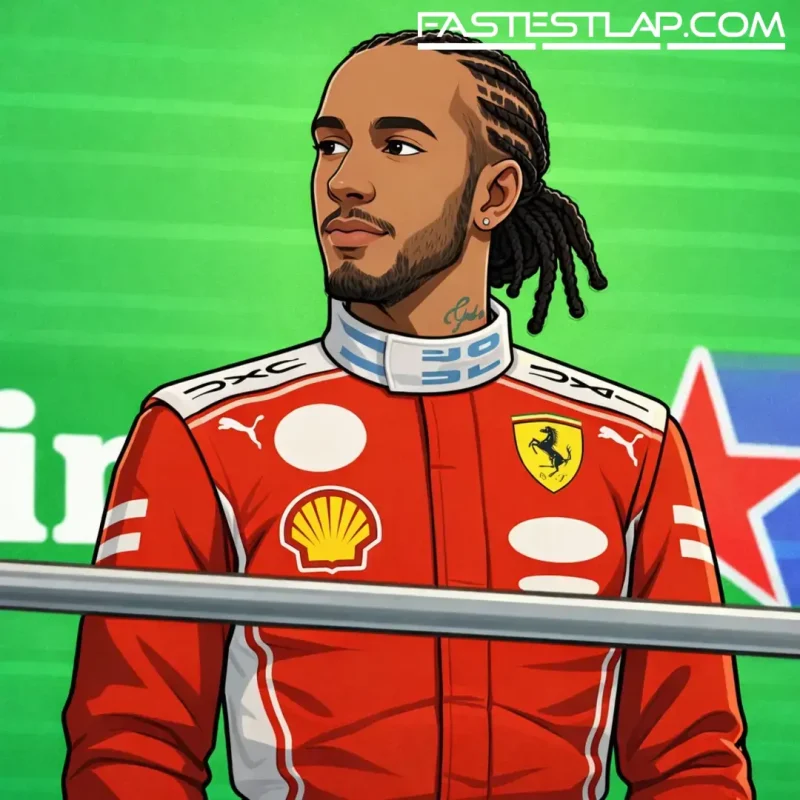
Lewis Hamilton didn’t just grab a podium in China — he bought himself a little breathing room.
After a bruising first season in red, the sight of Hamilton stepping onto the rostrum at Shanghai felt like one of those moments that lands harder inside the paddock than it does on the timing screens. P3 might be routine for a seven-time world champion, but this one carried the weight of 2025: a year of coming up short, of weekends ending with apologies to a team that measures everything in trophies, and of a narrative outside the garage that kept circling back to the same question — whether the move to Ferrari had come a year too late.
Hamilton’s answer in 2026 has been pretty clear so far. Ferrari has started the season as a solid second force in the Constructors’ picture, with a podium at every round, and Hamilton’s own points tally already has him in healthier territory than at the same stage last year. Charles Leclerc has 49 points, Hamilton 41 — not a gap that screams “number two”, and certainly not one that suggests Hamilton’s simply hanging on.
What’s changed, Hamilton insists, is less about any single result and more about finally having a proper second winter embedded inside Ferrari’s way of working. He’s talked openly about how underrated the adjustment is when you swap teams at this level: it’s not just steering wheels and procedures, it’s culture, language, engineering habits, even how meetings feel.
“You can arrive and jump into a cockpit,” Hamilton said, “but learning the new tools, particularly a different culture and a different way that people like to work… and adopting that into the way you like to work.”
There’s also an important technical subtext to his optimism. Hamilton arrived at Ferrari with a car concept already “completed”, and in 2025 the team effectively pulled the plug on development early — leaving both drivers to do the best they could with a package that wasn’t going to be dragged into contention by bolt-on upgrades. That kind of year can be poisonous: not only are you chasing results with one hand tied, you’re learning a new organisation while the car underneath you isn’t giving clear answers.
Hamilton’s read is that Ferrari banked that pain and has spent it wisely. “We took so many learnings through that last year as a team,” he said. “And we’re applying those to this year, and it’s just started off so much better.”
China was the proof-of-life moment. It was Hamilton’s 203rd career podium — a record-stretching number that doesn’t really need polishing — but crucially his first with Ferrari. For a driver who’s spent his entire career turning big occasions into routine, you could tell this one actually meant something.
Part of it was the company. The podium lineup had a weirdly circular feel: Kimi Antonelli, Hamilton’s successor at Mercedes, took his first grand prix win; George Russell, Hamilton’s former Mercedes team-mate, was there too. And in among the celebrations was Peter “Bono” Bonnington — the race engineer who has been the constant voice in Hamilton’s career, now in the Mercedes orbit alongside Antonelli.
Hamilton described it as “nostalgic”, and he wasn’t forcing the emotion. He’d also made it a family week: last year’s sprint race high point came with his father present; in China he brought his mother. That’s not a throwaway detail. Drivers at this end of the sport don’t often invite that kind of intimacy into a weekend unless it matters to them.
“I’ve been trying to get that podium for a long time,” Hamilton admitted. “It felt like I’ve never had to work so hard just to get a podium.”
Inside Ferrari, he said, the reaction was more relief than vindication. Hamilton has repeatedly highlighted how supportive the mechanics and engineers have been through the low points — the kind of internal backing that’s easy to assume should exist at a top team, but doesn’t always survive a season of under-delivering.
“Every weekend fell short last year, and I’d come back and you feel gutted,” he said. “But they’re always like, ‘Next time, next time’. They’re always just so positive and supportive.”
That’s why the China result landed so strongly back at the garage. “To finally have the podium, and come back and see how happy and how grateful they were… really warmed my heart,” Hamilton said. “So that just encourages me to continue to push even harder.”
And yet, Hamilton being Hamilton, he didn’t let the moment sit in a sentimental frame for long. Asked about the chatter that swelled late last season around his future — retirement talk, questions about whether Ferrari had made a mistake — he made it clear he still clocks the voices that take shots at him.
“I saw some of the certain individuals, that hadn’t had anywhere near the success that I’d had, just talking negatively, as they continue to do so today,” Hamilton said, adding that starting 2026 strongly has felt like a chance to “show that I still have what it takes to compete at the front.”
That edge matters. Ferrari doesn’t need a guest star. It needs a driver who can absorb the pressure of being Hamilton in a Ferrari, then turn it into lap time. The early signs suggest the fit is starting to look less like a romantic late-career swing and more like a partnership with teeth.
Three rounds in, nobody’s handing out prizes. But in a sport powered by momentum and perception as much as wind tunnels and lap simulations, Hamilton’s first Ferrari podium was more than a statistic. It was a marker — to the team, to the critics, and probably to himself — that this story is only just getting going.