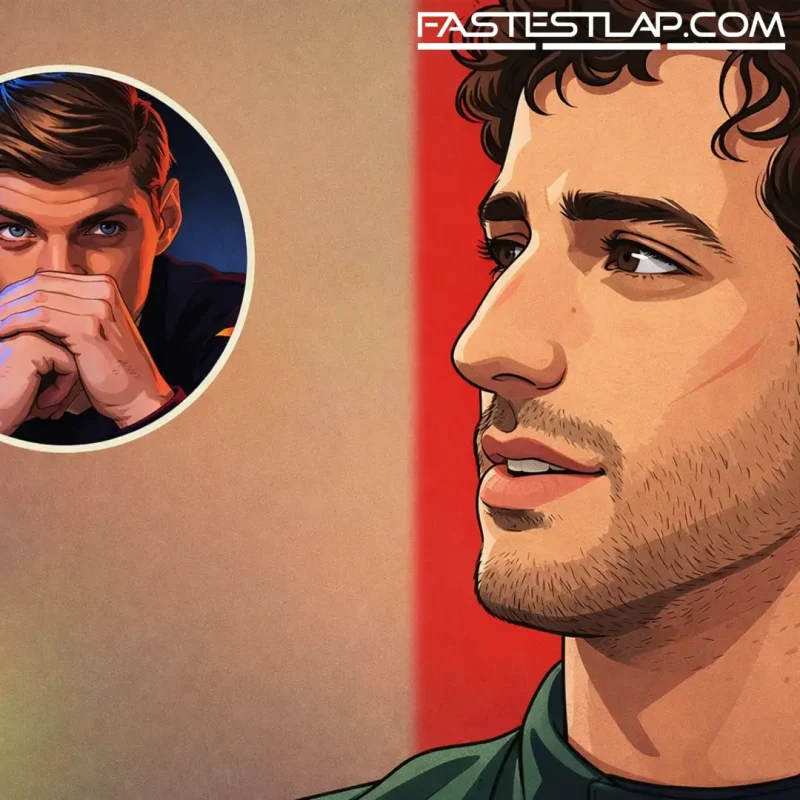
Daniel Ricciardo has never been one to rewrite history to make himself look cleverer in hindsight. If anything, his recent reflections on walking away from Red Bull at the end of 2018 are striking because they’re not wrapped in nostalgia or self-justification — they’re framed as a question he still doesn’t have an answer to.
In a wide-ranging interview with *The Athletic*, Ricciardo admitted the obvious counterfactual still follows him around: what if he’d stayed put alongside Max Verstappen? The easy assumption from the outside is that he’d have banked more wins in the sport’s sharp end. Ricciardo doesn’t even really argue with that. But he also paints a less comforting alternative — one where Verstappen’s trajectory doesn’t just edge him out, it swallows him.
“There’s also a scenario where Max just obliterated me as the years went on and maybe my career ended even quicker,” Ricciardo said. “I don’t know.”
That line lands because it cuts against the popular caricature of Ricciardo’s Red Bull exit as a dramatic, emotionally-driven flinch. He’s pushed back on that narrative again here. He insists it wasn’t about avoiding a fight with Verstappen — it was about reading the room, and specifically about what the team dynamic was going to become as Verstappen matured from prodigy into the centre of gravity at Milton Keynes.
“At the time, some of the narrative was all like: ‘Am I kind of running from the fight?’” Ricciardo said. “I don’t think I was running from the fight. I was just concerned with how things were going to go moving forward. I was more concerned about the team dynamic more than running from a fight.”
That’s the part that will resonate in an F1 paddock that’s always understood driver line-ups as politics as much as performance. Ricciardo and Verstappen were team-mates from 2016 to 2018, and in that window Ricciardo was good enough — quick enough, robust enough — to make it a genuine pairing rather than a hierarchy. He’s clear about that, too: “At the time, I was competitive with Max and we were pushing each other really well.”
But he’s equally clear-eyed about what Verstappen became. Verstappen went on to win four consecutive world titles between 2021 and 2024. Red Bull, meanwhile, has churned through partners alongside him ever since Ricciardo left; the current incumbent, Isack Hadjar, is the sixth driver to fill that seat in the years since.
Seen through that lens, Ricciardo’s “what if” isn’t only about trophies. It’s about survival at the top end of the grid — the difference between being a front-line name in the story and becoming a footnote in someone else’s era. Ricciardo’s fear isn’t that he’d have lost. It’s that he’d have been reduced.
And yet he doesn’t pretend there wasn’t a cost to leaving. Ricciardo freely concedes he “almost certainly” would’ve won more races had he remained at Red Bull. He finished his career with eight F1 victories across 257 starts between 2011 and 2024, with all but one of those wins coming in Red Bull colours. The outlier — McLaren’s 2021 Italian Grand Prix win at Monza — remains one of the most joyous and defiant moments of his later career, precisely because it didn’t fit the arc.
That’s why Ricciardo refuses to label the Red Bull decision a regret. It’s not a confession, it’s an unresolved thought. “I don’t know if I’d go as far as saying [it’s] a regret,” he said. “But it remains a curiosity.”
There’s a neat symmetry to Ricciardo now occupying a different kind of space around Red Bull. After stepping away from motorsport last year — a year on from his final F1 appearance — he took on an ambassadorial role with Ford, Red Bull’s engine partner for the 2026 programme. It’s not a comeback story, not even close; it’s more like a quiet acceptance that the sport moves on, and you either move with it or get dragged.
That acceptance has been a theme in Ricciardo’s recent public comments. Last week, he spoke candidly about being replaced by Racing Bulls in 2024 and admitted — bluntly — that it was a relief in the end. He said on the *Drive* podcast, alongside Ford CEO Jim Farley, that the decision being taken out of his hands spared him having to make the most difficult call of his career.
“Ultimately, I got let go. That was the reality at the time,” Ricciardo said. “I think once that happened, I’d been let go twice in the last two years and it had also taken a lot out of me.
“I’d put a lot of my soul into it. I was pretty exhausted by it.
“On reflection, I was grateful that they made the decision for me. I think it would have been hard to be like: ‘I’m done.’”
Then came the most unvarnished part — the admission elite athletes rarely give you until years later, if at all.
“I think I knew I was probably done because I knew it was harder for me to perform at the level I could,” he said. “For whatever reason, I lost a little bit of something and it’s OK to admit it.”
That, more than the Red Bull “curiosity”, is the line that tells you where Ricciardo is now. Not bitter. Not spinning. Not selling a fairytale. Just taking stock.
And maybe that’s why his Red Bull exit still fascinates: because it sits at the crossroads between two truths Ricciardo holds at once. Staying might’ve meant more wins. It also might’ve meant being flattened by one of the sport’s most relentless talents — and being forced out earlier, not later.
In Ricciardo’s mind, the question isn’t whether Verstappen would’ve been “extremely hard to beat”. He already knows that answer.
The real question is whether, in that alternate timeline, there would’ve been enough Ricciardo left to recognise himself.