Suzuka has a habit of sharpening everyone’s edges, and the early weeks of 2026 are doing the same to Formula 1’s biggest names. Between simmering frustration with the new rules, a genuine reliability headache, and the usual round of ego management that follows the paddock around the world, Monday’s talking points in Japan weren’t so much a news cycle as a mood board for where this season is heading.
Lewis Hamilton, now properly settled into his second year at Ferrari, is still taking aim at the cottage industry that has grown around analysing his every move. The seven-time champion didn’t name names this time, but the target was familiar: “certain individuals” in the media who, in his view, haven’t achieved anything close to what he has yet remain comfortable dishing out the negativity.
It’s a continuation of the pushback he made late last year when he fired shots at the likes of Nico Rosberg and Ralf Schumacher. What’s changed is the context. Hamilton’s Ferrari stint is no longer a novelty; it’s a project with momentum. A first podium in red earlier this season in China has already shifted the tone from “can he still do it?” to the more interesting question: how often can he do it, and what does Ferrari look like when the honeymoon phase is replaced by expectation?
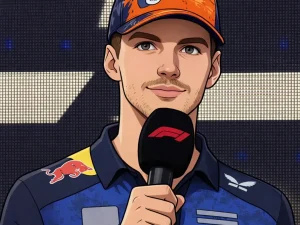
If Hamilton’s relationship with external judgement is still combustible, Max Verstappen’s relationship with the 2026 rulebook is bordering on existential. The four-time world champion has been one of the regulations’ fiercest critics, and at Suzuka he again warned that the new era could ultimately drive him away from F1 altogether — a threat that lands with extra weight given he’s never hidden his desire to race elsewhere.
David Coulthard, though, poured cold water on the idea that the FIA might try to step in and “save” the category from a Verstappen exit. His view is simple: the governing body isn’t going to intervene to keep one driver happy, even if that driver is the sport’s most potent competitive force and commercial magnet rolled into one. That’s not necessarily a moral stance as much as it is political reality — once you start tailoring rules to placate a single superstar, you’ve essentially admitted the regulations aren’t robust enough to stand on their own.
Verstappen’s broader point is harder to ignore. He’s not complaining about a minor competitive inconvenience; he’s challenging the direction of the product. And with his participation in next month’s Nürburgring 24 Hours already on the calendar, the subtext is obvious: he’s not bluffing about having options.
Elsewhere in the paddock, Daniel Ricciardo offered a dose of self-awareness that felt refreshingly unvarnished. Asked again about the long-running theory that he regrets leaving Red Bull at the end of 2018, Ricciardo flipped the premise. He suggested his F1 career might have ended even faster had he stayed and been “obliterated” by Verstappen, and he rejected the notion that he was “running from a fight” when he jumped to Renault for 2019.
It’s an interesting reframing, because it acknowledges what plenty of drivers won’t say out loud: sometimes the smartest career move isn’t about chasing the fastest car, it’s about controlling the trajectory of your own reputation. Ricciardo’s Red Bull years delivered eight wins — all but one of his career total — but he’s blunt about what the Verstappen machine became. There’s no shame in admitting you saw the wave coming and chose not to be the one caught underneath it.
While the sport’s biggest storylines tend to orbit personalities, Aston Martin and Honda are stuck dealing with a problem that can’t be spun away: vibration. Honda has now admitted the issue is worse on track with the AMR26 than it appears on the dyno, which is the kind of sentence that makes engineers go quiet for a moment. Fernando Alonso has even been spotted taking his hands off the steering wheel at times — not exactly the body language of a driver convinced his car is behaving normally.
Honda saw encouraging signs from a prospective fix in Japan, but ultimately didn’t run it in qualifying or the race because of reliability concerns. That decision tells you everything. If you’re leaving a “promising” remedy on the shelf at Suzuka, you’re not confident it survives the full abuse cycle, and the calendar won’t wait while you get confident.
All of this funnels into the bigger, more sensitive conversation happening this week: refinements to the 2026 rules are set to be discussed by the FIA, FOM and the teams. The trigger, at least publicly, has been safety and format concerns after the FIA acknowledged that increased closing speeds contributed to Oliver Bearman’s accident at Suzuka. Qualifying tweaks are expected to dominate the meeting, but there’s a risk F1’s decision-makers end up obsessing over the Saturday show while underestimating what fans and teams will tolerate on Sunday.
The subtle warning signs are already there. When drivers are openly floating exit scenarios, manufacturers are juggling reliability compromises, and the FIA is talking about unintended consequences of the new car behaviours, it’s not “teething problems” anymore — it’s feedback. The sport can either treat that feedback as noise, or as an early chance to avoid locking itself into a version of 2026 that nobody enjoys living with.
Suzuka didn’t just deliver headlines. It delivered a reminder: this new era is still being negotiated, in public, by the people who have to race it.