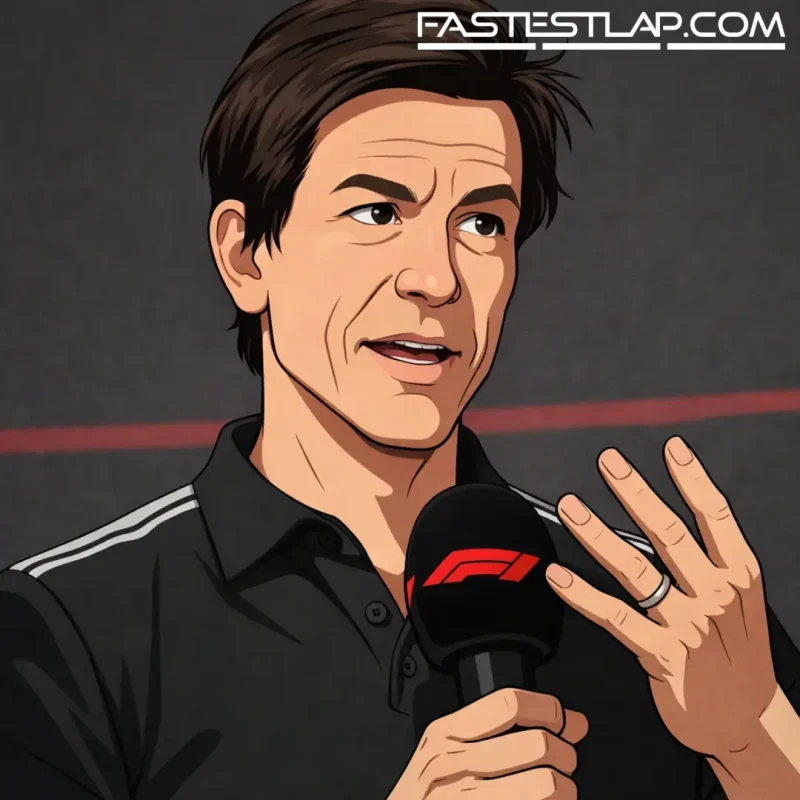
Toto Wolff has never been shy about calling things early, and Suzuka gave him fresh ammunition. In the middle of the paddock’s ongoing tug-of-war over 2026’s 50/50 electrical and combustion power split, the Mercedes boss is pushing the conversation beyond aesthetics and “Mario Kart” jibes, and back towards something more fundamental: whether the sport has accidentally engineered new ways to catch drivers out.
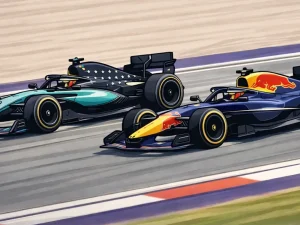
Everyone in Japan had the same talking point leaving Sunday. Oliver Bearman’s crash wasn’t just big — it was the sort of incident that makes engineers go quiet and start replaying data traces. The Haas rookie arrived at Spoon Curve with a huge speed delta to Franco Colapinto’s Alpine, around 50kph by Wolff’s account of the situation. Bearman took evasive action, found the grass, speared back across the track and hit the barrier hard enough for the impact to be logged at 50G. He walked away with a bruised right knee, which in 2026 counts as a small mercy.
The worrying bit, in Wolff’s telling, is how normal the sequence leading up to it now feels. With these power units, harvesting and redeploying energy has become a live strategic exercise for the driver — not a background optimisation handled discreetly by software. That harvesting typically happens at the end of straights, and depending on what the car ahead is doing with its battery state, the closing speeds can be brutal. If the driver in front is lifting to recharge while the one behind isn’t “super clipping” or managing energy in the same way, you can arrive at a braking zone with a difference that looks like someone’s thrown out a parachute.
“That’s something which we need to look at clearly, what’s happened,” Wolff said in Suzuka. His frustration wasn’t aimed at any one team or driver so much as at the broader reality that the new rule set is still in its infancy. “Regulations are in a very immature way. And I’m sure the FIA and our teams, we’re gonna analyse the accident very carefully to see how we can avoid these things.”
He added, with a hint of the gallows humour you tend to hear when a technical department has already disappeared into a meeting room: “I’m sure there’s more competent people than me already in Mercedes scratching their heads how to avoid that.”
The Bearman incident has landed at an awkward moment, too. Power unit manufacturers are due to discuss the early-season picture at Thursday’s PUAC meeting, and it’s hard to imagine the safety angle not dominating parts of it. The sport can argue — correctly — that closing speeds have always been part of racing. But what’s changed is the trigger. This isn’t a classic tow or DRS effect; it’s a new kind of variability created by energy management decisions that can be invisible to the driver behind until it’s almost too late.
And Wolff doesn’t think the hazard begins and ends with a single scary moment at Spoon.
Drivers in Suzuka also complained about the way the cars react when they make tiny changes to throttle position — the kind of half-lift you’d use to breathe the car into a corner or manage entry speed without fully committing to braking. In previous eras, that’s a nuanced part of driving these cars quickly. In 2026, Wolff suggests, it can be the start of an argument between the driver and the power unit about what the car should be doing.
“This is something we should be working at, to make it a little bit less sensitive,” he said. “That the tiniest of lifts causes an unpredictable situation.”
That’s the key word paddock engineers keep circling: unpredictability. Drivers can cope with difficult. They can even cope with a car that’s edgy as long as it’s consistent in its vices. What they struggle with is behaviour that changes depending on battery state, deployment strategy, or harvesting demands — especially when those parameters can swing corner-to-corner. At a place like Suzuka, where rhythm is everything and commitment is usually rewarded, any extra uncertainty is amplified.
Wolff did offer a reality check on some of the more dramatic radio messages and post-session comments. Not every complaint, in his view, should be taken at face value.
“Now it was for me, maybe one or the other statements were over exaggerated,” he said. “Some people got it right, some people got it wrong.
“And if you deploy tons of energy in the first sector, you shouldn’t be surprised that in the last you’re running out of it.”
That’s the political balancing act in one neat paragraph: yes, there are genuine system-level issues to address, but there’s also a learning curve — and some of the early pain is self-inflicted by teams and drivers still exploring where the limits are.
Even so, Wolff’s broader point stands. If the new formula encourages big, sudden speed changes on the straights, and if it also makes the car’s response to small driver inputs less intuitive, then F1 can’t simply shrug and say everyone will adapt. The FIA and the teams will have to find a way to “optimise the systems,” as Wolff put it, and reduce the sensitivity without neutering the very energy-management battles the rules were meant to create.
Suzuka is a track that exposes weak links without mercy. This year it did it with a crash and a handful of uneasy conversations in the motorhomes afterwards. If the sport is serious about not waiting for a worse outcome, the next few PUAC meetings may be less about performance convergence and more about making sure the new era isn’t quietly building traps at the end of every straight.