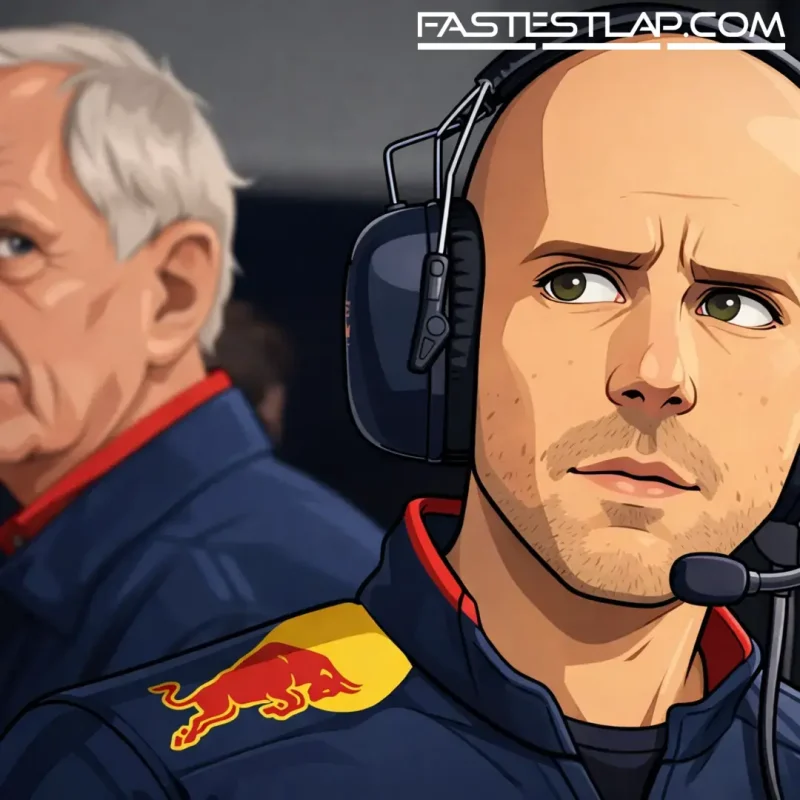
Helmut Marko doesn’t tend to do understatement, but even by his standards the verdict on Gianpiero Lambiase’s planned exit landed with a thud: “a significant loss.”
Lambiase’s decision to leave Red Bull for McLaren for the 2028 season has the feel of one of those moves that won’t bite immediately — there’s still time to run — but changes the temperature in the room the moment it becomes public. Engineers don’t just walk out with a toolbox. They take habits, language, trust, and a way of working that’s been forged under pressure and refined across championships.
For Max Verstappen, Lambiase has been that constant voice since 2016. Not a PR-friendly pairing either. Their radio has always sounded like two people who know exactly how far they can push each other because they’ve been through the messy bits together. Marko, speaking to APA, summed it up in the kind of line paddock people love because it’s true enough to sting: “The two were like an old married couple. They had their discussions and disputes, but this is a significant loss.”
The intrigue, of course, is that this isn’t happening in isolation. Red Bull in recent years has watched a steady stream of senior names peel away: Adrian Newey to Aston Martin, Jonathan Wheatley to Audi, and McLaren picking up Rob Marshall and Will Courtenay. Marko and Christian Horner are also no longer there. Lambiase leaving isn’t just another departure; it’s one that sits right at the core of the race team’s weekly heartbeat, because race engineering at the sharp end isn’t a plug-and-play job.
Red Bull will publicly lean on its depth — and Marko did exactly that, suggesting a promotion from within because “the team is large.” That’s a fair point as far as org charts go. But anyone who’s spent time around a top operation knows the hard part isn’t filling a seat; it’s replicating the chemistry that’s been built across years of split-second decisions, bruising debriefs, and those long, quiet moments when a driver needs to hear the right thing at the right time.
There’s also a second layer to this: what it signals, rather than what it changes on day one. Lambiase’s timeline — 2028 — means Verstappen and Red Bull still have a runway, but announcements like this invite everyone to start reading the tea leaves. Verstappen has previously suggested Lambiase’s presence was tied closely to his own future, with the memorable line along the lines of “as soon as he stops, I stop too.” That’s the sort of statement that sounds absolute in the moment and then gets tested by real life: ambition, competitiveness, family, the state of the team, the next regulation cycle.
Jos Verstappen, at least, has tried to cool the inevitable leap to conclusions. Speaking to RaceXpress, he made it clear this wasn’t a bombshell dropped out of nowhere.
“We’ve known about it for a while and we also knew when it was going to happen,” he said. “We’ve got another year and a half or two years to work with him.
“It’s a huge opportunity for him and we understand that. We’ve also told him: you have to go for it and grab it with both hands. It’s up to Red Bull to find his replacement. We’ll see.”
That’s a notably pragmatic tone — less emotional attachment, more acceptance that careers move and elite people want new challenges. Which, in itself, is telling. In this business, the first reaction tends to be the honest one: if the Verstappen camp were genuinely blindsided or furious, it would read very differently.
From McLaren’s perspective, it’s a heavyweight hire in the most practical sense. Lambiase isn’t a figurehead. He’s spent a decade inside Red Bull Racing, joining in 2015 and initially working as Daniil Kvyat’s race engineer before becoming central to Verstappen’s operation. That kind of experience doesn’t just bring “knowledge”; it brings a feel for what a top-level driver demands, how weekends pivot, and how to keep the decision-making chain clean when the noise gets loud.
For Red Bull, the immediate question is how they manage the transition without letting it become a weekly sideshow. If Lambiase is staying through this period, it requires maturity on both sides: continuing to operate at full commitment while everyone knows the partnership has an expiry date. That’s not unheard of in F1 — plenty of senior people serve notice and carry on — but it’s rarely comfortable when the relationship is as high-profile and as emotionally charged as this one.
And that’s the point Marko was really making. You can replace a job title. Replacing a working relationship that’s been stress-tested in every scenario F1 can throw at you is another matter entirely.
The paddock will do what it always does: treat this as a clue, and then build a larger story around it. Maybe it becomes a footnote. Maybe it’s the first domino in a bigger shift. Either way, Red Bull now has one more critical piece to re-bed in — and one more reminder that, in modern F1, stability is a competitive advantage you only notice once it’s gone.