Oscar Piastri’s 2026 season has already contained enough misfortune to rattle a less settled head. Two races, two non-starts — a crash on the way to the grid at his home Australian Grand Prix, then a China weekend where McLaren didn’t even get the chance to show its hand thanks to separate Mercedes power unit battery issues that sidelined both cars.
And yet, inside McLaren, the dominant takeaway isn’t the points left on the table. It’s the way Piastri carried himself through it.
Team principal Andrea Stella didn’t dress it up at Suzuka: the reset has been noticed, and it’s had an effect that goes beyond one driver’s mood.
“The start of the season has given Oscar the opportunity to test where he was with his maturity, with his strength, with his ability to absorb adversity,” Stella said in Japan. “The team is so impressed by the strength that this driver is exhibiting… when you see a driver responding like that to a second race in which he was not in condition to be part of it, then this becomes extremely motivational for all the team.”
There’s a particular kind of pressure in those situations that doesn’t always translate outside the garage. A driver can shrug off a poor qualifying session, even a messy race, because at least they’ve been in the fight. A DNS is different: the helmet stays on, the rituals happen, the heart rate goes up — and then it’s over before it begins. Do that twice at the start of a new era, when everyone’s still calibrating form and belief, and you’ve got a neat little test of character.
Stella framed Piastri’s response as something broader than performance. It wasn’t just about a driver “getting faster and faster”, he said, but “a person getting more and more mature and strong from a mental point of view.” That sort of language matters coming from a team boss: it’s the subtext of trust, and the kind of trust that becomes valuable when the season starts asking difficult questions.
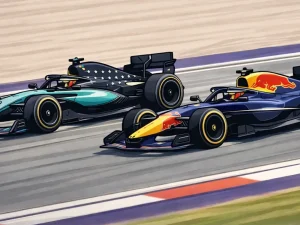
Suzuka, at least, gave Piastri the chance to answer some of them on track. He qualified third, then made the kind of opening-lap statement that tends to get noticed even in a crowded paddock: he took the lead at the start and, for a spell, looked capable of turning McLaren’s early-season frustration into a properly disruptive result.
The problem was that Suzuka also underlined how thin the margins still are when you’re trying to punch up against a dominant car. Mercedes’ W17 pace was the reference, and while Piastri could initially keep George Russell honest, the race pivoted with a Safety Car that broke against him. By the flag he was 13.7 seconds behind the winner, Kimi Antonelli.
That final number is what it is — but the significance for McLaren was more psychological than mathematical. After Melbourne and Shanghai, simply having a clean, competitive weekend and finally getting Piastri’s campaign moving counted as its own small milestone. The team left Japan encouraged it’s taken a clear step forward, with Stella’s comments reading like someone keen to bottle that momentum quickly.
Just as interesting, though, was where Stella steered the conversation next: not to the technicalities of the Suzuka swing, but to the dynamic between his drivers.
McLaren spent 2025 with Piastri and Lando Norris as title rivals — a scenario that can either sharpen an organisation or quietly corrode it. Stella’s read is that it’s done the former. At Suzuka, he was unusually candid about how much he’s enjoying watching the pair work together.
“I’ve actually been thinking about it because I see how well they collaborate,” he said. “These guys have gone through a quest for a world championship… competing with one another, and now they keep exhibiting this level of mutual respect.”
That’s not a throwaway line. Teams always talk up harmony; most of them are one bad Sunday away from discovering what their “values” look like under stress. Stella argued this one’s more robust — partly nurtured by McLaren, partly just who Norris and Piastri are.
“This is also why they drive a McLaren,” he said. “It just wouldn’t work… if we didn’t share the same values, the same mindset, the same approach to racing.”
The key point landed in the next breath: Stella admitted that without the experience of 2025, he might still be waiting to see how things held up once a championship was on the line. But that test has already been taken — and, in his eyes, passed.
“If we had not had the 2025, I would say, ‘Let me see once they become rivals for the championship,’ but we have had it already,” he said. “So at the moment I’m just proud and happy with what they are doing for McLaren and for themselves.”
In the short term, that cohesion is a competitive tool. McLaren has started 2026 on the back foot through circumstances as much as speed, and the last thing it needs is internal noise while it tries to turn promise into points. In the longer term, it’s a warning shot to the rest: if the car comes to them, they’re not going to beat themselves.
For Piastri, Suzuka didn’t deliver the fairytale comeback result — not with the Safety Car cutting across his strategy and Antonelli disappearing ahead — but it did something almost as valuable at this stage of the year. It reminded everyone, including the people building the car around him, that the driver hasn’t gone anywhere. And it gave McLaren a weekend where the conversation was about potential again, not damage limitation.
After the way his season began, that’s a small win. The kind good teams quietly stack up before the bigger ones arrive.