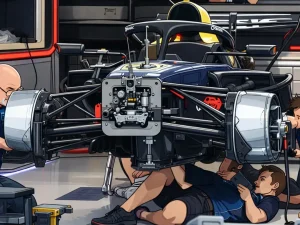
F1’s first season under the 2026 rules was always going to be defined by what teams learned away from the TV cameras as much as what they did on Sundays. This week’s off-track running — and off-hand comments — did a decent job of sketching where the sport’s early fault lines are forming.
At the Nürburgring, Pirelli’s tyre programme brought McLaren and Mercedes to a circuit current F1 cars haven’t visited since the one-off Eifel Grand Prix back in 2020. It’s the sort of test that looks innocuous on the calendar but matters because it’s one of the few chances to build mileage without the pressure of parc fermé politics and sprint-weekend compromises.
For Oscar Piastri, though, day one was a reminder that not all test days are created equal. A technical issue on the McLaren limited him to 65 laps — barely half the work completed by George Russell, who rattled off 127 in the Mercedes. In tyre testing, the lap count isn’t just a vanity metric. It’s the difference between a clean set of comparative runs and a day spent firefighting, reshuffling the plan and leaving Pirelli short of the neat A/B/C story it wants from identical conditions.
The timing isn’t ideal for McLaren either. With the new-era cars still being understood and the 2026 pecking order looking anything but settled, wasting a day’s learning — even in a test that isn’t directly about outright performance — is the kind of small loss that tends to show up later as a big question mark. Mercedes, by contrast, banked its mileage and the extra data points that come with it. Russell didn’t just drive more; he enabled the team to cycle through more variables and give Pirelli a more complete read.
Elsewhere, Fernando Alonso spent part of F1’s extended April break doing what Alonso does: turning up somewhere interesting, driving something serious, and making it all look completely normal. He ran Aston Martin’s Valkyrie LM at Paul Ricard, with the car billed by the company as the “ultimate incarnation” of the Valkyrie used in WEC and IMSA.
There’s an intriguing through-line here that’s hard to ignore. Aston Martin’s Valkyrie was designed by Adrian Newey during his Red Bull years, and Newey is now Aston Martin’s team principal. Alonso driving the LM at a familiar Grand Prix venue might not change a single point in the F1 championship, but it does underline how Aston Martin wants to position itself: a brand with proper engineering depth, a motorsport portfolio that talks to itself, and a culture that keeps its star driver busy and engaged even when F1 goes quiet for a moment.
The paddock reality, of course, is that these little signals matter in 2026 because the rules reset has left teams scrambling for narrative as much as lap time. You can hear it in the way Ferrari is talking, too.
Fred Vasseur has now openly acknowledged a “deficit of performance” in straight-line speed with the SF-26 — effectively backing up what Lewis Hamilton said a few weeks ago when he pointed to Ferrari’s weakness on the straights in its fight with Mercedes. Ferrari can point to something important: it has finished on the podium in each of the first three races of 2026. But that consistency also sharpens the frustration, because it suggests the car is close enough to be in the conversation every weekend while still lacking a key weapon when it needs to convert those Sundays into wins.
Straight-line speed deficits are the kind of problem that can be both simple and messy. Simple, because the symptom is obvious and every rival can see it. Messy, because fixing it without upsetting the rest of the car is rarely straightforward — and in a regulation reset year, teams are often forced to choose between chasing peak numbers and protecting the platform they understand.
And then there’s Red Bull, where the noise is less about lap times and more about who’s (still) in the room.
Jos Verstappen has taken aim at Ralf Schumacher’s suggestion that Max Verstappen and Red Bull are missing Helmut Marko’s presence in 2026, dismissing it in typically blunt fashion. Marko’s departure from Red Bull GmbH at the end of last year closed a defining chapter — he’d been instrumental to the organisation’s F1 operation for more than two decades — but the Verstappen camp has been clear that the relationship hasn’t been severed. Max has already said he remains in contact with Marko.
What this really speaks to is how the paddock reads power shifts. In a stable era, the team’s structure is background noise. In a new-rules season, with everyone looking for reasons why one project is clicking and another is stumbling, personnel changes become an easy explanation — and an easy stick to poke with. Jos Verstappen’s response isn’t just a defence of Marko or Max; it’s a pushback against the idea that Red Bull’s story can be neatly narrated from the outside.
All of which feeds into a broader point that’s hard to escape three races into 2026: the new rules have landed to a fairly lukewarm reception, and not everyone who talked a good game pre-reset has delivered. Aston Martin and Williams, in particular, have been framed as underwhelming relative to what their build-up suggested.
Maybe that’s the most honest takeaway from a week like this. The mileage matters, the admissions matter, the side-projects and soundbites matter — because 2026 is still in its sorting-hat phase. Some teams are stacking laps and sharpening their understanding. Some are publicly diagnosing weaknesses they haven’t yet cured. And some are discovering that in a reset year, the narrative can turn on something as small as a day lost to a technical glitch in the Eifel.