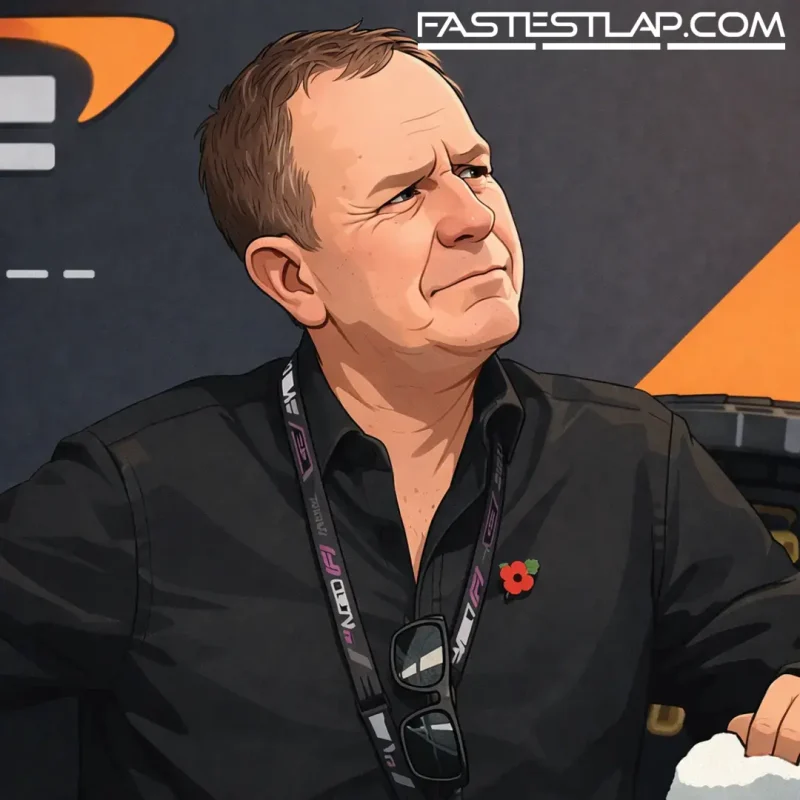
Martin Brundle isn’t going anywhere — at least not in the way the internet briefly convinced itself he was.
After skipping China and Japan, the Sky F1 mainstay has moved to calm the noise around his 2026 workload, insisting his arrangement remains what it’s been for a while: a set number of races, not a slow walk into retirement. Brundle is due back in the box at next month’s Miami Grand Prix and says he’ll continue to cover 16 weekends a season.
The spark for the latest round of speculation was the familiar cocktail of a reduced calendar and a pundit rota that’s easy to misunderstand if you’re determined to read doom into it. Sky has long rotated its on-air team, and Brundle hasn’t attempted the full schedule “every weekend” grind for years. What’s changed in 2026 is simply the arithmetic around it.
Brundle, now 66, responded directly to a concerned fan on social media after a report framed his absence as a “major broadcasting change”. He didn’t bother with corporate niceties.
“Utter clickbait nonsense Margaret, don’t be concerned,” Brundle wrote. “I’ve done 16 races per year for a good while now and continue to do so.
“In fact with the cancellations I am at 15 of the remaining 19 races this season, subject to world events of course, as always.”
That last line is doing some work. The cancellations of the Bahrain and Saudi Arabian grands prix have squeezed the calendar, and Brundle’s point is straightforward: if the season shrinks, the “number of races” doesn’t automatically scale with it — so the proportion of weekends he appears can look different without anything actually changing.
It’s also a reminder of how modern F1 broadcasting works at the top end. Sky’s coverage is an endurance sport in its own right. The travel is relentless, the off-track commitments are constant, and the job requires a particular kind of edge: sharp enough to call nonsense when it appears, and experienced enough to explain complex moments without turning them into lectures. Even for someone as seasoned as Brundle, doing every single round is less a badge of honour than a recipe for burning out on live television.
Brundle’s 16-race plan represents a small step down from last year, when he worked 18 weekends out of a 24-round season. But the bigger story isn’t the number; it’s the reality that Sky’s lead voice is still very much there, just deployed with the kind of rotation most broadcasters now treat as standard.
The timing of all this didn’t help, either. Brundle’s recent absences handed Jenson Button a prominent run in the co-commentary chair in Japan, and Button’s performance drew the usual praise — smooth delivery, contemporary driver references, and that knack for sounding measured even when the race is in full chaos.
Former BBC F1 presenter Jake Humphrey went a step further, publicly calling Button “the natural successor” to Brundle. That’s the sort of label that can become sticky in F1: flattering, loaded, and immediately interpreted as a succession plan rather than what it usually is — a compliment in the moment.
Button, for his part, was quick to pour cold water on the idea that he’s circling Brundle’s seat.
“Nobody should be replacing Martin until he decides he’s had enough,” Button wrote in response. “I’ve listen [sic] to Martin in comms since I started in the sport and love his knowledge, insights and work ethic.
“As much as I enjoy jumping in the comms box when Martin is taking a well deserved break I wouldn’t want to do anymore as I’ve got enough going on!”
That “enough going on” matters. Button isn’t just a broadcaster; he’s also an ambassador for Aston Martin, and the modern ex-driver media portfolio tends to come with sponsor work, appearances, and a calendar that can get crowded fast. Committing to being a full-time lead commentator across a globe-trotting season is a different proposition entirely — one that requires clearing the decks in a way few ex-drivers actually want to.
For Sky, the dynamic is pretty healthy. Brundle remains the reference point — the voice that can cut through the noise, the paddock operator with the instincts and relationships built over decades. But the rotation also gives the broadcaster flexibility and space to keep a bench of credible names sharp, whether that’s Button or other voices stepping in across the year.
And for viewers, Brundle’s message was basically this: relax. He’s still doing what he’s been doing, and if you’ve convinced yourself that every missed weekend is the beginning of the end, you’re arguing with the evidence of the last few seasons.
The real tell is that Brundle didn’t sound like someone negotiating his way out. He sounded like someone mildly irritated that a standard rota had been dressed up as a breaking-news crisis — and confident enough in his role to swat it away in a sentence.
He’ll be back in Miami. And, by his own reckoning, he’ll be back plenty after that — calendar permitting.