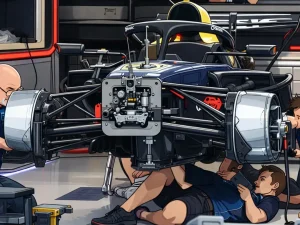
The FIA has moved quickly to close off a qualifying loophole that Mercedes and Red Bull had been leaning on, and it’s a reminder of how this early phase of 2026 is going to look: aggressive interpretation, short windows of advantage, then a clarifying directive and everyone moves on.
At the centre of it is a trick that effectively sidestepped a mandatory power reduction on the approach to the timing line in qualifying. The knock-on was significant: the MGU-K power would be rendered inaccessible for 60 seconds. In other words, teams had found a way to game a system designed to manage deployment behaviour, flipping it into something that could be used as part of a planned performance routine rather than a safeguard.
The FIA’s message is blunt. This is an “emergency” tool — something to prevent component damage — and not something to be baked into a run plan. The new technical directive is intended to shut that down before it becomes endemic, and before other teams pile in and the governing body is left trying to unwind a paddock-wide habit mid-season.
There’s always a slightly cynical reading when a directive lands this early: either the FIA has been tipped off by rivals who’ve spotted it in data traces and timing anomalies, or the trick has become obvious enough that leaving it alone invites exactly the kind of escalation the FIA says it wants to avoid. Mercedes and Red Bull being the names attached isn’t surprising, either. In any new regulatory cycle, the teams with the deepest resource and the sharpest operational culture tend to find the edges first — and they rarely keep them to themselves for long.
That technical policing arrives at a time when Red Bull, in particular, can’t afford distractions. Three races into 2026 and the team has just 16 points on the board — a grim return by their own standards, and one that has only sharpened the sense that Milton Keynes is in the middle of a proper shake-up rather than a routine early-season wobble.
Max Verstappen’s race engineer Gianpiero Lambiase is the latest senior figure to announce he’s leaving, and there’s a growing sense around the team that the door might not stop swinging there. When an organisation is winning, staff churn is usually interpreted as opportunistic poaching and normal career drift. When performance drops and big names start moving, it becomes harder to separate cause from effect.
Red Bull now finds itself in an awkward spot: it needs stability to engineer a recovery, but the recovery itself can be undermined if too many key operators decide the next chapter will be written somewhere else. That’s not just about pitwall voices and garage leadership; it’s about the institutional memory that turns a new car concept or a new power unit regime into something raceable, week after week.
While Red Bull is trying to steady itself, Ferrari is enjoying the sort of early-season atmosphere that tends to shift the mood of the whole paddock. The team has started 2026 strongly, taking podiums in each of the opening three races, and that form has prompted a public note of confidence from chairman John Elkann, who says Ferrari is approaching the season with “unity and determination”.
That wording matters, because it comes with a bit of backstory. Elkann drew criticism late last year after he urged Lewis Hamilton and Charles Leclerc to “talk less” during the closing weeks of 2025, when Ferrari fell short of its ambitions. Right now, with results already offering tangible evidence of progress, it’s easier for Ferrari’s leadership to frame the narrative around togetherness rather than tension management.
And in Ferrari’s case, narrative has financial weight as well as sporting importance. The boom years of the Liberty Media era have been kind to every team on the grid, but Ferrari remains F1’s valuation benchmark — now pegged at $7.1 billion, up from $2 billion in 2020. That figure is as much about brand gravity as it is about lap time, but the two are never fully separable. A Ferrari that looks settled and competitive doesn’t just win races; it sells the idea of Formula 1 to sponsors, partners and new audiences in a way only Ferrari really can.
The broader picture is a sport that’s simply gotten bigger, and more expensive, and harder to ignore. With 11 teams now sharing in that rising tide, the commercial landscape is starting to look less like a traditional motorsport ecosystem and more like a global entertainment league with constructors attached. The numbers reflect that — and they also raise the stakes when performance drops. A troubled season doesn’t just sting on Sunday; it can echo through staffing, sponsorship leverage, and long-term confidence in leadership.
Even Sky’s broadcast booth has its own version of continuity questions. Martin Brundle has sought to calm any nerves about his future, insisting he’ll continue to attend 16 races per season. That reassurance follows a run of praise for Jenson Button, who filled in for Brundle in Japan, and a familiar round of speculation about who might eventually become the long-term voice of the gridwalk.
Button has already pushed back on the idea that he’s the “natural successor”, but this is how these conversations always start in F1: someone does a good job in a high-visibility role, the paddock starts imagining the next decade, and then everyone involved tries to slow the story down.
For now, the storyline that matters most is the one the FIA has underlined with that directive. In 2026, the margins are going to be found in the fine print — and then, just as quickly, they’ll be litigated out of existence. The teams that adapt fastest won’t just be the ones who spot the loopholes first, but the ones who can keep performing when the loopholes disappear.