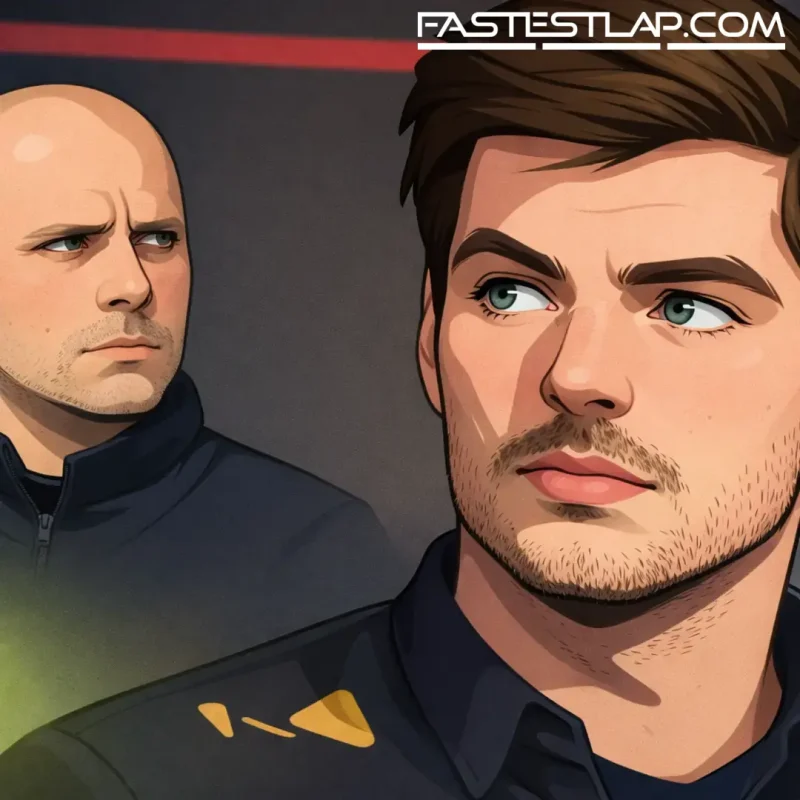
Max Verstappen has confirmed what plenty in the paddock suspected: when McLaren came calling for Gianpiero Lambiase, Red Bull’s long-time race engineer didn’t just make the decision in isolation — he ran it past the driver he’s been joined at the hip with for a decade.
And Verstappen, far from trying to block it, effectively gave him a shove out the door.
Speaking at a Viaplay event, Verstappen said Lambiase “asked me for my approval” after receiving what the Dutchman described as a “fantastic offer” from McLaren. The move, announced last week, will see Lambiase join the Woking organisation as chief racing officer, with McLaren stating he’ll arrive “no later” than 2028 — the point at which his current Red Bull contract expires.
“He told me what kind of offer he’d received,” Verstappen explained. “I said: ‘You’d be daft not to take it.’
“We’ve already achieved everything together and then he gets such a fantastic offer, especially with his family in mind and the security it would bring him. He asked me for my approval, so to speak, and I told him he absolutely had to go for it. He really wanted to hear that from me.”
It’s a revealing glimpse into a relationship that has long been one of the defining partnerships of Red Bull’s modern era — not just in results, but in tone. Verstappen and Lambiase have been through the sharp edges together: the clipped radio exchanges, the pressure-cooker strategy calls, and the sort of ruthless execution that turns title fights into title processions. They first worked together at the 2016 Spanish Grand Prix, when Verstappen won on his Red Bull debut, and the pairing later formed the backbone of the run of world championships Verstappen delivered between 2021 and 2024.
McLaren’s success in landing Lambiase hasn’t happened in a vacuum either. It’s understood there was competition for him — including interest from Aston Martin over a senior role — which only underlines the level of regard he holds inside the sport. Race engineers with his combination of technical credibility, calm authority, and driver-handling instincts don’t appear on the market often. When they do, teams tend to sharpen elbows.
There’s also a very human element to Verstappen’s reaction that’s easy to miss if you focus solely on the competitive fallout. This isn’t the usual “we wish him well” corporate farewell. Verstappen framed it as a life decision as much as a career move, and the fact Lambiase sought his blessing says a lot about how deeply intertwined their working dynamic has been — and how carefully both sides want to manage the end of it.
Jos Verstappen has already indicated the Verstappen camp knew about the switch well in advance. “We’ve known about it for a while and we also knew when it was going to happen,” he said, adding: “We’ve got another year and a half or two years to work with him… It’s up to Red Bull to find his replacement. We’ll see.”
That last line carries a familiar edge. Red Bull doesn’t just need a competent engineer to sit on the pit wall and read out gaps; it needs someone who can operate in Verstappen’s world — fast, blunt, intolerant of noise — while still pushing back when needed. Lambiase has been one of the few who can do it without it becoming a weekly drama.
The timing inevitably feeds into the bigger question that refuses to go away: what does this mean for Verstappen’s longer-term commitment to Red Bull and even to Formula 1 itself?
Verstappen has previously been quoted as saying he would “stop too” if his working relationship with Lambiase ended. More recently, he’s renewed threats about stepping away from F1 amid his dissatisfaction with the 2026 rules. Yet Jos Verstappen suggested the context has changed since those earlier remarks, pointing to what they’ve already achieved together.
“I think things have changed,” he said. “Especially after four championships, you’ve achieved a lot together. The final decision is up to Max, but I think he’ll just carry on.”
Whether that’s a genuine shift in mindset or simply realism, the immediate consequence is clear: Red Bull now has a defined countdown to a major internal change, and McLaren has time to integrate a high-level hire without the pressure of an instant handover. Lambiase’s “no later than 2028” arrival date gives all parties room to plan — but it also makes the next phase of Red Bull’s Verstappen project feel less permanent than it did a month ago.
For Verstappen himself, the week ahead is less about politics and more about track time — of a very different kind. He’ll be back in action at the Nürburgring 24-hour qualifiers this weekend ahead of his debut in the endurance classic next month, sharing a Red Bull-branded Mercedes-AMG GT3 with Lucas Auer. The qualifiers will also give Verstappen his first experience of driving the Nordschleife at night, an extra layer of difficulty on a circuit that doesn’t need one.
The schedule quirk is notable too: those qualifiers were originally set to clash with the Saudi Arabian Grand Prix, before that race was cancelled. Instead, Verstappen gets another uninterrupted block to indulge a side project that, in its own way, hints at a driver keeping his options — and motivations — wide open.
Back in F1, Red Bull will insist it’s business as usual. Maybe it is, for now. But when a driver like Verstappen openly says he told the one voice he trusted most on the radio to take a rival’s offer, it’s hard not to hear the subtext: even the most successful partnerships in this sport don’t last forever — and everyone involved is starting to act accordingly.