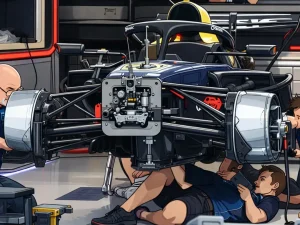
Ayao Komatsu isn’t pretending Haas has suddenly become a big-hitter just because 2026 has started brightly. If anything, his message is the opposite: the team is getting results because it’s learned to live with being outgunned — and because, on a regulation reset, execution counts for more than shiny infrastructure.
Haas has spent most of its decade in Formula 1 scrapping to turn limited resources into points, often looking sharp one weekend and anonymous the next. The early phases of this new rules era have offered a rare chance to reset that pattern, and Komatsu’s confidence comes from how cleanly Haas has hit its targets rather than any claim it’s solved the grid.
He points to the basics first: getting the new car through shakedown, then ticking off the heavyweight early-season milestones — Barcelona and both Bahrain tests — without the kind of delays that can derail a smaller operation before the racing even begins. With so many unknowns at the start of a new technical cycle, a team that simply turns up ready can buy itself momentum.
That’s been Haas’s quiet strength so far. Komatsu describes it as “togetherness”, but what he’s really talking about is the discipline required to do the unglamorous work properly when you don’t have spare capacity to paper over mistakes.
The sting in the tail is his admission of what Haas *doesn’t* have. While rivals lean on deep off-track toolsets, Haas is still in the position of needing to learn big things at the circuit — and to learn them quickly. That’s not romantic underdog talk; it’s an operational reality that shapes how aggressively you can develop a car across a season.
Komatsu is candid about the consequence: the development race is going to be “very tough”. Under the cost cap, the sport’s supposed to be more compressed — but anyone in the paddock will tell you the cap doesn’t magically equalise capability. It just changes where the advantages live. Facilities, simulation quality, and the ability to correlate off-track work to the real world remain decisive, and Komatsu knows Haas is still building that side of the operation.
A key detail is the team’s ongoing effort to close that gap with a simulator installation at Banbury, alongside other tools intended to reduce how much Haas has to “discover” on race weekends. It’s the sort of investment that doesn’t pay off overnight, but if Haas wants this early promise to become something more sustainable, it’s exactly where the fight has to be.
For now, Haas’s biggest comfort is that the car has what Komatsu calls a “decent characteristic” — a proper base. In other words, it’s not one of those new-regulation cars that looks fine on paper and then refuses to behave in the wind, in traffic, or across different circuits. Haas believes it’s pointing in the right direction; the question is whether it can add performance at a rate that keeps it in touch as everyone else ramps up.
And that’s where the human factor has started to matter as much as the hardware. Komatsu’s praise for Oliver Bearman is revealing, not just because Bearman is delivering, but because of how he’s delivering.
Haas signing the Ferrari youngster already looks like one of the smarter moves on the grid. Bearman outscored Esteban Ocon last year and, early in 2026, sits seventh in the standings — the sort of return that changes the temperature inside a midfield garage. Komatsu doesn’t talk about him like a prospect being managed; he talks about him like a cornerstone.
What Haas values most isn’t raw speed — Komatsu is clear that Bearman’s pace “has never been in doubt” — but the rate at which he’s turned speed into a complete weekend. He points to last season’s late-year gains in consistency, and to Mexico, where Bearman’s P4 came under heavy pressure. Those are the weekends teams remember when they decide whether a driver is simply quick or genuinely leading them somewhere.
Komatsu also dwells on the bits fans don’t see: how Bearman works with engineers and mechanics, how he absorbs information, articulates what the car’s doing, digests it, then applies it. In a year when teams are still decoding a new generation of cars, that loop can be worth lap time all by itself — especially for a squad that admits it has to learn at the track because it lacks certain off-site tools.
Perhaps the most pointed compliment is about emotional control. Komatsu says Bearman doesn’t drain the room when something goes wrong; he lifts it. That’s the kind of quality that sounds like soft leadership talk until you’ve watched a midfield team trying to execute a tricky run plan on a messy Friday, or chasing a correlation issue that’s eating its weekend alive. Momentum and morale are performance factors, particularly when you’re stretched thin.
None of this guarantees Haas a fairy-tale season. If anything, Komatsu’s assessment reads like a warning wrapped in optimism: the foundations are good, the direction is correct, but the rest of the grid won’t stand still — and Haas can’t afford to either. The next phase is less about surviving the new-regs launch and more about whether Haas can industrialise its early competence into a development cadence that doesn’t fade by mid-year.
Still, there’s a noticeable change in the way Haas is talking. It isn’t selling hope. It’s talking about process — milestones hit, tools being added, and a driver whose ceiling, in Komatsu’s words, he “can’t see” yet. In Formula 1, that’s usually the point where a midfield story becomes something more serious: not a miracle, just a team doing enough things right, often enough, to force the paddock to pay attention.