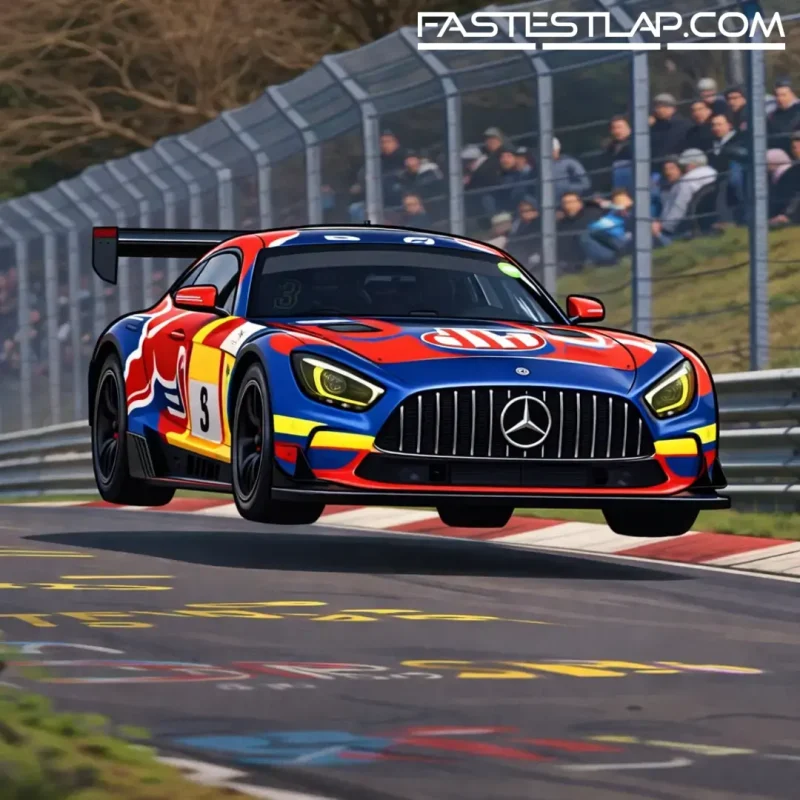
Max Verstappen was back circulating the Nürburgring Nordschleife on Sunday morning, climbing into a Red Bull-branded Mercedes-AMG GT3 less than a day after the ADAC 24h Nürburgring Qualifiers were rocked by a fatal accident.
The opening qualifying race on Saturday was abandoned following a multi-car incident early on the Nordschleife that involved seven competitors. Juha Miettinen, 66, was fatally injured in the pile-up. Medics attended immediately, but he was later declared dead at the circuit’s medical centre.
Nürburgring race control confirmed the sequence of events in a statement, explaining that the race was stopped to allow recovery and rescue operations to take place. The other six drivers involved were taken to the medical centre and nearby hospitals for precautionary checks, with organisers stating none of them were in a life-threatening condition.
Given the scale of what happened, the most striking thing about Sunday wasn’t simply that cars were running again — it was how quickly the weekend had to pivot from shock to the controlled routine of a race meeting trying to continue. The Nordschleife has always existed in that uncomfortable space where mythology, speed and consequence sit closer together than in almost any other form of circuit racing. When something goes wrong there, it doesn’t just interrupt a schedule; it resets the emotional temperature of the whole paddock.
For Verstappen, the return to track underlined a familiar truth about top-level drivers who race across categories: they’re capable of compartmentalising in a way most people can’t. That isn’t coldness. It’s a professional necessity. But it’s also why days like this are always a little jarring to watch from the outside — the same machinery, the same blind crests and high-speed compressions, now with a far heavier silence hanging over them between runs.
The Qualifiers resumed on Sunday with a morning session ahead of Race 2 later in the afternoon, as teams and drivers tried to re-find focus amid an inevitably subdued atmosphere. Verstappen, running the Mercedes-AMG GT3 in Red Bull colours, was among those back out on the ‘Green Hell’, building speed again on a lap that never really allows you to ease in — not with traffic, not with the margins, not with the way the place asks questions of you every few seconds.
Organisers have not, within the information released so far, detailed the precise trigger for Saturday’s collision beyond confirming the number of cars involved and the immediate stoppage of the race. What is clear is that the weekend’s narrative has been fundamentally altered. A qualifying event is normally where everyone’s attention is split between lap times, track position and the usual gamesmanship of endurance racing. Instead, Sunday morning began with the sport’s oldest obligation: carrying on, carefully, after tragedy.
Verstappen’s presence inevitably draws a larger spotlight — he’s a global name even in a paddock full of professionals — but the wider point is that everyone sharing that track had to make the same decision. Do you get back in the car? Do you trust yourself to be sharp enough? Do you trust the environment? Those are questions drivers rarely voice publicly in real time, yet they’re always there after an incident like this, especially at the Nordschleife, where the circuit’s scale makes it feel less like a venue and more like a landscape.
Sunday’s running doesn’t close the book on what happened on Saturday; it never can. But it does show how endurance racing, perhaps more than any other branch of the sport, is built on a grim sort of resilience. The cars go back out, the teams go back to the timing screens, and the drivers — Verstappen included — go back to doing the job at racing speed, because that’s what they’ve trained themselves to do.
Miettinen’s death leaves the Nürburgring community mourning one of its own. The rest of the weekend will unfold, but it will do so with a different weight, and with the knowledge that even in 2026, on a track with the Nordschleife’s history and reputation, the margins can still be unforgiving.