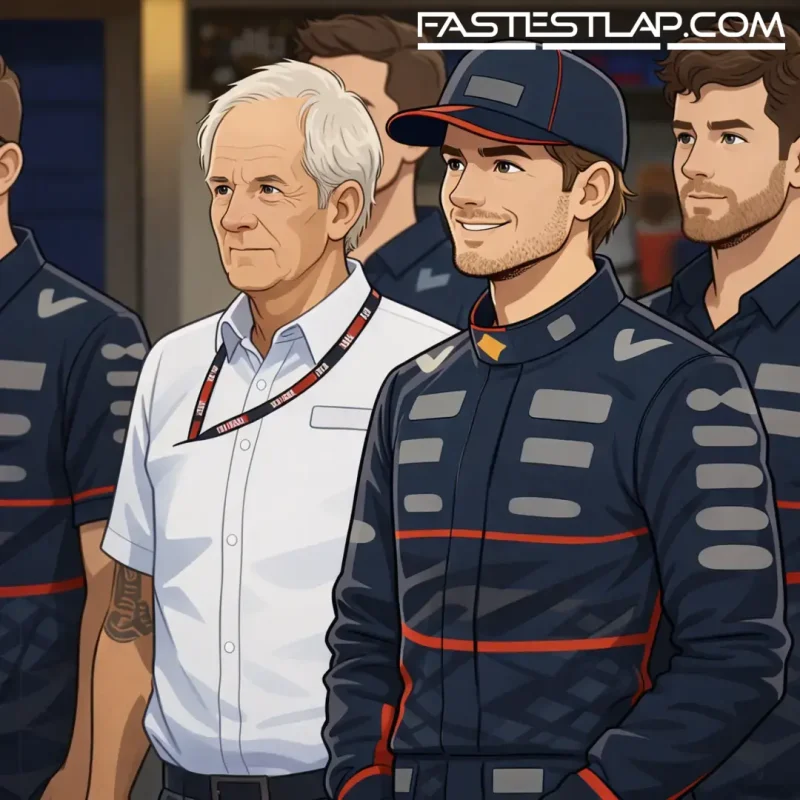
Helmut Marko has never been one for soft landings, and he isn’t offering Red Bull one now, either. The 82-year-old has doubled down on the claim that a single moment tipped him into walking away from the team he helped build: Max Verstappen missing out on a fifth straight world title in 2025.
In an interview with *Die Zeit*, Marko rejected the idea that his departure at the end of last season had anything to do with growing tired of a new generation of drivers, staff, or paddock culture. For him, it was simpler — and, in his mind, heavier.
“No. The reason was my disappointment that we didn’t win the world championship in 2025,” he said. “I wanted to draw my own conclusions from that.”
That answer inevitably invites the obvious follow-up: really? A title lost by two points was enough to end an era? Especially after a season in which Red Bull, by Marko’s own admission elsewhere, was up against a McLaren package widely viewed as the class of the field.
But Marko’s perspective has always been shaped by history and by standards that most teams don’t dare set out loud. He framed 2025 not as a brave near-miss, but as a missed shot at something bordering on myth — a fifth consecutive drivers’ championship. “Only Michael Schumacher managed that at Ferrari,” Marko said. “It was a huge disappointment.”
There’s a revealing subtext in that comparison. Marko isn’t just lamenting a lost trophy; he’s mourning a legacy milestone, the kind that would’ve cemented Red Bull’s Verstappen era as something beyond dominance in a specific ruleset. Four straight titles already put Verstappen in a club of his own at Milton Keynes, matching Sebastian Vettel’s 2010–13 run. Five would’ve been the number people reach for in arguments about all-time peaks, the figure that drags a modern operation into the same sentence as Schumacher’s Ferrari machine.
Instead, 2025 became the season that proved Red Bull could bleed — and that Verstappen could still nearly win anyway.
As Marko tells it, Verstappen’s campaign was defined by a late surge that turned what looked like a comfortable McLaren march into a pressure-cooker. After the summer break, Verstappen didn’t just score points; he lived on the podium, taking six wins in the run-in and forcing Lando Norris to earn every inch of his first world championship. When the dust settled, Norris had it by two points.
For most organisations, that sort of rally would be spun as a statement of resilience. For Marko, it appears to have been the opposite: proof that the margins at the very top are so unforgiving that “almost” is just another word for failure — and that the team, in his view, had let a historic opportunity slip.
His comments also underline what people inside the sport have long known about Marko: he’s wired like the drivers he’s backed. He doesn’t really do consolation prizes, and he’s always been drawn to personalities that treat second place like an insult.
In the same interview, Marko reflected on what he saw in Vettel and Verstappen when they were teenagers. The Vettel anecdote is vintage Marko — a young driver who had won 18 out of 20 races in Formula BMW, yet sat in Marko’s office unhappy about the two that got away. “I remember that unbridled determination,” he said.
And Verstappen? Marko’s description is familiar, but still striking in how it frames Max as fully formed long before the rest of the world caught up. “Verstappen gave the impression that the mind of a 25-year-old man was housed in his 15-year-old body,” he said, adding that Verstappen’s “extremely effective and rigorous” training under his father helped hard-wire the clarity of purpose that has defined his career.
Read those quotes alongside his explanation for leaving Red Bull and they land differently. This wasn’t just Marko talking about two exceptional talents; it was Marko revealing the environment he’s always tried to cultivate — one where the obsession is the point, where the target isn’t “a title”, it’s a run at the record books. When you live like that, a two-point loss isn’t romantic. It’s corrosive.
Marko, though, hasn’t vanished from the paddock ecosystem. Earlier this month he was confirmed as an ambassador for the Austrian Grand Prix, his first formal Formula 1 role since exiting Red Bull. And despite no longer being on the team’s organisational chart, he’s still in contact with former colleagues — “on the other end of the phone,” as the report put it.
That last detail might matter most. Marko is saying he left because of a “huge disappointment”, but he’s not presenting himself as someone who has washed his hands of the operation entirely. In typical Marko fashion, it’s less a retirement than a repositioning: stepping out of the day-to-day grind while keeping a line open to the people he trusts.
Still, the bluntness of his reasoning will sting in some corners of Red Bull. Not because it’s wrong to be angry about losing a championship by two points — everyone in that building will have replayed the season’s decisive moments endlessly — but because it frames the team’s response as insufficient. Verstappen’s post-break run was extraordinary; Marko’s takeaway is that extraordinary wasn’t enough, and that the failure to finish the job was significant enough to prompt his own exit.
In a sport that runs on narrative as much as numbers, Marko has made his closing chapter at Red Bull sound like the one thing he can’t tolerate: a story that ends just short of the line.