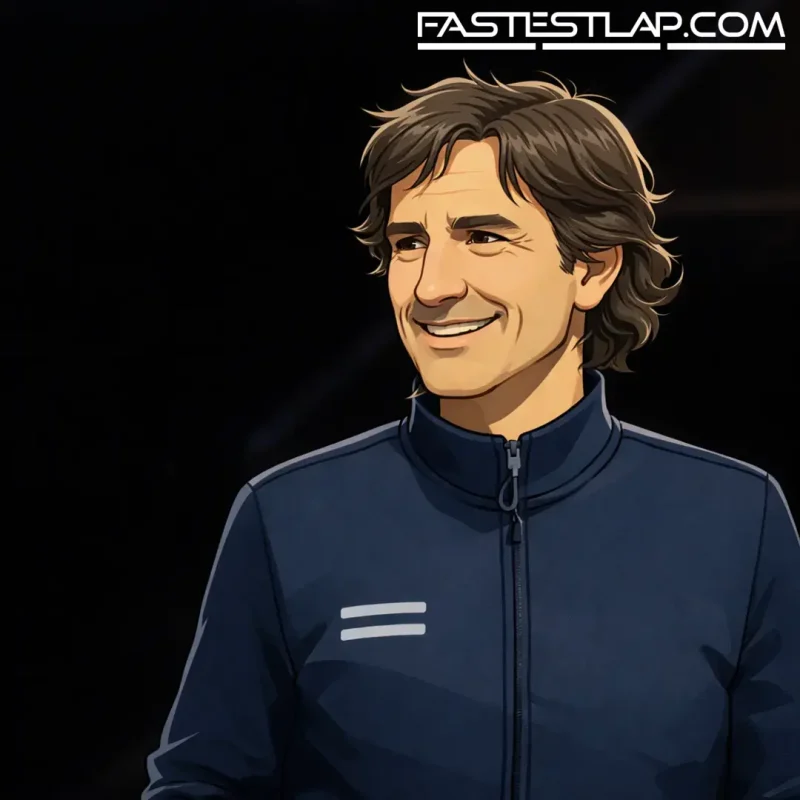
Alex Zanardi has died aged 59, his family confirmed on Saturday, bringing to a close one of motorsport’s most extraordinary lives — a career defined as much by resilience and reinvention as by raw speed.
Zanardi’s time in Formula 1 came in fragments across the 1990s, appearing on the grid between 1991 and 1999 with Jordan, Minardi, Lotus and Williams. He never quite found the stable footing in grand prix racing that his talent suggested, but the paddock always had a sense of his character: bright, forceful, unmistakably Italian in his energy, and stubbornly unwilling to shrink into the background.
If F1 never became his natural habitat, American open-wheel racing did. Zanardi’s finest results arrived in CART, where he won back-to-back titles in 1997 and 1998 with Chip Ganassi. In that era he wasn’t simply a frontrunner — he was a headline act, the sort of driver who could turn a race on its mood as much as its strategy, and who made winning feel like an event rather than a routine.
And yet, for all the triumphs, it’s impossible to talk about Zanardi without confronting the moment that redefined him in the public imagination. At the 2001 American Memorial 500 at the EuroSpeedway Lausitz, a late pit stop set in motion a chain of events that remains seared into racing memory. Spinning on his return to the track, he was struck by Alex Tagliani; the impact severed the front end of Zanardi’s car and he lost both of his legs.
Plenty of racing stories end there. Zanardi’s didn’t. Two years later he returned to competition, contesting the Monza round of the 2003 European Touring Car Championship with hand-operated brake and accelerator controls — a technical adaptation, yes, but also a statement of intent. It wasn’t framed as a stunt; it was simply Zanardi insisting, in the most Zanardi way possible, that his relationship with racing wasn’t negotiable.
That same insistence ran through the rest of his sporting life. He continued racing in various series until stepping away in 2019, but his competitive outlet expanded rather than narrowed. Zanardi threw himself into handcycling and triathlon, and he did it with the focus of someone who understood elite sport in its purest sense: preparation, pain, precision, repetition — and then doing it all again.
His achievements in Paralympic sport were not symbolic add-ons to his earlier fame; they were major victories in their own right. At the London 2012 Paralympic Games he won gold in the men’s road time trial H4, then added another gold in the individual H4 road race and a silver for Italy in the mixed team relay H1-4. Four years later in Rio, he took gold in the H5 road cycling men’s time trial and in the mixed team relay, plus silver in the road race.
For an audience that lives and breathes lap times, it’s worth pausing on what that actually means: Zanardi didn’t just return to sport — he mastered a different discipline at the highest level, repeatedly, across multiple Games cycles. Few athletes, in any arena, have executed that kind of second act.
His family announced his death in a statement released on Obiettivo3’s social media pages.
“It is with deep sorrow that the family announces the passing of Alessandro Zanardi, which occurred suddenly yesterday evening, May 1,” the statement read. “Alex passed away peacefully, surrounded by the love of his loved ones.
“The family sincerely thanks all those who are expressing their support during this time and asks for respect for their grief and privacy during this time of mourning. Details regarding the funeral will be announced at a later time.”
In motorsport we’re accustomed to measuring legacies in championships and wins, in big-team contracts and signature drives. Zanardi’s record has those highlights — especially in CART — but his impact was always bigger than a results page. He became a reference point: for engineers asked to make the impossible possible; for drivers forced to re-learn their craft; for anyone in the sport who needed a reminder that the competitive spirit isn’t tied to circumstance.
Zanardi’s story never fitted neatly into the categories we like to use in racing. F1 driver, champion, survivor, Paralympian — all true, none sufficient on their own. What remains, above all, is the impression of an athlete who refused to let life dictate the boundaries of his ambition.