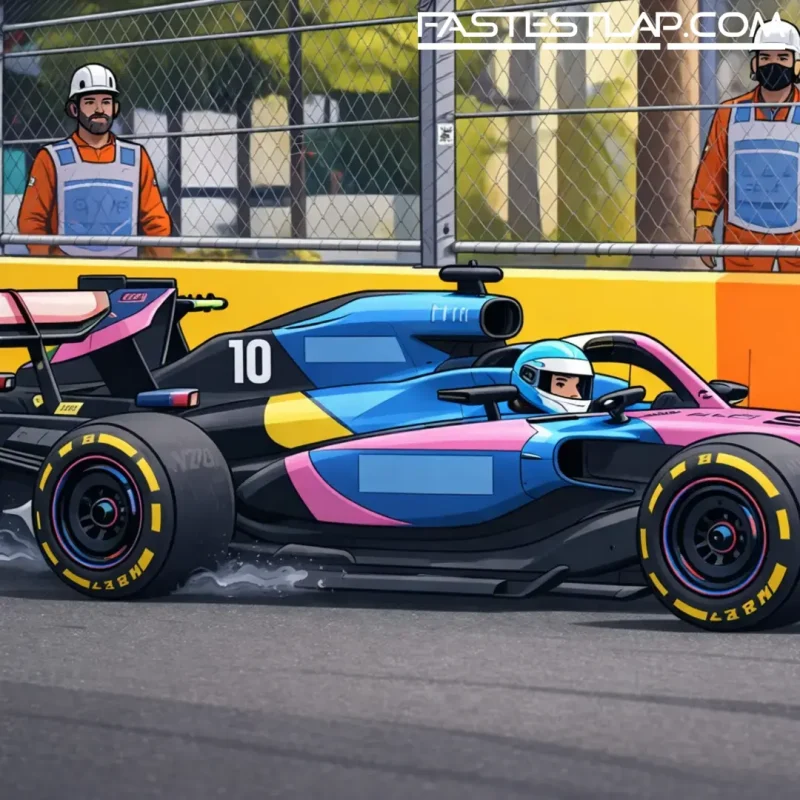
Liam Lawson is set to face the stewards after Sunday’s 2026 Miami Grand Prix following a clash with Pierre Gasly that ended in one of the more alarming images of the season: the Alpine flipped and left perched on the tyre barrier.
The incident, which the FIA confirmed would be investigated after the race, unfolded as Lawson tried to force his way down the inside of Gasly. The two made contact and Gasly’s car rotated into the barrier, tipping over before coming to rest partly suspended at Turn 17. Lawson’s race ended as well, making it a double retirement and a costly afternoon for both teams.
Miami’s opening phase was already tense, and the first Safety Car didn’t take long to appear. Ahead of the Lawson-Gasly incident, Isack Hadjar had hit the wall at the Turn 15/16 complex, setting off a chain of yellow flags and compressing the field at a point in the lap where drivers are jostling for track position and visibility is compromised by the tight stadium section.
It was in that atmosphere—restarts looming, tyres and brakes still coming up to temperature, and the midfield sensing opportunity—that Lawson made his move. Exactly how much control Gasly had, and whether Lawson’s car was sufficiently alongside to “own” the corner, will be the heart of the stewards’ discussion. On track, though, the outcome was immediately clear: Alpine’s race was done, and Racing Bulls had a wrecked car of its own to recover.
The good news, and the only thing that really matters in the minutes after a shunt like that, was Gasly’s quick radio message to confirm he was okay. With the Alpine inverted and awkwardly balanced on the barrier, the moment had the paddock holding its breath—another reminder that even in an era of extraordinarily robust survival cells, a simple piece of wheel-to-wheel contact can still produce a nasty-looking end result.
For Lawson, the post-race investigation puts his Miami weekend under an unwelcome spotlight. Racing Bulls has been fighting hard in the thick of the pack, and Lawson’s reputation is built on being assertive—sometimes right on the edge of what rivals will tolerate. That edge can win you positions in the midfield chaos, but it also narrows the margin for error to almost nothing, especially in a section of track like Turn 17 where the car on the outside quickly runs out of options.
The stewards will now decide whether this was a clumsy misjudgement, a racing incident, or something warranting a penalty. Whatever the verdict, it’s the sort of collision that tends to linger beyond the paperwork: drivers remember who sent it, teams remember who wrote off the parts, and the next time those two find themselves side-by-side into a braking zone, there’s usually a little less patience on offer.
Miami, as ever, delivered its share of drama. This one, though, wasn’t the spectacle anyone wanted.