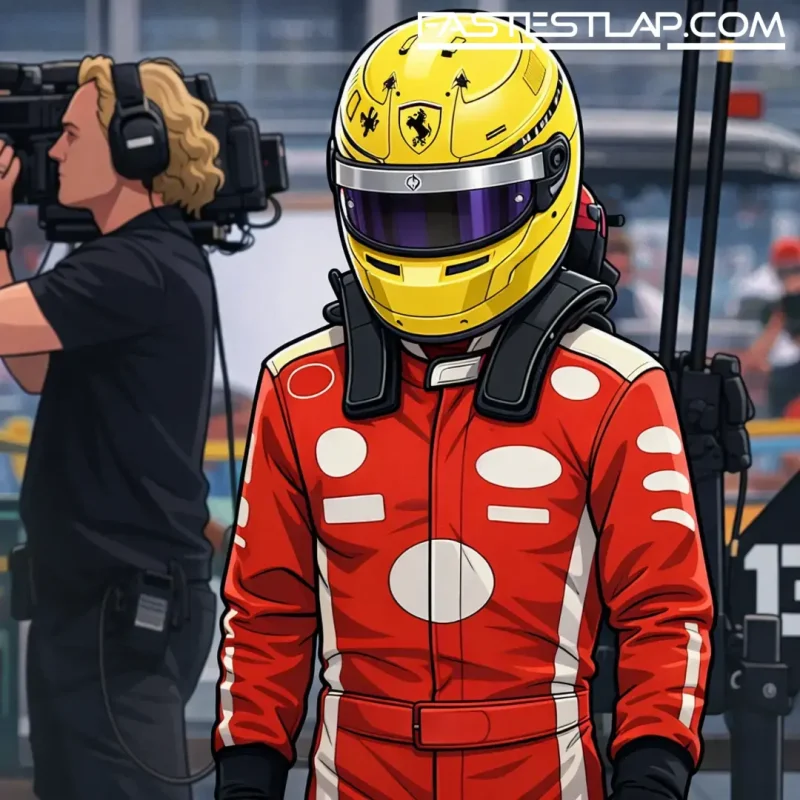
Lewis Hamilton giving Franco Colapinto the middle finger on lap one in Miami wasn’t caught by the world feed, but it didn’t take long for the onboard clip to do the rounds. The Ferrari driver had just been tipped into damage in the opening-lap mess with the Alpine, then – right hand briefly off the wheel as he drew alongside on the back straight – made his feelings unmissable.
Hamilton went on to finish sixth, one place ahead of Colapinto, and said afterwards the contact had cost him around half a second per lap. In other words: he was annoyed, he felt it had hurt his race, and he reacted in the moment. None of that is unusual in Formula 1. The optics, though, have landed right in the middle of the FIA’s never-ending struggle to look consistent on “driver conduct”.
Enter Daniel Juncadella, who has form on this exact topic and isn’t shy about pointing out what he sees as a familiar pattern. The Spaniard – better known to many F1 fans this week as one of Max Verstappen’s teammates for next weekend’s Nürburgring 24 Hours – was fined at the 2025 WEC season finale in Bahrain for the same gesture, aimed at Augusto Farfus. The penalty then was €5,000, with €4,000 suspended, and the stewards didn’t exactly couch it in gentle language, calling it “rude, disrespectful and wholly inappropriate in motorsport.”
So when Hamilton’s Miami gesture surfaced without any obvious follow-up from race control or the stewards, Juncadella’s response was immediate and pointed.
“So I take it there wasn’t a fine, was there?” he wrote on social media. “The FIA’s double standards… They never fail.”
Pressed on whether he thought the whole thing was being overblown, Juncadella didn’t do the usual backtrack. He wasn’t arguing that Hamilton should be hauled in for hours or made an example of; he simply wanted the same ruler applied.
“I don’t think it’s right for him to do that,” he added. “But slap him with a €2,000 fine, just like they did to me.”
This is where the FIA has made life difficult for itself. In the wake of Verstappen’s high-profile swearing punishment during his title-winning 2024 season – when he used foul language in an FIA press conference at Singapore and was assigned “some work of public interest” – the governing body went harder on language and behaviour ahead of 2025. That triggered predictable resistance from drivers in F1 and the World Rally Championship, and the FIA eventually moved to a distinction between “controlled” and “uncontrolled” environments.
Press conferences and formal media moments are “controlled”; team radio and heat-of-the-moment stuff is treated with more latitude. It was the FIA’s attempt to acknowledge what anyone in the paddock already knows: you can’t demand the same emotional register from someone threading a car through a first-lap squeeze as you can from someone sat behind a microphone with a sponsor backdrop.
On paper, Hamilton’s Miami moment sits firmly in that “uncontrolled” bucket. It happened in-car, in the middle of a live situation, and it wasn’t broadcast on the official feed. That likely explains why nothing appears to have come of it.
But that’s exactly the problem Juncadella is poking at. The FIA wants to be seen as setting standards, not chasing virality. Yet in practice, the line between “we only act when it’s formal” and “we only act when it’s visible” can get blurry fast, especially across championships. A gesture on an F1 onboard that leaks after the fact is still the same gesture; the only thing that changed is who saw it, and when.
It also doesn’t help that the FIA’s recent record on these issues is already politically charged. Verstappen didn’t just accept his Singapore sanction quietly; he turned it into a weekend-long statement, giving clipped answers in FIA sessions and holding an impromptu paddock media scrum after the official press conference had ended. He eventually served his punishment ahead of the FIA’s end-of-season awards ceremony in Rwanda, but the whole saga left a lingering sense that the governing body had picked a fight it didn’t need.
Now, in 2026, it’s the kind of backdrop where a small moment can light up a much bigger argument. Hamilton’s gesture isn’t going to become a sporting scandal on its own; drivers have been exchanging less-than-polite signals since long before onboard cameras existed. What it does do is test whether the FIA’s messaging about “context” and “setting” is actually a framework – or just a convenient set of words to justify whichever outcome produces the least noise.
For Hamilton, it’s unlikely to go any further. For the FIA, this is another reminder that once you start policing behaviour, you don’t get to choose the clean cases. You inherit the messy ones too – the ones where the punishment (or lack of it) tells everyone in the paddock exactly how consistent you really are.