Max Verstappen’s first proper flirtation with the Nürburgring 24 Hours was always going to be judged on pace, because that’s how we’re conditioned to assess him. But the more revealing tell, at least in the eyes of people who’ve actually made a career out of surviving the Nordschleife, is what happens when the stopwatch *doesn’t* capture the difficulty: traffic management, timing, and the kind of patience that feels almost alien in modern Formula 1.
Markus Winkelhock — a multiple winner of the race outright — reckons Verstappen’s already showing the sort of “invisible” racecraft that separates quick visitors from drivers who genuinely understand endurance racing. And he points to one specific corner sequence as evidence: Flugplatz, where bravery gets you attention but judgement wins you hours.
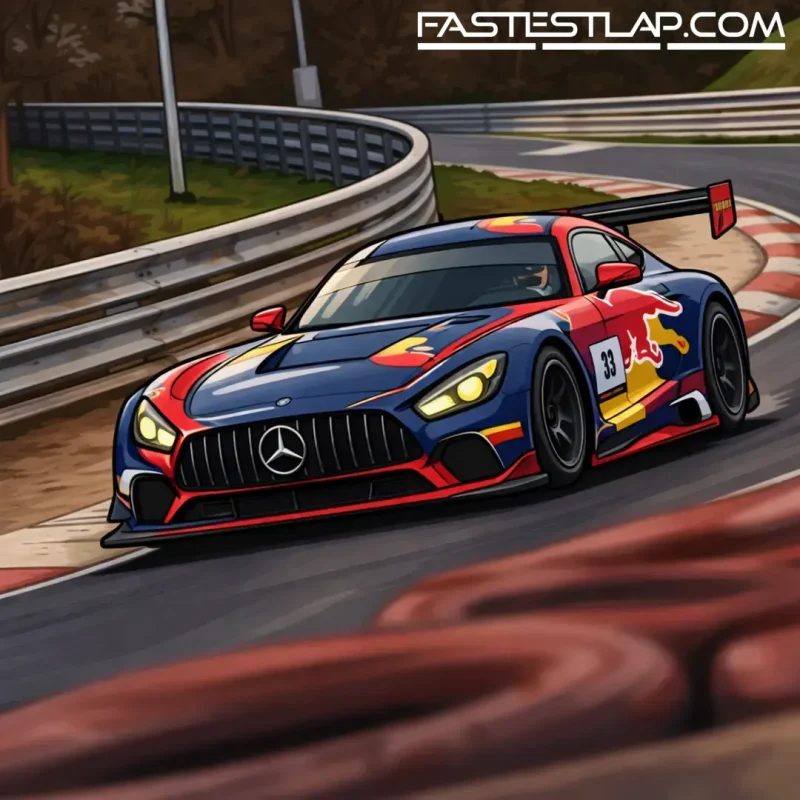
Verstappen is racing this weekend in the Intercontinental GT Challenge’s Nürburgring 24 Hours, driving a Mercedes-AMG GT3 EVO alongside Lucas Auer, Dani Juncadella and Jules Gounon in the SP9 GT3-Pro class. It’s the culmination of a deliberate, months-long effort to do the event properly — not as a vanity appearance, but as a serious attempt to be competitive at the sharp end of the biggest GT race on the calendar.
That seriousness has been obvious in how he’s approached the whole process. He worked through the steps to secure the necessary DMSB permit, achieved during the NLS7 round of the Nürburgring Langstrecken-Serie in 2025 in a CUP3 GT4 Porsche. Later that year he stepped up into a top-class GT3 Ferrari and, with Chris Lulham, won NLS9.
He’s also already had a taste of how messy and unforgiving this paddock can be. Verstappen was part of the winning line-up at NLS2 this year, only for the result to be taken away due to an operational error by his team that meant too many sets of tyres were used. And while last month’s NLS4 and NLS5 outings showed flashes of competitiveness, neither offered the sort of clean run you’d want as prep for a 24-hour race: NLS4 was stopped after the tragic death of Juha Miettinen, while NLS5 was undone by car damage and a resulting performance drop-off.
Winkelhock, meanwhile, is hardly a casual observer. The son of former F1 and sports car racer Manfred Winkelhock, Markus is still remembered in F1 circles for that wonderfully chaotic 2007 European Grand Prix cameo with Spyker, when he briefly led after gambling on wets at a soaked Nürburgring. Since then he’s become a sports car heavyweight, winning the Nürburgring 24 Hours outright in 2010, 2012, 2014 and 2017, and collecting further podiums in 2011, 2019 and 2020.
This year he’ll race in the SPX class in a Mercedes 190E HWA EVO.R — but in Miami, where he was visiting the F1 paddock as Audi’s guest and doing Pirelli Hot Laps duty in the new Audi RS5, the conversation inevitably drifted to Verstappen and what to expect when the lights go out on Saturday and the place turns properly hostile.
The first thing that struck Winkelhock wasn’t speed, but attitude. In a discipline that can be suspicious of superstars dropping in for headlines, Verstappen has, in Winkelhock’s view, shown up like “normal” — a racer who wants the experience on its own terms.
“He’s an F1 superstar, but he doesn’t behave like that,” Winkelhock said. “I think he enjoys it because this is a completely different world… he likes the pure racing.”
The adaptation is what really gets Winkelhock talking. The point isn’t simply that an F1 driver can be fast in something else — we’ve seen plenty of that across eras — it’s the context: a GT3 car with weight, less downforce, different braking demands, and then the Nordschleife itself, which is its own category of problem.
“For me, I have to say I’m really impressed with the way he did it,” Winkelhock said. “Coming from an F1 car, it’s much lighter, with much more downforce… and then going on the Nordschleife, which is not a normal race circuit, if you have no experience… what he does is insane.”
Yet Winkelhock’s most interesting praise isn’t about Verstappen’s outright commitment through high-speed sections — it’s about the parts of the lap where you can lose 20 seconds without doing anything “wrong”. The Nürburgring 24 Hours can put 160 to 180 cars on the circuit at once, with speed differentials that can reach 80 km/h or more. That’s not just inconvenience; it changes the way you build a lap.
“The traffic — F1 drivers are not used to this different speed difference,” Winkelhock said. “To read and judge this traffic, all the GT3 drivers can gain and lose a lot of time in traffic.”
His example is telling. Approaching Flugplatz, the instinct for drivers without the experience is to sit on a slower car’s rear wing, then accelerate again as the road opens — a move that costs momentum and ruins the run to Schwedenkreuz. Winkelhock says the smarter play is counterintuitive: back off, create a gap, then use the “overrun” to time an overtake on the exit and carry speed.
“It’s more clever to back off… and then exit Flugplatz with the overrun to overtake,” he explained. “Many drivers who don’t have the experience, they just stop behind the slow car and start to accelerate again.”
Winkelhock says Verstappen already gets it. He watched 45 minutes of Verstappen’s onboard from his second race in the Mercedes, focusing on how he handled a stint tucked up behind Christopher Haase’s Audi.
“Max understands how to take the flow through the traffic,” he said. “It was crazy to see the amount of experience he already has.”
The wider context makes the Nürburgring cameo even more intriguing. Verstappen is doing this in the middle of a long 2026 F1 season, and he’s been candid that the sport’s new power unit regulations have dulled his enjoyment. On top of that, Red Bull is no longer operating from the front with the same authority, which has inevitably changed the texture of his weekends.
Endurance racing, by contrast, offers a different mental rhythm: longer stints, more variables, fewer absolutes — and a heavy emphasis on adapting rather than controlling. Winkelhock believes that’s where Verstappen’s natural instincts are doing the work.
“He’s not really thinking about it… he’s just adapting to what’s going on,” Winkelhock said. “These are two completely different worlds… but it doesn’t even take him two to three laps, and he’s already on it.”
The Nürburgring 24 Hours has a habit of humbling everyone, no matter the CV. But if Verstappen’s already making the right decisions in the places nobody’s watching — lifting to make a pass happen two corners later, protecting momentum rather than ego — that’s usually the point where a “guest appearance” stops looking like one.