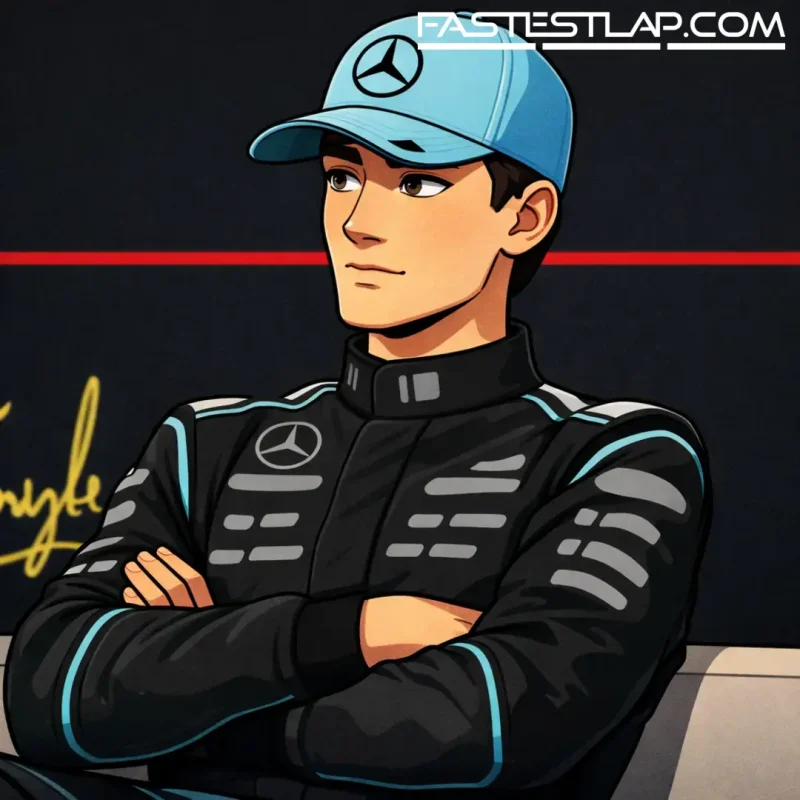
George Russell hasn’t even had time to properly settle into Formula 1’s 2026 reality before the sport starts daydreaming about the next one.
Four races into a brand-new rule set that’s supposed to anchor the championship for the next five seasons, and the paddock is already running its familiar loop: what works, what doesn’t, and what we’d like back when the next reset eventually arrives. It’s telling that the conversation has spilled beyond engineers and into the FIA’s top office, with president Mohammed Ben Sulayem floating the idea that a return to V8 engines could be on the table as early as 2030.
Asked what he’d want from the next regulation cycle, Russell didn’t hide behind diplomacy. He went straight to the stuff that still gets drivers leaning forward in their chairs: noise, weight, and feel.
“Going back to V8, I think that would obviously be pretty cool,” Russell said, before quickly nodding to the modern non-negotiable. “The sustainable fuel topic is a fantastic one, and I think would be great for Formula One.”
That combination — more emotive engines paired with sustainable fuel — is quickly becoming the compromise that lets everyone sound like they’re winning. Fans get a more visceral product, manufacturers keep a credible story, and the FIA can frame it as evolution rather than retreat. Whether it’s that simple is another matter, but Russell’s point was less about nostalgia for nostalgia’s sake and more about what it does to the driving experience.
Then he landed on the issue that never really goes away: mass.
“Lighter cars,” he said. “I think we need to find ways to reduce the cars even more, because I think that has been a positive impact in terms of the racing and the drivability, being able to fight close with one another, but still keep in a way that we can have these overtakes.”
That’s the needle F1 keeps trying to thread — cars that are responsive and “alive” enough to reward commitment, without building themselves into such aerodynamic tyrants that anyone within a second gets cooked alive. Russell’s argument is interesting because it pushes back against the lazy “back in my day” version of the debate. He even used the early-2000s era, so often held up as the aesthetic and auditory peak, as a cautionary tale.
“If you look at the glory days of Formula 1 20 years ago… in the early 2000s there was no overtaking at all,” he said. “So that’s something we need to remember.”
It’s a rare moment of perspective from a current driver, because the temptation is always to paint the past as pure. Russell’s basically saying: yes, give us the cool stuff — but don’t pretend it automatically produces better racing.
All of that sits in the background of a much more immediate truth for Russell: if Mercedes really does have early-season dominance under the 2026 rules, this might be his cleanest route to a title. And yet even inside that dream scenario, the rhythm can shift in a hurry — something he’s feeling with rookie team-mate Kimi Antonelli starting to gather momentum.
Russell acknowledged as much, pointing out that form can turn quickly across a long season. “Clearly, he’s in a really great place at the moment and momentum is with him,” he said of Antonelli, “but I’ve experienced myself in championships I’ve won on how momentum swings throughout the year.”
Notably, Russell insisted he’s not framing his weekends through the championship lens — at least not publicly. “To be honest, I’m not even considering it,” he said. “It’s just I want to get back onto the top step at the podium.”
There was a hint of frustration in the way he laid out the season’s early shape: three rounds where he felt the performance was there to win, followed by a weekend where it wasn’t. “The first three races, I had the performance to do that. This weekend, I did not have the performance to do that,” he said. “So I could be standing here now with three very different results from the previous races… But obviously, things worked out differently in Japan and China.”
That’s the tightrope for Russell in 2026. He’s simultaneously the experienced lead in a team that expects to contend, and the guy being prodded weekly by a team-mate young enough to race without scar tissue. When you’re in that position, it’s no surprise your mind drifts to the next regulation cycle — because you know how quickly the window can open, and how brutally fast it can slam shut again.
Russell will be 33 by the time the next major rule reset comes around, as he noted. That adds another layer to his wishlist: it’s not just about what sounds good on a poster. It’s about what gives drivers a car that rewards skill, puts on a show, and doesn’t rely on dirty air or physics to decide whether a fight can happen.
For now, though, the only part of the future Russell can actually influence is the next race — and the next one after that — while Mercedes’ intra-team storyline keeps bubbling. The regulation talk will keep swirling because it always does, but if Russell wants to be more than the guy making sensible points about V8s and lighter cars, he’ll know the real work is still done in parc fermé.