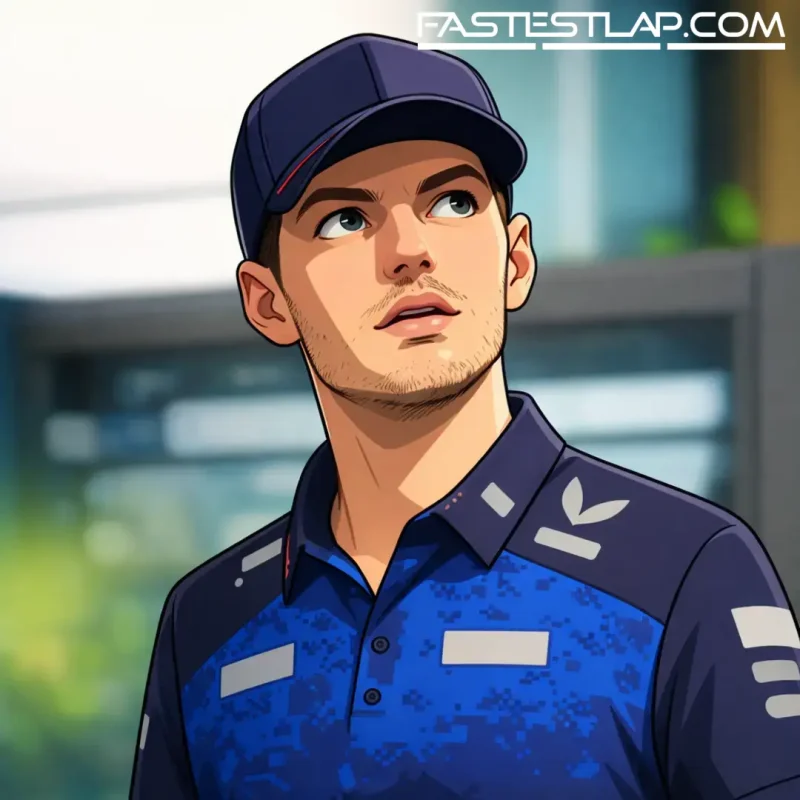
Max Verstappen insists he’s in no rush to decide how long he wants to stick around in Formula 1, brushing aside the idea that the sport’s recent enforced downtime has pushed him any closer to a call on his long-term future.
The Red Bull driver heads into the weekend with attention swivelling in two directions at once: his on-track frustrations with F1’s 2026 rule set, and his Nürburgring 24 Hours debut with Verstappen Racing. Put those together and it’s not difficult to see why the paddock keeps circling back to the same question — how much longer does Verstappen really want this life?
Contractually, the situation is straightforward. Verstappen is signed to Red Bull through 2028. Politically and personally, it’s messier. He’s never made a secret of the fact he doesn’t see himself racing into his forties, Alonso- or Hamilton-style, and this season’s regulations have only sharpened the conversation.
Verstappen has been the most prominent critic of the 2026 package, describing it in unflattering terms — “anti-racing” and “Mario Kart” among them — and he hasn’t exactly softened that stance even as F1 and the FIA moved to make early adjustments. Energy management tweaks were introduced ahead of the Miami Grand Prix, but his view remained that the sport was tinkering rather than fixing.
Then came the unusual break in the calendar, created by the cancellations of the Bahrain and Saudi Arabian Grands Prix. The assumption from the outside was obvious: a quieter stretch, fewer obligations, and plenty of time for Verstappen to sit back and think about whether F1 is still giving him what he wants.
He says it didn’t work like that.
“Nothing new, to be honest, on that side,” Verstappen said when asked whether the interruption had triggered any deeper reflection. “In those weeks, I was busy with other things.
“But I still have time, and I’m taking my time.”
That line matters, because it’s become easy to interpret every Verstappen side quest — sim racing, GT programmes, now a 24-hour race at the Nürburgring — as a breadcrumb trail away from grand prix racing. There may be something to it in the long run, but he’s also simply doing what he’s always done: racing wherever he can, and speaking plainly when he doesn’t like the direction of travel.
Before plans for further changes in 2027 were laid out, Verstappen’s tone on the current “fixes” was sceptical rather than hostile. He described the steps taken so far as “a tickle”, suggesting the fundamentals of the 2026 racing product haven’t been transformed by the tweaks.
Still, there was a notable shift in one area: he sounded encouraged by the fact drivers have had more direct dialogue with the FIA and Formula 1 leadership. Verstappen has long argued that those actually driving these cars have a clearer feel for what produces proper racing — and, crucially, what doesn’t.
“The positive thing about it, we had some nice meetings with Formula 1 and the FIA,” he said. “And I think that’s probably like a starting point, hopefully for the future, even in a few years’ time, or maybe I’m not here anymore.
“I really hope that for the future drivers as well, there’s more input to come from the drivers to the organisers in general. Because I do think that most of the drivers here, we have a good understanding and a good feel of what is needed to make Formula 1 a good product, a fun product, and I think that’s already like a huge step forward in terms of the communication.
“Of course, with the changes that are made, I think it’s more like a tickle, because at the end of the day, you know, F1, it’s a very complex and political sport, but I think everyone has tried their best to at least do something. But of course, it won’t change the world.”
There’s a telling candour in that: appreciation for the effort, little belief in the outcome, and an acknowledgment that he might not be around to benefit from whatever comes next. It’s not a threat, exactly. But it’s not reassurance either.
Against that backdrop, the Nürburgring 24 Hours lands with extra weight. Verstappen will make his debut in the event as part of Verstappen Racing, sharing a Mercedes-AMG GT3 Evo run in collaboration with Winward Racing. His team-mates are established GT3 names — Jules Gounon, Dani Juncadella and Lucas Auer — giving the line-up a serious, professional edge rather than the “celebrity entry” vibe that sometimes follows cross-discipline appearances.
And that’s the point. This isn’t Verstappen doing a novelty outing for the cameras. It reads like an authentic investment in endurance racing, the kind that makes you wonder how he sees the next phase of his career — whether that’s as a parallel programme while he’s still in F1, or as something that eventually replaces it.
For now, Verstappen is trying to keep the two conversations separate: yes, he’s unhappy with the way the new-era racing feels; yes, he’s exploring other forms of competition; no, he’s not ready to put a timestamp on his exit from Formula 1.
But in a sport where every word is parsed and every weekend becomes a referendum, “I’m taking my time” is its own kind of message. It tells Red Bull, the FIA, and F1’s commercial brain trust that one of the championship’s defining stars isn’t going to be persuaded by small adjustments — and that if the product doesn’t move closer to what drivers actually want to race, the grid can’t assume he’ll be there out of habit.